

If you are looking for a “USAA diminished value claim form,” there isn’t one. USAA has no dedicated form for this. Diminished value is handled inside the standard property damage claim, which means you have to raise it yourself, in writing, and prove the number. This guide covers how.
The loss itself is straightforward: your car was repaired properly and still sells for less, because the accident is now on its history report. If a USAA member caused the crash, that loss is recoverable from their policy.
The Three Kinds of Diminished Value
Getting the terminology right matters, because only one of these is claimable.
- Inherent diminished value — the loss caused purely by the accident appearing on the record, even after perfect repairs. This is what you claim.
- Repair-related diminished value — extra loss from poor workmanship: mismatched paint, aftermarket parts instead of OEM, panel gaps, rattles that were not there before.
- Immediate diminished value — the drop between the pre-accident value and the value while the car sits damaged, before repairs. Rarely claimed against an insurer.
Do You Qualify?
| Condition | Why it matters |
|---|---|
| The USAA driver was at fault | This is a third-party claim against their policy. Shared fault reduces or defeats it. |
| The car was repaired, not totaled | Diminished value is the loss remaining after repair. A total loss is settled on actual cash value instead. |
| You own the vehicle | You need to hold the title. On a lease, the leasing company is the party carrying the loss. |
| The damage was significant | Structural or frame work builds a case. Cosmetic damage generally does not. |
| The car was newer with a clean history | Newer, lower-mileage cars with no prior accidents have the most value to lose. |
One point specific to this carrier: USAA membership is limited to military members, veterans and their families, so the at-fault driver is almost certainly in that community. It makes no difference to your legal position or to how the claim is handled — it is a standard third-party property damage claim either way.
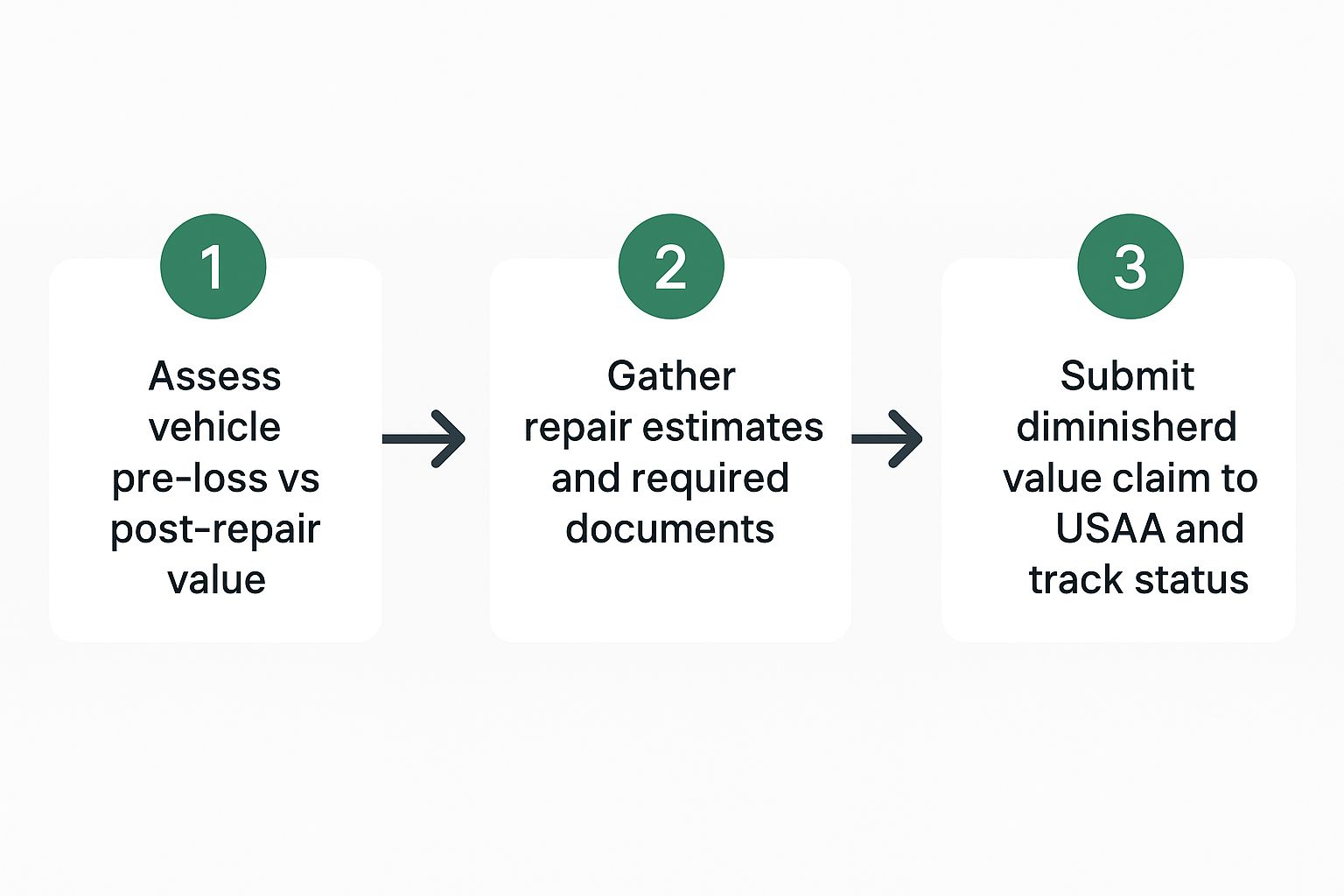
How USAA Calculates the Offer
Insurers commonly use a capped formula known as 17c, named after paragraph 17(c) of the assessment method that came out of the Mabry v. State Farm litigation in Georgia in 2001. The arithmetic is worth seeing, because it explains why the first offer is usually so far below what the car actually lost.
- Cap at 10% of pre-accident value. A $40,000 car has its maximum diminished value fixed at $4,000 before anything is examined.
- Apply a damage multiplier. Damage graded “severe” might carry 0.75: $4,000 becomes $3,000.
- Apply a mileage multiplier. 50,000 miles might carry 0.60: $3,000 becomes $1,800.
The offer is $1,800 on a car that may well have lost several thousand at resale. Notice what the formula never does: look at what comparable cars are selling for where you live. That omission is the whole argument.
Building the Claim
| Document | Why it matters | Where to get it |
|---|---|---|
| Police or accident report | Establishes fault, which the whole claim rests on | The law enforcement agency that responded |
| Itemised repair invoice | Proves severity — ask for the detailed version, not the insurer’s summary | The body shop that did the work |
| Photos, before and after | Shoot the post-repair set from the same angles as the damage photos | Your phone |
| Vehicle history report | Shows the accident now on record — this is the loss, documented | Carfax or AutoCheck |
| Independent appraisal | The number the claim is built on | A certified appraiser |
Without an independent appraisal the exchange is your opinion against USAA’s formula, and the formula wins. A USPAP-compliant report puts comparable local sales behind your figure and shifts the burden onto USAA to say what is wrong with the market data.
Get a free diminished value estimate to see what you are working with.
Opening the Claim
Do this once repairs are complete. Open a standard auto claim with USAA online or by phone, then state the diminished value element explicitly — it will not be added for you:
“In addition to the repair costs, I am formally requesting compensation for my vehicle’s inherent diminished value resulting from this accident. I will be providing a certified appraisal to document this loss.”
You are not obliged to give a recorded statement to the other driver’s insurer. Adjusters use recordings to find inconsistencies. Decline politely and keep the exchange in writing.
What goes in the demand letter
- Your name, contact details and the USAA claim number
- Date of loss, the at-fault driver’s name and the police report number
- Your vehicle’s year, make, model and VIN
- The exact amount claimed, taken from the appraisal
- Copies of the police report, repair invoice and appraisal — never originals
- A response deadline of 15 to 30 days
Send it by certified mail with return receipt so you can prove the date it arrived. There is a full template here: diminished value claim letter template.
Negotiating the Offer
| What the adjuster says | What to say back |
|---|---|
| “The repairs restored it to pre-accident condition.” | “I appreciate the quality of the repairs, but they cannot erase the accident history. A discoverable accident record permanently lowers market value, and that is what my appraisal documents.” |
| “Our valuation shows a lower figure.” | “My report is based on comparable sales and dealer quotes in our local market. Could you provide a breakdown showing how your offer was calculated, so we can compare the data?” |
| “We don’t accept third-party appraisals.” | “This is a certified, independent appraisal using verifiable market data — a more accurate measure than a generic formula. Can you point to a specific error in the data or methodology?” |
| “Your state doesn’t allow diminished value claims.” | “Could you point me to the specific statute you’re relying on?” Then check it. This is sometimes accurate and sometimes not — a handful of states genuinely do restrict third-party recovery. |
Follow every call with a short email summarising it. That record is what makes escalation possible.
If USAA Denies or Stalls
- Insist on the denial in writing, with the specific reason. You cannot rebut a position you have not been given.
- Ask for a supervisor. Adjusters work to authority limits; their manager has a higher one.
- File a complaint with your state’s Department of Insurance — find yours through the NAIC directory. It is free and insurers must respond in writing.
- Small claims court. Most diminished value claims fall under the limit, which runs roughly $5,000 to $15,000 by state. See our guide to diminished value in small claims court.
One clarification worth making, because it is widely got wrong: the appraisal clause in an auto policy is a contractual remedy between you and your own insurer. As a third-party claimant you have no contract with USAA, so you cannot invoke it against them. It is a route for first-party disputes only.
Deadlines
Your deadline is your state’s statute of limitations for property damage — commonly two to six years from the date of the accident, and it runs from the crash, not from when repairs finished. It also changes: Florida cut its negligence period from four years to two for claims accruing on or after 24 March 2023. Check your state’s current limit on our state-by-state diminished value laws page rather than relying on a general range.
This is general information, not legal advice. For anything turning on your state’s law, speak to an attorney licensed there.
Frequently Asked Questions
Is there a USAA diminished value claim form?
No. USAA has no dedicated diminished value form. The claim is handled within the standard property damage process, which means you have to raise it yourself and support it with a certified appraisal. If you do not ask, it will not be offered.
What is the time limit for filing my claim?
It depends on your state’s statute of limitations for property damage — commonly two to six years from the date of the accident, running from the crash rather than from the repair. Deadlines change: Florida cut its negligence period to two years for claims accruing on or after 24 March 2023.
What if USAA denies my claim?
Insist on the denial and its specific reason in writing, then rebut it with your appraisal. If that goes nowhere, ask for a supervisor, file a complaint with your state’s Department of Insurance, or take it to small claims court.
Is an independent appraisal really worth the cost?
In practice, yes. An insurer’s valuation protects the insurer. An independent, USPAP-compliant report replaces an argument about opinions with verifiable market data, which is what gives you something to negotiate with.
Can I invoke the appraisal clause against USAA?
Not on a third-party claim. The appraisal clause is a contractual remedy in your own policy and binds your own insurer. Since you have no contract with USAA as the at-fault driver’s carrier, it does not apply — your escalation routes are a supervisor, the Department of Insurance, or small claims court.
Will filing raise my own insurance rates?
A third-party claim is made against the at-fault driver’s USAA policy, not your own, so it is not a claim on your record. The accident itself may still affect your premium depending on your state and carrier.
About SnapClaim
SnapClaim is a premier provider of expert diminished value and total loss appraisals. Our mission is to equip vehicle owners with clear, data-driven evidence to recover the full financial loss after an accident. Using advanced market analysis and industry expertise, we deliver accurate, defensible reports that help you negotiate confidently with insurance companies.
With a strong commitment to transparency and customer success, SnapClaim streamlines the claim process so you receive the compensation you rightfully deserve. Thousands of reports have been delivered to vehicle owners and law firms nationwide, with an average of $6,000+ in additional recovery per claim.
Why Trust This Guide
This article was reviewed by SnapClaim’s team of certified auto appraisers and claim specialists with years of experience preparing court-ready reports for attorneys and accident victims. Our content is regularly updated to reflect the latest industry practices and insurer guidelines.
Get Started Today
Ready to prove your claim? Generate a free diminished value estimate in minutes and see how much you may be owed.
Get your free estimate today