

Even after perfect repairs, your car’s value takes a permanent hit after an accident. This financial loss is called “diminished value,” and it’s the difference between what your car was worth moments before the crash and what it’s worth now with an accident on its record. Insurance companies rarely volunteer to pay for this loss, but with the right proof, you can fight for the compensation you deserve.
Why Your Car’s Value Drops After an Accident
The moment a collision occurs, your vehicle’s financial story changes forever. Even with the best repairs making it look and drive like new, its market value is immediately and permanently damaged because the accident history now follows it on reports from services like CarFax.
This accident history creates doubt for any future buyer. They’ll wonder about hidden structural damage, mismatched parts, or reliability issues that might surface later.
The Clean vs. Repaired Comparison
Imagine two identical cars for sale—same year, make, model, and mileage. One has a clean history, while the other shows a moderate collision six months ago, though it has been fully repaired.
Which one would you choose? Most buyers would pick the accident-free car without hesitation. To even consider the repaired vehicle, you’d expect a significant discount.
That discount is diminished value. It’s the real money you lose when you sell or trade in your car simply because it was in an accident.
This isn’t a small amount; a vehicle can lose 10% to 30% of its pre-accident value after a collision. To get that money back, you need to understand what causes this drop and how to prove it.
The factors below work together to lower your car’s market value right after a collision.
Immediate Impacts on Car Value After an Accident
| Factor | Description |
|---|---|
| Accident History Stigma | A documented accident on a vehicle history report instantly makes a car less desirable to potential buyers. |
| Fear of Unseen Damage | Buyers worry that even the best repairs can’t fix hidden structural problems that may cause issues later. |
| Lower Resale & Trade-In Offers | Dealerships automatically offer less for a car with an accident history because they know they’ll have to sell it for less. |
Worrying about your car’s lost value is normal, but the good news is you can take action. The key is to prove your loss with solid, objective evidence, which is the first step toward getting the fair compensation you’re owed.
Understanding Diminished Value: The Hidden Cost
After an accident, most people focus on visible repairs like dents and paint. However, the biggest financial hit is often the unseen drop in your car value after an accident, a concept known as diminished value.
Diminished value isn’t a single issue; it covers a few different types of financial loss. Understanding these categories helps you build a stronger case when negotiating with the insurance company.
This infographic breaks down the key factors that reduce your car’s worth after a collision.
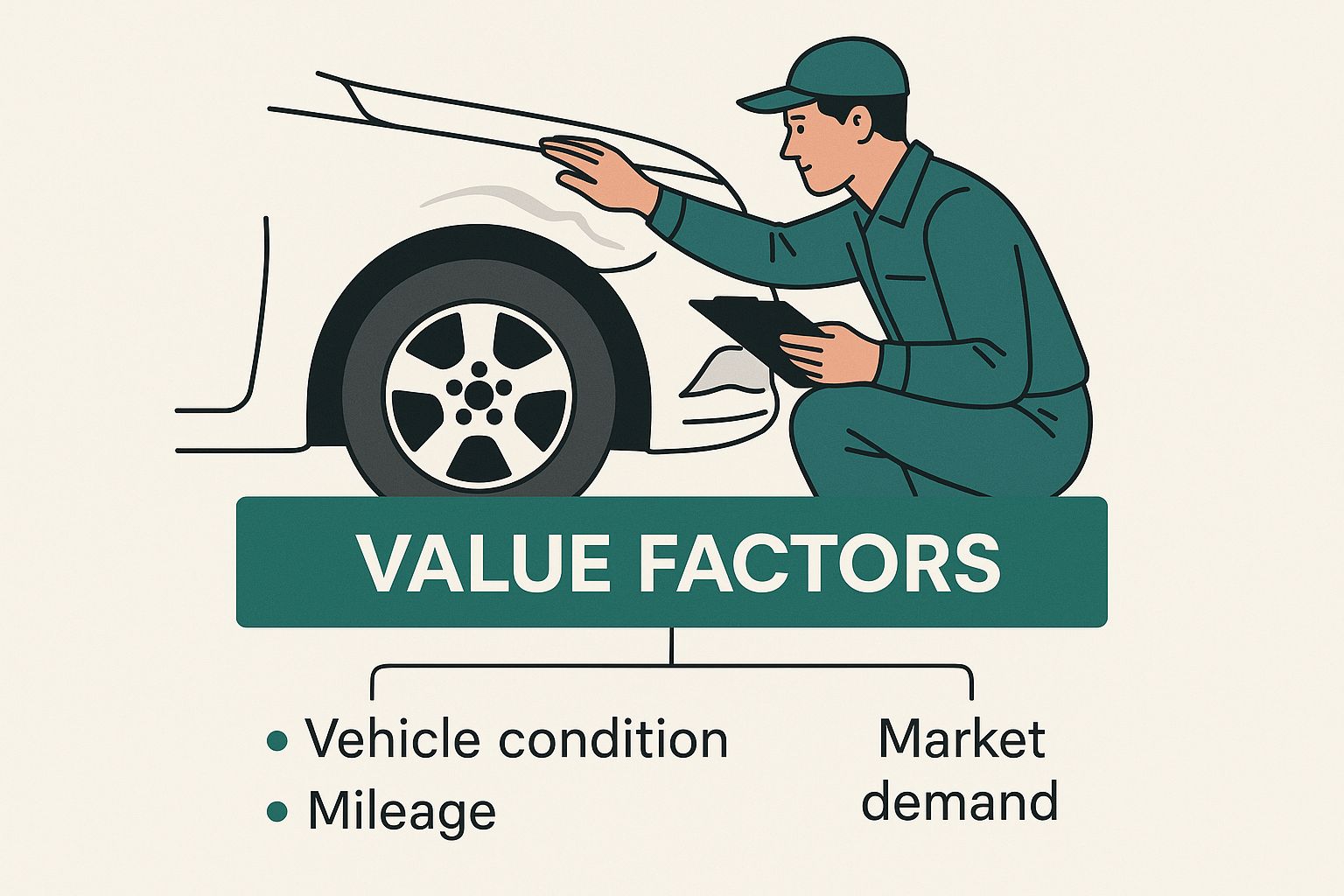
As you can see, the accident history, repair quality, and buyer perception create a financial loss that a standard insurance check for repairs doesn’t cover.
Inherent Diminished Value
Inherent Diminished Value (IDV) is the most common and unavoidable loss. It’s the automatic drop in your car’s market value simply because an accident is now documented on its vehicle history report. Even with flawless repairs using factory parts, your car is worth less than an identical one with a clean record because a smart buyer will always pay less for a car that’s been in a wreck. This is the primary loss that most diminished value claims aim to recover.
Repair-Related Diminished Value
While inherent diminished value occurs even with perfect repairs, Repair-Related Diminished Value is caused by subpar repair work. This loss is a direct result of poor workmanship or the use of cheap, inferior parts.
Common examples include:
- Mismatched Paint: The new paint is a slightly different shade, making the repair obvious.
- Aftermarket Parts: The shop used non-original (non-OEM) parts that don’t fit or function correctly.
- Lingering Problems: The car has new rattles, pulls to one side, or has electrical issues after being repaired.
This type of value loss is in addition to the inherent loss and proves the vehicle was not restored to its pre-accident condition.
Immediate Diminished Value
Immediate Diminished Value is the difference between your car’s pre-accident value and its value right after the collision, before any repairs are made. Essentially, it’s what your car is worth in its damaged state. Once repairs are completed, this value is replaced by inherent and, if applicable, repair-related diminished value.
Knowing these three types helps you speak the insurance adjuster’s language and show that your financial loss goes far beyond the repair bill. The next step is to document that loss with a professional appraisal. A certified report from SnapClaim provides the hard evidence needed to prove the full drop in your car value after an accident and supports your demand for fair compensation.
Key Factors That Determine Post-Accident Value
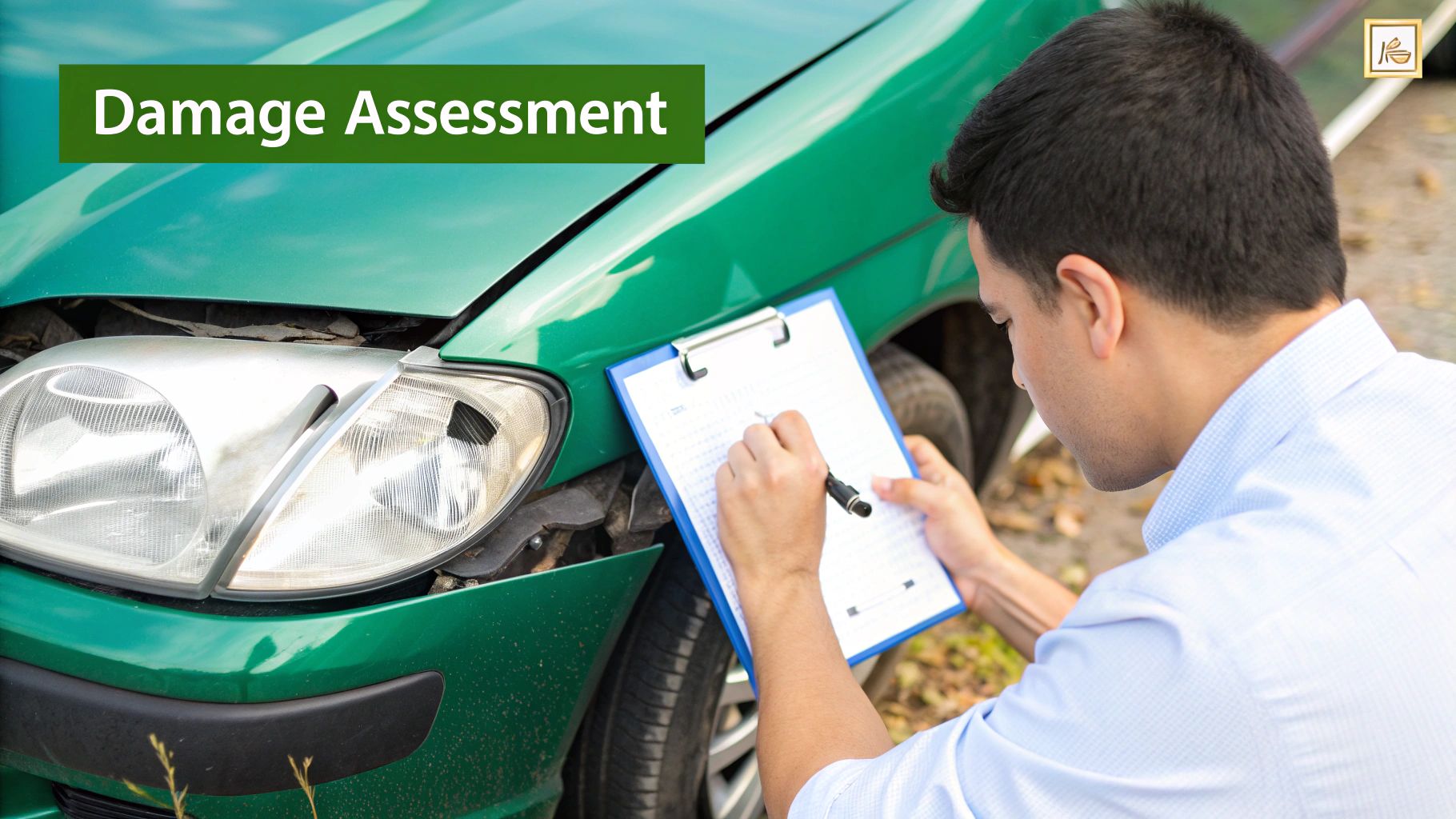
Figuring out exactly how much your car value after an accident has dropped isn’t a guessing game. Several key factors determine the final amount, and understanding them is crucial for building a solid claim.
Not all accidents are equal. A minor fender-bender on an older sedan will have a very different financial impact than major frame damage on a new luxury SUV. Here’s what insurers and professional appraisers look at.
Damage Severity: Structural vs. Cosmetic
This is the most important factor. The severity of the damage—whether it was cosmetic or structural—changes everything.
- Cosmetic Damage: This includes scratches, small dents, and scuffed bumpers. While it still adds an accident to the vehicle’s record, the impact on its value is less severe because the car’s core safety and performance are not affected.
- Structural Damage: This is the real value-killer. It refers to damage to the vehicle’s frame or unibody. Any crash requiring frame straightening or welding of major components will cause a massive drop in value. Buyers avoid cars with structural repairs due to concerns about long-term safety and reliability.
If an accident report mentions “frame damage,” it’s a major red flag for any potential buyer, and the car’s value will plummet.
Vehicle Age and Mileage
The age and mileage of your car play a huge role in how much value it loses. Newer, low-mileage cars have more value to lose, so they take a bigger financial hit from an accident.
For example, a one-year-old car with 10,000 miles might lose $5,000 in value from a moderate collision. A seven-year-old car with 120,000 miles might only lose $1,500 from the same accident because its pre-accident value was much lower.
Make, Model, and Pre-Accident Condition
The type of car you drive heavily influences its post-accident depreciation. Luxury, exotic, and high-performance cars suffer a much steeper drop in value compared to standard sedans or SUVs.
Buyers of premium brands like BMW, Mercedes-Benz, or Lexus expect a flawless vehicle with a clean history. The stigma of an accident is much greater in this market, leading to a huge loss. It’s not uncommon for a high-end vehicle to lose 25-40% of its value after a collision.
Additionally, the car’s condition before the accident matters. A well-maintained vehicle will lose a greater percentage of its value than one that already had dings and scratches.
Quality of Repairs: OEM vs. Aftermarket Parts
Finally, the quality of the repair work directly affects your car’s final value. Using Original Equipment Manufacturer (OEM) parts is the gold standard because they are identical to the factory originals. However, to save money, insurance companies often push body shops to use cheaper aftermarket or used parts.
This can lead to:
- Poor panel gaps and misaligned parts.
- Paint colors that don’t match perfectly.
- Reduced performance or compromised safety.
A professional appraiser will analyze the final repair invoice to see what kind of parts were used. Documenting the use of non-OEM parts provides powerful proof that your car wasn’t restored to its pre-accident condition and strengthens your diminished value claim.
How Insurance Companies Calculate Your Car’s Value
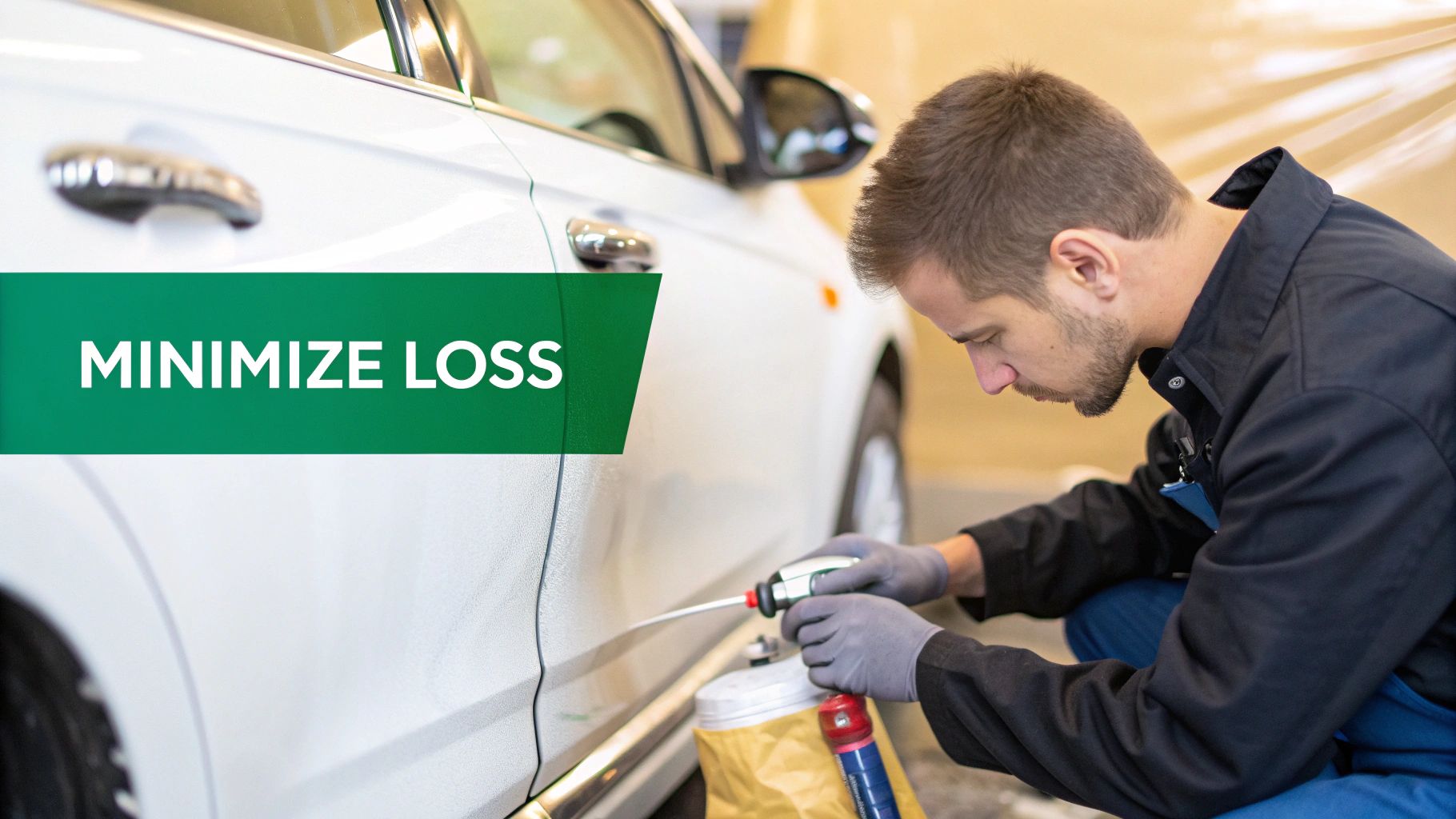
When you file a claim, insurance companies have a process for calculating your car’s value, and it’s designed to protect their bottom line. To get the settlement you deserve, you need to understand how they work. Adjusters use their own valuation software and methods that often lead to a lowball first offer.
Biased Comparisons and Unfair Adjustments
A common tactic is to use “comparable” vehicles that aren’t truly comparable to lower your car’s value. An adjuster might compare your low-mileage, fully-loaded model to a base model with high mileage and a spotty service history. This flawed comparison naturally results in a lower pre-accident value.
They also apply “condition adjustments” for minor, pre-existing scratches or normal wear and tear, slashing hundreds or thousands of dollars from the offer. It’s a way of penalizing you for simply using your car.
The insurer’s goal is simple: establish the lowest possible pre-accident value for your vehicle. This saves them money on both total loss and diminished value claims, directly at your expense.
The Problem With the 17c Formula
Some insurance companies use a simplistic and widely criticized formula called Rule 17c to calculate diminished value. This formula uses arbitrary caps that rarely reflect your actual financial loss.
Here’s a quick overview of how it works:
- Starts with a 10% Cap: The formula first limits the maximum potential loss to 10% of your car’s pre-accident market value.
- Applies a Damage Modifier: This amount is then reduced based on damage severity (e.g., minor cosmetic damage might only get a 0.25 multiplier).
- Applies a Mileage Modifier: Finally, the number is cut again based on your car’s mileage, shrinking the final payout even more.
This rigid approach ignores your vehicle’s unique features and the realities of your local market. The value it produces is almost always far lower than what an independent appraiser would determine. The best way to counter these tactics is with a professional, independent appraisal that provides unbiased, real-world data to support your negotiations.
How to Document Your Diminished Value Claim
To recover the car value lost after an accident, the burden of proof is on you. Insurance companies require a rock-solid, evidence-based case before they will pay a diminished value claim. Organized documentation is your most powerful tool.
Think of it as building a case file. Your goal is to tell a clear story of your vehicle’s value before the accident and then prove how much that value has dropped.
Gather Your Core Accident Documents
First, collect every document related to the accident and repairs. These papers form the foundation of your claim.
Your essential document checklist should include:
- The Police Report: This provides an official, third-party account of the accident, often noting the severity and who was at fault.
- The Final Repair Invoice: This critical document itemizes every part replaced and all labor performed, showing the extent of the damage and whether OEM or aftermarket parts were used.
- Photos and Videos: Visual proof is powerful. Take pictures of the damage from all angles immediately after the crash, during the repair process, and of the finished work.
Prove Your Car’s Clean Pre-Accident History
Next, you need to prove your vehicle was in excellent condition before the collision. A car with a clean record is worth more, and demonstrating this is essential for getting the full value you’re owed. Obtain a vehicle history report from a trusted source like CarFax or AutoCheck. This report is official proof that your car was “unblemished” before the at-fault driver damaged it, shutting down any attempts by the insurer to claim its value was already low.
A clean vehicle history report establishes a high baseline value from which the post-accident loss can be accurately measured, strengthening your entire argument.
Get a Certified and Independent Appraisal
This is the most critical step. While other documents provide context, a professional, independent diminished value appraisal gives you the objective proof of loss that insurance companies cannot easily dismiss. An estimate from a car dealer or an online calculator won’t stand up to scrutiny. You need a report designed to be defended.
This is where SnapClaim provides the leverage you need. We deliver a USPAP-compliant (Uniform Standards of Professional Appraisal Practice) report, the gold standard respected by insurance companies nationwide. Our report doesn’t guess; it analyzes real-time market data, your car’s specifics, and the severity of repairs to calculate the true financial loss. Our guide on how to file a diminished value claim walks you through the entire process.
This professional appraisal transforms your claim from a simple request into a formal, evidence-backed demand. Best of all, with SnapClaim’s money-back guarantee, there’s no risk. If your insurance recovery is less than $1,000, we refund the appraisal fee completely.
Negotiating a Fair Settlement With Insurers
Once you have a professional appraisal and supporting documents, you are in a position of strength. You’re no longer just asking for compensation—you’re presenting a formal, evidence-backed demand. Negotiating with an insurance adjuster can be intimidating, but now you have the proof needed to counter lowball tactics and secure a fair settlement for your car value after an accident.
Your SnapClaim report is the anchor of your argument. It is a USPAP-compliant document from certified experts that clearly outlines your vehicle’s lost value. This is the kind of professional evidence adjusters take seriously.
Presenting Your Diminished Value Claim
Begin by sending a formal demand letter to the at-fault driver’s insurance company. Keep it professional and concise. State the exact diminished value amount you are claiming and attach a copy of your certified SnapClaim appraisal report.
Stay calm and persistent throughout the negotiation. The adjuster may try to dismiss your claim or offer another low amount. Stand your ground politely and reference specific data points from your appraisal to justify your figure. If the insurer tries to declare your car a total loss instead, knowing your rights is key. We cover this in our step-by-step guide to disputing a total loss offer.
The Impact of Brand and Damage on Value
Not all cars lose value equally after an accident, a fact your appraisal will highlight. Real-world data shows a significant difference in value loss depending on the car’s make and the severity of the damage.
Post-Accident Value Loss by Brand and Severity
This table shows estimated diminished value percentages for popular car brands after minor vs. major accidents.
| Car Brand | Loss After Minor Accident | Loss After Major Accident |
|---|---|---|
| Toyota | 10-15% | 25-30% |
| Honda | 10-15% | 25-30% |
| Ford | 12-18% | 30-40% |
| BMW | 20-30% | 40-55% |
| Mercedes-Benz | 20-30% | 40-55% |
| Tesla | 25-35% | 50-60% |
As shown, a minor accident might reduce a Toyota’s value by 10-15%, while a major crash can cause a 25-30% drop. For luxury brands like BMW, a major accident can erase 40-55% of the car’s value. This is why a one-size-fits-all formula like 17c is inadequate.
Your Risk-Free Path to Fair Compensation
We understand that taking on a large insurance company can feel like a risk. That’s why we stand behind our reports with a simple, straightforward guarantee.
SnapClaim’s Money-Back Guarantee: If the insurance recovery from the claim is less than $1,000, the appraisal fee is fully refunded.
This guarantee removes the financial risk, allowing you to pursue the compensation you’re owed with confidence. You have everything to gain and nothing to lose. Don’t let the insurance company dictate your car’s worth. Take control with objective, powerful evidence.
FAQ: Common Questions About Car Value After an Accident
Navigating the claims process after an accident can be confusing. Here are clear answers to some of the most common questions we receive.
Can I claim diminished value if I was at fault?
Generally, you can only file a diminished value claim against the at-fault driver’s insurance company. If you caused the accident, your own insurance policy typically does not cover your car’s drop in market value. However, insurance laws vary by state, so it’s always a good idea to check your local regulations for any exceptions.
Is there a deadline for filing a diminished value claim?
Yes, every state has a “statute of limitations” for property damage claims, which includes diminished value. This is a legal deadline for filing your claim, which can range from one to five years depending on your state. It is crucial to act quickly after your repairs are complete, as missing this deadline means you lose your right to recover compensation.
What if my car is declared a total loss?
If an insurance company declares your car a total loss, you cannot file a diminished value claim. A total loss settlement is intended to pay you the vehicle’s full fair market value from before the accident. Diminished value claims are only for vehicles that are repaired. In a total loss situation, your focus should be on ensuring the insurer’s valuation is fair and accurate. For more information, you can check resources like the Texas Department of Insurance.
Why do I need a professional appraisal?
An independent, certified appraisal is your most powerful tool. Unlike a dealer’s opinion or an online calculator, a professional report provides unbiased, evidence-based proof of your financial loss that stands up to scrutiny from insurance adjusters. It strengthens your negotiating position significantly. SnapClaim’s money-back guarantee makes this step risk-free: if the insurance recovery from the claim is less than $1,000, we will fully refund your appraisal fee.
Don’t let an insurance adjuster dictate your car’s worth. Take back control with objective proof. Order a certified appraisal report from SnapClaim to support your negotiations and recover the true car value after an accident.