

A diminished value calculator estimates how much your car’s worth drops after an accident. But free tools often use generic formulas that ignore your vehicle’s unique market data—costing you hundreds or even thousands in compensation
What Is Diminished Value and Why Does It Matter?
When your car is damaged in an accident, your main concern is getting it repaired. But what happens to its market value after the repairs are done? The reality is, even a perfectly repaired vehicle is worth less than it was moments before the collision.
This permanent loss in resale value is called inherent diminished value. It’s the financial hit your car takes simply because it now has a permanent accident record.
Think about it from a buyer’s perspective: if you’re choosing between two identical used cars, but one has a clean history and the other has a reported accident, which would you pay more for? The difference in what a buyer would pay for those two cars is the diminished value.
Why Quality Repairs Aren’t the Whole Story
Repairs restore your car’s appearance and function, but they can’t erase its past. The moment an accident is reported, it becomes a permanent part of the vehicle’s history for any future buyer to see. This history creates doubt, which always leads to lower offers when you decide to sell or trade it in.
The at-fault party’s insurance owes you for this drop in fair market value. The problem is, they won’t volunteer to pay what you’re truly owed. To understand your rights, it helps to know the basics of personal auto insurance policies.
Your vehicle’s accident history directly impacts its perceived worth, no matter how good the repairs are. This stigma causes a real financial loss that you are legally entitled to recover.
To get fair compensation, you must prove the loss exists and accurately calculate its amount. This is where a professional, evidence-based appraisal becomes your most important tool. You can learn more about the formal process in our guide on what is a diminished value claim.
How Insurance Companies Calculate Diminished Value
When you file a diminished value claim, the insurance adjuster doesn’t just make an educated guess. They rely on a standardized, internal formula designed to produce a quick, consistent, and—most importantly for them—low payout.
The most common formula insurers use is known as “Rule 17c.” While it appears methodical, it’s a system that often fails to reflect your vehicle’s true loss in the real world. The entire process is engineered for the insurer’s efficiency, not to make you financially whole again.
The 17c Formula: A Closer Look
The 17c formula starts by putting an artificial cap on your potential claim. It immediately limits the maximum loss to a small percentage—often just 10%—of your vehicle’s pre-accident book value. This caps your potential recovery before any other real-world factors are even considered.
From there, the insurer applies two more deductions to reduce the payout even further:
- Damage Multiplier: This adjusts the capped amount based on the severity of the damage. Minor cosmetic issues get a low multiplier, while major structural repairs get a higher one. However, the final amount can never exceed the initial 10% cap.
- Mileage Multiplier: This reduces the offer based on your car’s mileage, assuming older cars lose less value after an accident.
The infographic below shows a simplified version of how a basic diminished value calculator processes these steps.
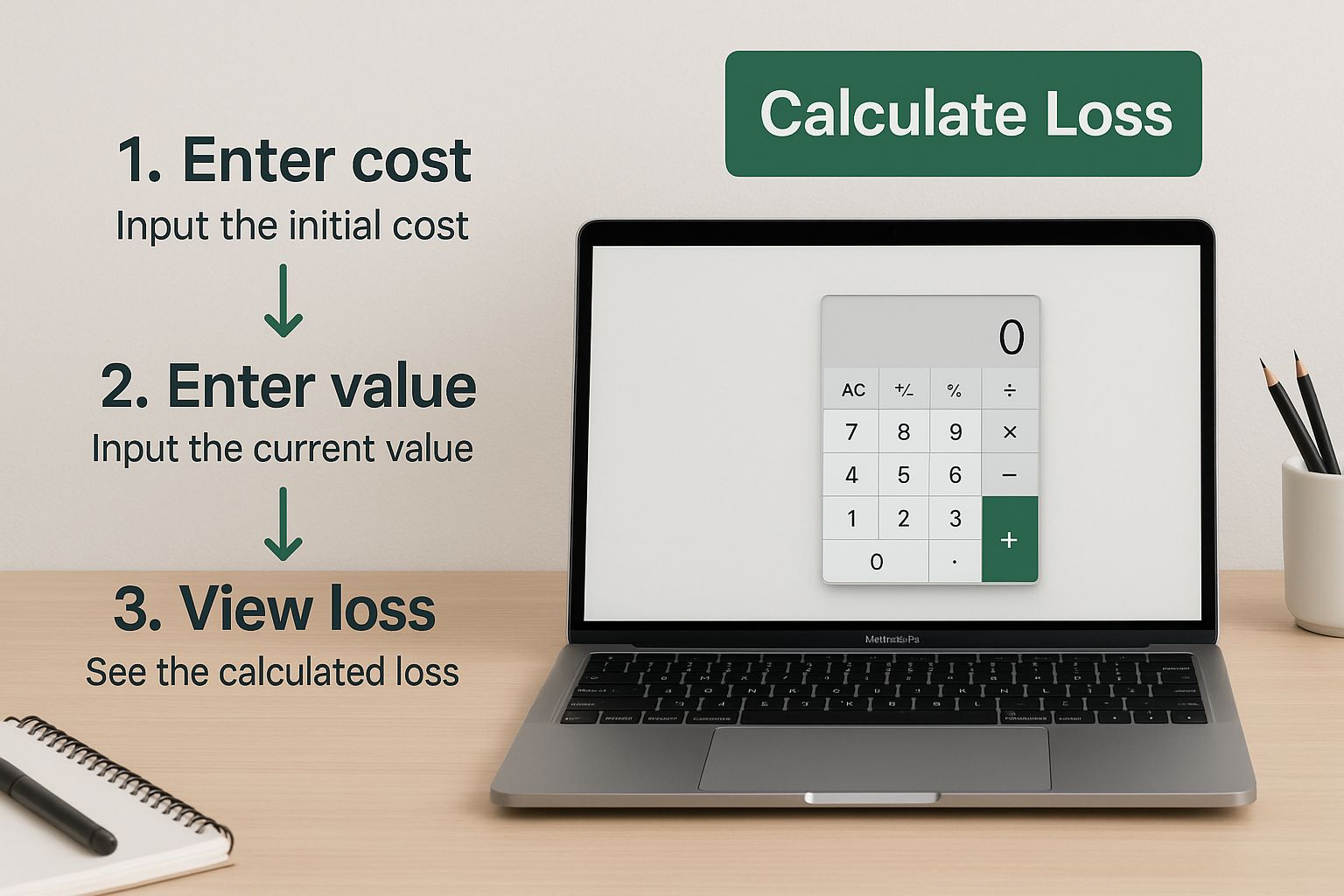
This rigid process is designed to systematically decrease your payout at every step.
A Real-World Example of the 17c Flaw
Let’s see how this plays out. Imagine your car was worth $30,000 before the accident. Using the 17c formula, the insurance company immediately caps your potential claim at $3,000 (10% of the car’s value). That’s the absolute most you can get, right from the start.
This cap doesn’t care if your car is a high-demand luxury vehicle that will take a huge resale hit or a standard economy car. Then, they’ll apply the mileage and damage multipliers to shrink that $3,000 figure even more.
This one-size-fits-all approach ignores crucial factors that determine a car’s actual market value, like local demand, repair quality, and your vehicle’s make and model. The result is almost always a lowball offer backed by a formula that protects their bottom line, not yours. Learn more about what impacts your car’s post-accident price in our guide on how much an accident can devalue a car.
The Hidden Flaws of Instant Online Calculators
Free online diminished value calculators seem like a perfect solution. You enter a few details, click a button, and get an instant number. While tempting, these tools often provide a misleading estimate of your car’s actual financial loss.
The problem is that most of these automated calculators are built on the same oversimplified formulas that insurance companies use, like the 17c method. They produce a generic estimate that ignores the critical details determining a car’s real-world market value. This can leave thousands of dollars on the table when you negotiate with an adjuster.
Why Generic Numbers Don’t Work
A free online calculator is like a generic t-shirt—fast and cheap, but it doesn’t fit your unique situation. A professional appraisal is like a custom-tailored suit, designed to perfectly match your circumstances. An automated calculator can’t account for the unique factors that make or break a successful claim.
These tools almost always overlook key details, including:
- Local Market Demand: A popular truck in Texas will have a different value loss than the same truck in New York.
- Vehicle Desirability: Certain makes and models hold their value better than others. A generic formula doesn’t know the difference.
- Severity of Damage: These tools can’t distinguish between minor cosmetic fixes and significant structural damage that permanently stigmatizes a vehicle.
- Quality of Repairs: A top-tier repair job versus a sloppy one has a huge impact on resale value—something a basic calculator ignores.
A number from a free diminished value calculator won’t stand up to a skeptical insurance adjuster trained to find holes in unsupported claims. They will ask for proof, and a printout from a website isn’t credible evidence. You can start with a free diminished value estimate from SnapClaim to get a better sense of your loss without these limitations.
From a Vague Estimate to Solid Evidence
An insurance adjuster’s job is to minimize claim payouts. When you provide a generic figure, you give them an easy reason to dismiss your claim or stick to their lowball offer. They need documented, evidence-based proof to justify paying what you’re actually owed.
A successful diminished value claim isn’t built on a vague estimate; it’s built on a comprehensive market analysis that proves the financial loss. This shifts the negotiation from an argument over opinions to a discussion based on facts.
This is why a certified appraisal is so critical. It transforms your claim from a simple request into a market-supported argument that an insurer must take seriously. It provides the adjuster with the specific, verifiable data needed to approve a fair settlement.
Market Factors That Truly Determine Diminished Value
A car’s diminished value isn’t determined by a rigid formula. It’s decided by the real-world used car market. This is where a professional appraisal report proves its worth over a generic online diminished value calculator.
A proper valuation analyzes the dynamic factors that real buyers and sellers consider every day. It transforms your claim from a simple request into a market-backed argument that an insurance company has to take seriously. Instead of being limited by an artificial cap, you get hard evidence of what your vehicle has actually lost in value.
Beyond the Formula: What Really Matters
The biggest issue with automated calculators and insurance company formulas is that they treat every car the same. They can’t differentiate between a high-demand truck in Texas and a common sedan in California. Those regional details are crucial for determining resale value.
A solid appraisal factors in these critical market dynamics to build a strong claim:
- Vehicle Popularity: How desirable is your specific make and model? A popular SUV known for reliability will have a different value loss than a sedan that’s no longer in production.
- Regional Buyer Demand: Local tastes matter. Your car’s value is tied directly to what buyers in your area are willing to pay.
- Quality of Repairs: The appraisal must examine the bodywork closely. Excellent repairs can lessen the value hit, but sloppy work will scare off buyers and increase the diminished value.
These are the real-world factors that formulas miss, and they’re what make an appraisal accurate and defensible.
Market Conditions and Your Claim
Broader market conditions, like supply and demand or seasonal buying trends, also play a huge role in your claim’s outcome. This is why real-time market data is so important for negotiating a fair settlement.
A certified report analyzes these precise market dynamics, providing the hard evidence needed to counter an insurer’s generic, formula-based offer. It proves your loss with facts, not assumptions.
By grounding your claim in real-world data, you shift the negotiation to your advantage. SnapClaim’s expert reports reflect your vehicle’s true position in today’s market, giving you the proof you need to negotiate effectively. We also offer a money-back guarantee: if the insurance recovery from your claim is less than $1,000, we’ll refund your appraisal fee completely.
Why a Certified Appraisal Is Your Strongest Tool
When you’re dealing with an insurance company, an instant online estimate is just an opinion. A certified appraisal report, on the other hand, is documented proof.
This professional report is the single most powerful tool for negotiating a fair diminished value settlement. It’s not just another calculation; it’s a detailed, evidence-based analysis prepared by an expert, turning your request into a factual argument that is difficult to ignore.

From a Simple Number to Solid Proof
Insurance adjusters are trained to challenge unsupported claims. They need a logical, evidence-based reason to approve a higher payout, and a certified appraisal gives them exactly that. It becomes the factual foundation of your claim by analyzing all the critical variables a basic calculator misses.
Here is what a professional appraisal provides:
- Specific Damage Analysis: It goes beyond vague terms like “moderate,” detailing the exact nature of the damage and identifying if it was structural—a major factor that hurts resale value.
- Repair Quality Assessment: The report considers the quality of the bodywork and parts used. Poor repairs can worsen the value loss, and a proper appraisal accounts for it.
- Local Market Valuation: Your car’s value is not a national average. The appraisal analyzes how desirable your specific vehicle is in your local market, providing a true-to-life valuation.
This level of detail gives the adjuster the documentation needed to justify the settlement you deserve. The diminished value appraisal cost is often a small investment for a much larger return.
Grounding Your Claim in Market Reality
An accident can mean a significant financial loss when you sell or trade in your car, especially with used car values remaining high. A certified appraisal connects this market reality to your specific vehicle, showing precisely how much value was lost due to the collision. It replaces guesswork with real-world data.
A certified appraisal isn’t just a document; it’s your leverage. It provides the credible, third-party validation that turns a disputed claim into a fact-based negotiation, empowering you to secure fair compensation.
This is why SnapClaim’s money-back guarantee offers complete peace of mind. If your insurance recovery from the claim is less than $1,000, your appraisal fee is fully refunded. It’s a risk-free way to pursue the fair settlement you are owed.
FAQs About Diminished Value Claims
Here are answers to some of the most common questions vehicle owners have about diminished value.
Can I claim diminished value if the accident was my fault?
Generally, no. You typically cannot file a diminished value claim with your own insurance company if you caused the accident. This type of claim is almost always paid by the at-fault driver’s liability policy. There are rare exceptions in certain states like Georgia, so it’s always smart to check the laws in your area on our state law pages.
Is there a time limit to file my claim?
Yes, every state has a statute of limitations for property damage claims, which includes diminished value. This deadline can range from one to six years, depending on where you live. If you miss this deadline, you lose your right to recover any compensation for your car’s lost value. The Federal Trade Commission (FTC) is a great resource for understanding your general consumer rights.
What if the insurer denies my claim or makes a low offer?
Don’t panic—this is a standard tactic. Insurance companies often deny a claim initially or counter with a low offer based on a biased formula. This is where your certified appraisal becomes your most powerful tool for negotiation. Our detailed guide on how to file a diminished value claim walks you through the entire process step-by-step.
When an insurer makes a low offer, it’s not the end of the conversation—it’s the beginning of the negotiation. A credible, data-driven report gives you the leverage to counter their offer with facts.
Stay professional and persistently refer to the evidence in your SnapClaim report. Point to the market data and comparable vehicle sales that support your claim. This shifts the conversation from their opinion to documented proof.
Ready to stop guessing and start proving your car’s true diminished value? SnapClaim provides the certified, data-driven appraisal reports you need to strengthen your negotiations and secure a fair settlement. Get a free estimate today or order your court-ready report in minutes.