

Your car was in a collision, but the repair shop did a fantastic job and it looks brand new. Unfortunately, that’s only half the story. Even with perfect repairs, the accident leaves a permanent mark on your car’s vehicle history report, creating a value gap that a car value after accident calculator is designed to measure.
That gap is called diminished value—the loss in resale value your car suffers simply because it now has an accident history.
What a Car Value After Accident Calculator Actually Measures
A car value after accident calculator provides a quick estimate of how much money your vehicle has lost because it now has an accident on its permanent record. It gives you a starting point for understanding what you may be owed in a diminished value claim.
Imagine two identical used cars on a dealer’s lot. They have the same make, model, year, and mileage. The only difference? One has a clean history, while the other has a collision on its CARFAX report. A buyer will almost always choose the one with a clean record or demand a steep discount on the other.
That discount is diminished value. The market simply doesn’t trust a previously damaged car in the same way, even if the repairs were flawless. A calculator offers a data-driven starting point to put a number on that loss, helping you begin a fair negotiation with the insurance company.
You can learn more about how to determine your vehicle value after an accident in our detailed guide.
Inherent vs. Repair-Related Loss in Value
It’s helpful to know that diminished value comes in different forms. A calculator primarily focuses on what’s called Inherent Diminished Value.
- Inherent Diminished Value: This is the automatic, unavoidable drop in resale value that occurs the moment an accident is recorded on your car’s history, regardless of how excellent the repairs are. This is the basis for most claims.
- Repair-Related Diminished Value: This is a separate issue caused by poor-quality repairs. Examples include mismatched paint, a frame that isn’t perfectly straight, or the use of cheap, non-original parts. These problems compound the value loss.
An accident history plants a seed of doubt in a buyer’s mind about the car’s long-term reliability. A good calculator analyzes factors like damage severity, your car’s age, and its pre-accident value to estimate that loss in market perception, turning a vague concept into a tangible number.
Gathering Your Information for an Accurate Estimate
Using a car value after accident calculator is a great first step, but its accuracy depends entirely on the quality of the information you provide. Getting these details right not only produces a more reliable estimate but also prepares you for the conversation with the insurance adjuster.
The better your inputs, the better your output. Let’s start with the basics of your vehicle before the accident happened.
Pre-Accident Vehicle Details
Your goal is to paint a crystal-clear picture of your car’s condition and value just moments before the collision. This means you need more than just the make and model. Be ready with:
- Exact Mileage: The precise number on your odometer.
- Trim Level and Options: Is it a base model or a fully loaded premium trim? Details like a sunroof, a high-end sound system, or advanced safety features all add to its value.
- Overall Condition: Note any pre-existing scratches, dings, or interior wear. Being honest here builds a more credible case.
When assessing your vehicle’s condition, a general car inspection checklist from a reputable source can be a huge help. It ensures you don’t forget small details that contribute to its overall state.
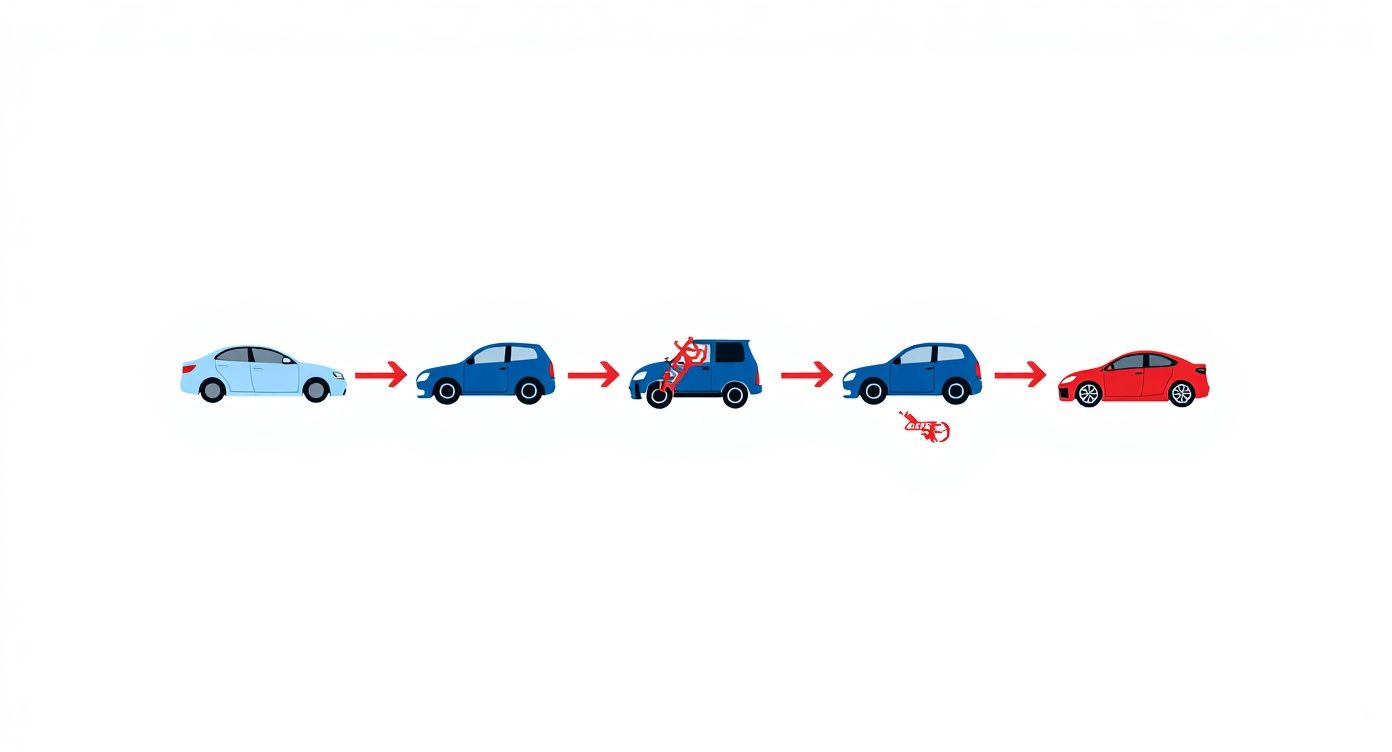
As you can see, even after top-notch repairs, a vehicle rarely returns to its original pre-accident market price. That new damage history sticks with it for good.
Post-Accident Repair Information
Next, you need the facts on the severity and type of damage. Your best source is the final repair invoice from the body shop. Scan that document for key details:
- Structural or Frame Damage: Any mention of this is a massive red flag for potential buyers and significantly increases the diminished value.
- Airbag Deployment: This clearly indicates a severe impact, not just a fender bender.
- Parts Replaced: Note whether they used Original Equipment Manufacturer (OEM) parts or cheaper aftermarket ones.
Insurance companies often use their own formulas to calculate this loss, and they rarely work in your favor. The infamous “17c formula,” for example, often caps diminished value at 10% of the car’s pre-accident value before applying other modifiers. Understanding their methods gives you a serious advantage when it’s time to negotiate.
How to Interpret Your Car Value After Accident Calculator Results
So, you’ve plugged your car’s details into a car value after accident calculator and now have a number. It’s tempting to see that figure as the final word, but it’s important to understand what it really means.
Think of that number as an educated starting point—not a guaranteed check from the insurance company. It’s an estimate of your car’s inherent diminished value, giving you a solid baseline for your claim and helping set realistic expectations for your insurance total loss payout or diminished value settlement.
What Shapes the Final Number
That calculator result isn’t random. Several key factors influence what you can recover in a diminished value claim. The most obvious is damage severity—structural repairs will always reduce a car’s value far more than minor cosmetic fixes.
Other critical elements include:
- Vehicle Age and Mileage: Newer cars with low mileage get hit hardest. A one-year-old luxury SUV could lose 20-25% of its value, while a five-year-old sedan with similar damage might only see a 5-10% drop.
- Brand Prestige: High-end brands like BMW or Mercedes-Benz suffer a bigger financial blow because buyers in that market expect a flawless history.
- Accident Severity: A vehicle history report showing airbag deployment or frame damage will scare off most buyers, leading to a much steeper decline in what someone is willing to pay.
To give you a clearer picture, here’s how different factors can play out for different types of vehicles.
Factors Influencing Diminished Value Estimates
| Factor | Low Impact Example (e.g., Honda Civic) | High Impact Example (e.g., BMW 5 Series) |
|---|---|---|
| Vehicle Age | 5+ years old | Less than 2 years old |
| Mileage | High (over 80,000 miles) | Low (under 20,000 miles) |
| Damage Type | Cosmetic (bumper, door dings) | Structural (frame, unibody) |
| Accident Severity | Minor fender bender, no airbags deployed | Major collision, airbags deployed |
| Typical DV % | 5-10% | 20-30% |
The specific details of your car and the accident are everything. Insurance companies often use their own internal formulas, like the notorious 17c method, which almost always produces a lowball number. An independent online tool gives you a much-needed reality check. If you want to see how that specific formula might impact your car, you can try SnapClaim’s diminished value 17c calculator for a more targeted look.
Ultimately, your online result is the first piece of evidence you can use to push back against the insurer’s initial offer and start the fight for a fair settlement.
Common Mistakes That Can Weaken Your Claim

Navigating a diminished value claim is full of small, easy-to-make errors that can cost you thousands. Even when you’re armed with a number from a car value after accident calculator, a few wrong moves can sink your chances of getting paid what you’re owed.
The biggest mistake is simply accepting the insurance company’s first offer. Adjusters are trained to minimize payouts, and their initial number is almost always a lowball figure based on formulas designed to benefit them, not you. Taking that offer without a fight is like leaving money on the table.
Relying on Flawed Formulas
Another huge pitfall is failing to question the insurer’s math. Insurance companies love using standardized formulas like the infamous “17c Rule,” which often caps your loss at a tiny percentage of the car’s pre-accident value. These generic calculations rarely consider your specific vehicle, local market conditions, or the true severity of the damage.
You can instantly strengthen your position by sidestepping these common blunders:
- Incomplete Documentation: Not keeping every single receipt, repair order, and email is a classic mistake. A strong paper trail is your best evidence.
- Waiting Too Long: Every state has a statute of limitations (a legal deadline) for property damage claims. If you wait, you could lose your right to collect anything.
- Using Only Free Estimates: A free online calculator is a great start, but it isn’t official proof. Adjusters can, and often will, dismiss these numbers easily.
An insurer’s valuation is not the final word; it’s a starting point for negotiation. You must be ready to counter it with solid, independent proof of your actual loss. This is exactly why moving from a simple online estimate to a professional appraisal from SnapClaim is the most important step you can take.
Turning Your Online Estimate into a Successful Claim
An online estimate from a car value after accident calculator is your starting whistle, not the finish line. Armed with this initial figure, your next move is to transform that number into a powerful negotiation tool to secure a real check from the insurance company.

When you present your findings to the insurance adjuster, expect pushback. They’re trained to dismiss free online results as generic and unreliable. Their job is to close your claim for the lowest amount possible, and a calculator’s estimate alone rarely gives you the leverage to change their mind.
From Estimate to Evidence
This is the point where a professional, certified appraisal becomes your most valuable asset. While an online tool gives you a great starting point, a SnapClaim report provides the hard, data-backed evidence needed to make your case undeniable. It shifts the conversation away from their internal formulas and toward verifiable market facts.
A certified report from a trusted appraiser like SnapClaim provides the objective proof that adjusters can’t easily dismiss. It shows you’ve done your homework and are serious about recovering your true financial loss, and it supports your case with certified data.
Strengthening Your Negotiation Position
A certified SnapClaim report backs up your claim with real market data, sales comparisons, and a court-accepted methodology. It gives you the solid ground you need to stand on. Navigating this process also means having some awareness of the bigger picture, including how state laws can affect your case. For instance, the impacts of tort reform on accident claims can change how some claims are handled.
Instead of just showing them a number, you’re presenting a comprehensive analysis that proves your diminished value. We have more info on working with the best diminished value appraisers who can arm you with the right documentation. This professional backing gives you the confidence to negotiate effectively.
Frequently Asked Questions (FAQ)
When it comes to diminished value, it’s easy to get lost in the details. Let’s clear up some of the most common questions we hear from vehicle owners so you can move forward with confidence.
Can I claim diminished value if the accident wasn’t my fault?
Yes, absolutely. In fact, this is the most common scenario for a successful diminished value claim. You file the claim against the at-fault driver’s insurance company to recover the loss in your vehicle’s market value. Your own policy typically covers repairs but not this specific type of value loss.
Is there a deadline to file my claim?
Yes, and this is critical. Every state has a legal cutoff for filing property damage claims, known as the statute of limitations. This window can vary dramatically, from as little as one year in some states to several years in others. You must act promptly after repairs are complete to protect your right to file. Check your specific state laws to confirm the deadline.
What should I do if the insurer denies my claim?
First, don’t panic. An initial denial or a lowball offer is a standard tactic. The best way to respond is with solid, independent evidence. A generic number from a car value after accident calculator might get brushed aside, but a certified appraisal report from SnapClaim provides the objective, market-based data you need to prove your loss and forces them to re-evaluate your claim based on facts.
How much do my car’s age and mileage matter?
They matter a lot. A newer car with low mileage almost always suffers a bigger financial loss after an accident. This is because its pre-accident value was much higher, and buyers in that market are extremely sensitive to any accident history. While older, high-mileage cars also lose value, the financial impact is usually less severe.
About SnapClaim
SnapClaim is a premier provider of expert diminished value and total loss appraisals. Our mission is to equip vehicle owners with clear, data-driven evidence to recover the full financial loss after an accident. Using advanced market analysis and industry expertise, we deliver accurate, defensible reports that help you negotiate confidently with insurance companies.
With a strong commitment to transparency and customer success, SnapClaim streamlines the claim process so you receive the compensation you rightfully deserve. Thousands of reports have been delivered to vehicle owners and law firms nationwide, with an average of $6,000+ in additional recovery per claim.
Why Trust This Guide
This guide was reviewed and verified by SnapClaim’s auto appraisers, who specialize in diminished value and total loss disputes. Our team continually updates every article to reflect current insurer guidelines, valuation standards, and court-accepted appraisal practices, ensuring that you’re relying on information trusted by professionals nationwide.
Get Started Today
Whether you’re challenging a low total loss settlement or proving your vehicle’s post-repair loss in value, SnapClaim makes it simple to take the next step. Our certified appraisal report provides the proof you need to negotiate fairly. Plus, our Money-Back Guarantee ensures you’re protected: if your insurance recovery from the claim is less than $1,000, SnapClaim refunds the full appraisal fee.
Generate a free estimate in minutes and see how much compensation you may be owed.