

After an accident, your focus is on getting your car repaired. But even after a flawless repair job, your vehicle now has an accident history—a permanent record that significantly lowers its resale value. This hidden financial loss is known as diminished value, and you need to calculate diminished value to recover the money you are rightfully owed.
What Is Diminished Value?
Insurance claims can be confusing, so let’s keep this simple.
Diminished value is the reduction in your car’s market value because it has been in an accident. Even when repaired perfectly, the vehicle’s history report is permanently stained. Future buyers will always pay less for a car with an accident record compared to an identical one with a clean history.
That difference in price is your diminished value. An independent appraisal provides the data-backed proof you need to negotiate a fair diminished value claim with the at-fault driver’s insurance company.
The Three Types of Diminished Value
While the concept is straightforward, it’s helpful to know the three specific types of diminished value. This clarifies exactly what you can claim.
- Immediate Diminished Value: This is the loss in value right after the collision, before any repairs. Since repairs are meant to restore this portion of the value, you typically don’t file a claim for it.
- Repair-Related Diminished Value: This loss occurs due to poor-quality repairs, like mismatched paint or the use of cheap aftermarket parts. This is a separate issue you would typically address with the body shop responsible for the work.
- Inherent Diminished Value: This is the most important type. It’s the automatic, unavoidable loss in value that remains even after perfect repairs. It exists solely due to the stigma of the accident history, and it is the focus of your claim.
For nearly every claim, you will focus on Inherent Diminished Value. In most states, you are legally entitled to recover this loss when the other driver is at fault.
Key Takeaway: Your claim isn’t about the quality of the repairs. It’s about proving that your perfectly fixed car is now worth less to a potential buyer simply because its history report is no longer clean.
Why You Must Calculate Diminished Value Independently
The at-fault driver’s insurance company is not on your side. Their primary goal is to settle your claim for the lowest possible amount. They use internal formulas designed to produce a low number, often just a few hundred dollars, hoping you’ll accept it without question.
To get fair compensation, you can’t just take their word for it. You need your own independent, data-backed proof. A professional diminished value calculation gives you the leverage to challenge their lowball offer and negotiate from a position of strength.
Decoding the Insurer’s 17c Formula
If you’ve received a surprisingly low diminished value offer from an insurance company, it was likely calculated using a method called the 17c formula.
This formula is not an accepted appraisal standard. It is an internal, insurer-friendly shortcut designed to systematically undervalue your claim. Understanding how it works is the first step toward defeating it.
The Origins of the 17c Formula
The 17c formula originated from a Georgia class-action lawsuit, Mabry v. State Farm. Insurance companies nationwide quickly adopted it because it produces consistently low payouts.
The formula takes a small percentage of your car’s value and applies arbitrary deductions to shrink the final number even more. It looks official on paper but has little connection to real-world car value after an accident.
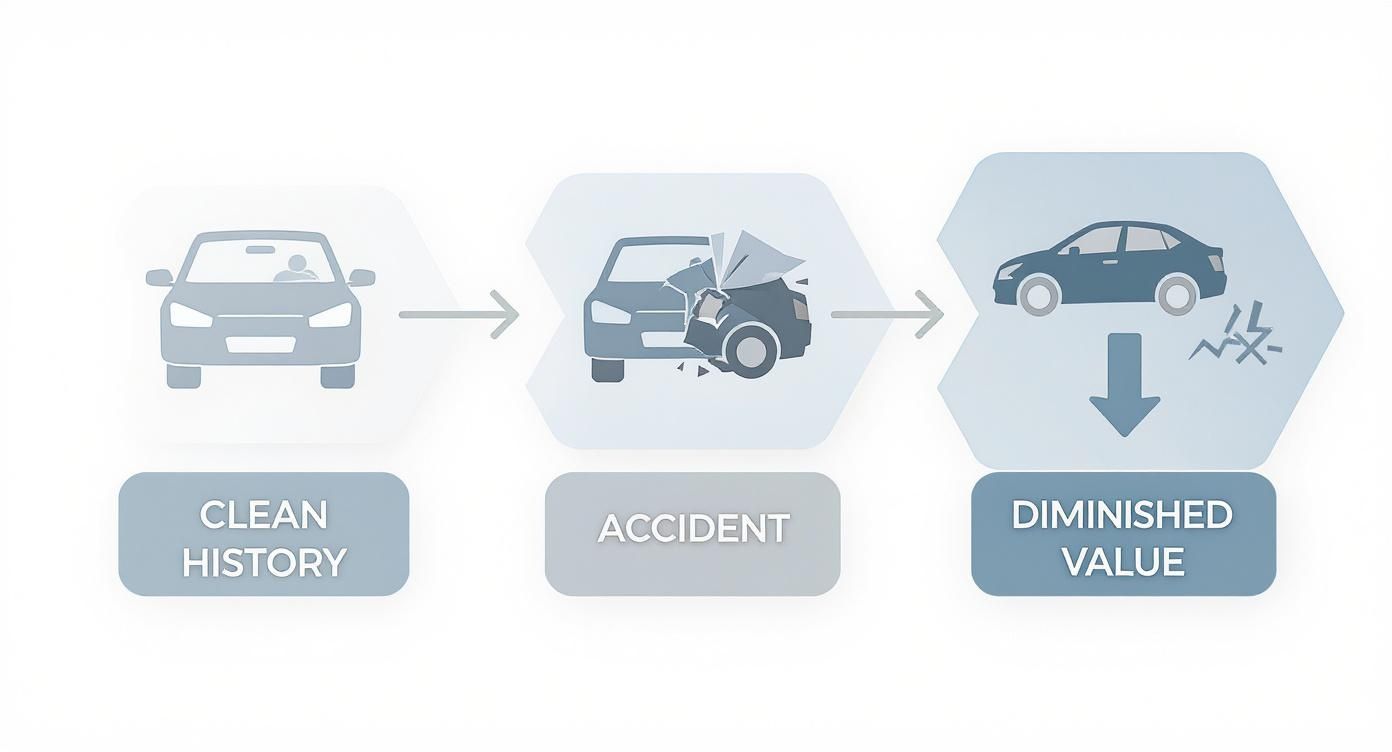
As you can see, once an accident is on the record, the vehicle’s value takes a permanent hit, even after repairs make it look and drive like new again.
How the Calculation Really Works
The 17c formula is a flawed, three-step process built to reduce your payout at every stage.
Here’s the breakdown:
- Start with a 10% Cap: The insurer takes your car’s pre-accident value (often from NADA) and caps the maximum possible diminished value at just 10%. If your car was worth $30,000, they start by assuming your maximum loss is $3,000, regardless of the accident’s severity.
- Apply a Damage Multiplier: Next, an adjuster applies a subjective “damage modifier” from 0.00 to 1.00 based on their personal assessment. A 0.50 multiplier would instantly cut that $3,000 down to $1,500.
- Apply a Mileage Multiplier: Finally, they apply another multiplier to deduct for mileage. Higher mileage means a lower multiplier, reducing your payout even further.
To see how an insurer might value your claim using this flawed method, try SnapClaim’s free 17c calculator.
The Major Flaws in the Formula
The 17c formula is a favorite of insurance companies, but it doesn’t hold up to real-world scrutiny.
- The Arbitrary 10% Cap: There is zero market data suggesting a car’s value can only drop by a maximum of 10% after an accident. For luxury cars, sports cars, or newer models, the real-world loss is often much higher.
- Subjective Damage Modifiers: The damage multiplier is just an adjuster’s opinion, not a fact. This leads to inconsistent and unfair results.
- Ignoring Market Factors: The formula completely ignores what buyers actually care about, such as brand reputation, repair quality, use of OEM parts, and local market demand.
Why This Matters: The 17c formula is a tool built for insurers, not a fair appraisal method. It creates the illusion of a data-driven process while using arbitrary caps and subjective opinions to drive your settlement into the ground.
Gathering Evidence for Your Calculation
To successfully calculate diminished value, you must first gather strong evidence. A solid claim is built on proof, not just opinions.
The more comprehensive your documentation, the harder it is for an insurance adjuster to dismiss your claim.
Establish Your Car’s Pre-Accident Value
The cornerstone of your claim is your car’s pre-accident Fair Market Value (FMV). You need to establish this figure independently using real-world data.
- Use Online Valuation Tools: Start with sources like Kelley Blue Book (KBB) and Edmunds for a baseline estimate.
- Find Local Dealer Listings: Search for comparable vehicles (same year, make, model, and similar mileage) for sale in your area on sites like Autotrader or Cars.com. This provides powerful, localized market evidence.
- Compile Your Findings: Take screenshots and save the vehicle details, including the VIN and asking price, for each comparable vehicle. This shows the adjuster you’ve done your homework.
Assemble Your Documentation Checklist
Next, gather all documents related to the accident and repairs. An organized file sends a clear message that you are serious about your claim.
| Document Type | Why It’s Important | Where to Get It |
|---|---|---|
| Police Report | Officially identifies the at-fault party, which is essential for a third-party claim. | The responding police department. |
| Photos & Videos | Provides undeniable visual proof of the damage before and after repairs. | Your smartphone at the scene and during repairs. |
| Final Repair Invoice | Details the total repair cost and specifies whether OEM parts were used. | The body shop that completed the repairs. |
These documents are crucial for building a strong case. To learn more about presenting this evidence, see our guide on how to file a diminished value claim.
Assess the Severity and Nature of Damage
Not all damage is equal. The type of damage your vehicle sustained directly impacts its loss in value.
Review your final repair invoice and look for:
- Structural vs. Cosmetic Damage: Frame damage, deployed airbags, or welding indicates a severe accident and will lead to a much higher diminished value.
- Use of OEM vs. Aftermarket Parts: The use of non-OEM (Original Equipment Manufacturer) parts can significantly lower a vehicle’s resale value.
- Reputation of the Repair Shop: Repairs from a manufacturer-certified facility are viewed more favorably than those from a shop with a poor reputation.
By gathering this evidence, you can build a compelling, market-based case for your car’s true loss in value.
Setting Realistic Payout Expectations
What is a realistic payout for a diminished value claim? While every case is unique, most successful claims settle for 10% to 25% of the vehicle’s pre-accident value.
Where your claim falls within that range depends on several key factors.
Key Factors That Drive Your Payout
When you calculate diminished value, some variables are more important than others.
- Vehicle Age and Mileage: Newer, low-mileage vehicles suffer the largest loss. A two-year-old luxury car will have a much higher diminished value than an older, high-mileage sedan, even with identical repair costs.
- Severity of Damage: Structural damage or deployed airbags are major red flags for buyers and justify a higher payout.
- Vehicle Type and Prestige: Luxury, exotic, and performance brands are extremely sensitive to accident history. Buyers in this market expect a flawless record, so any accident causes a steep drop in value.
How Repair Quality Fits In
High-quality repairs using OEM parts can soften the financial blow, but they cannot erase diminished value entirely.
Important Insight: A perfect repair doesn’t eliminate diminished value. It simply establishes the vehicle’s best possible condition after an accident. The loss in value comes from the permanent accident history.
Even perfectly repaired cars lose thousands. In one documented case, a standard sedan with a $6,621 repair bill still had $3,040 in proven diminished value. You can learn more about how these calculations are performed at RedRockInjuryLaw.com.
How a Certified Appraisal Strengthens Your Claim
A DIY estimate is a good starting point, but a certified appraisal is the most powerful tool for securing a fair settlement.
It changes the conversation from “I think my car is worth less” to “Here is the market data proving exactly how much value was lost.” A SnapClaim report levels the playing field, replacing the insurer’s subjective formulas with objective evidence.
Replacing Subjective Formulas with Market Data
A certified appraisal dismantles the insurer’s flimsy 17c formula. Instead of relying on generic math, a SnapClaim appraisal is built on real-time market analysis.
Our process includes:
- Hyper-Local Market Analysis: We identify comparable vehicles for sale in your geographic area, providing localized proof of value.
- VIN-Specific Valuations: We analyze your car’s unique trim, options, and condition to establish an accurate pre-accident value.
- Damage Severity Assessment: We review the repair estimate line-by-line, noting structural damage or the use of non-OEM parts—factors that heavily impact resale value.
By presenting this level of detail, you force the negotiation to focus on facts, not the insurance company’s self-serving formula.
The Rise of Data-Driven Valuations
The industry is shifting away from subjective methods to calculate diminished value. Modern, data-backed models using artificial intelligence are becoming the new standard.
These systems analyze vast amounts of real-time market data to generate accurate and defensible valuations, countering the bias of old formulas. This trend is a major win for vehicle owners seeking fair compensation. Learn more about where the industry is headed at Zebra Insurance
A Risk-Free Investment in Your Claim
An appraisal is an investment in maximizing your settlement. At SnapClaim, we make it a risk-free decision.
Our promise is simple: If your insurance recovery from the claim is less than $1,000, SnapClaim refunds the full appraisal fee—guaranteed.
This Money-Back Guarantee removes the financial risk, so you can confidently pursue the compensation you deserve. Learn more in our complete guide to certified auto appraisals.
Frequently Asked Questions (FAQ)
Here are answers to a few common questions vehicle owners have when they first calculate diminished value.
Can I claim diminished value if the accident wasn’t my fault?
Yes, absolutely. You can only recover diminished value from the at-fault driver’s insurance company. This is called a third-party claim. Your own insurance policy (a first-party claim) typically only covers the cost of repairs and does not cover the loss in your car’s market value.
Is there a time limit to file a diminished value claim?
Yes. Every state has a legal deadline called the statute of limitations for property damage. This time limit can range from one to six years, depending on your state. It is crucial to act quickly, because once this deadline passes, you lose your right to file a claim forever. Check the specific laws for your location on our state-by-state diminished value law pages.
What if the insurer rejects my appraisal report?
This is a common negotiation tactic. Stay firm and professional. Politely explain that your certified report is based on real-world market data, unlike their subjective 17c formula. Request a written explanation for their rejection. If the adjuster still refuses to negotiate fairly, ask to speak with a claims supervisor. A professional SnapClaim report is built to be defensible and provides the proof you need to negotiate confidently.
Do I need a lawyer for my diminished value claim?
For most claims, a certified appraisal report from SnapClaim provides all the evidence and professional standing you need to negotiate a fair settlement without an attorney. However, you might consider hiring a lawyer if your claim involves a very high-value vehicle, you also suffered significant personal injuries, or the insurance company is acting in bad faith.
Get your free estimate today or order a certified appraisal report to strengthen your insurance claim.
About SnapClaim
SnapClaim is a premier provider of expert diminished value and total loss appraisals. Our mission is to equip vehicle owners with clear, data-driven evidence to recover the full financial loss after an accident. Using advanced market analysis and industry expertise, we deliver accurate, defensible reports that help you negotiate confidently with insurance companies.
With a strong commitment to transparency and customer success, SnapClaim streamlines the claim process so you receive the compensation you rightfully deserve. Thousands of reports have been delivered to vehicle owners and law firms nationwide, with an average of $6,000+ in additional recovery per claim.
Why Trust This Guide
This guide was reviewed and verified by SnapClaim’s auto appraisers, who specialize in diminished value and total loss disputes.
Our team continually updates every article to reflect current insurer guidelines, valuation standards, and court-accepted appraisal practices, ensuring that you’re relying on information trusted by professionals nationwide.
Get Started Today
Whether you’re challenging a low total loss settlement or proving your vehicle’s post-repair loss in value, SnapClaim makes it simple to take the next step.
Generate a free diminished value or total loss estimate in minutes and see how much compensation you may be owed.
👉 Get your free estimate today