


That fender-bender wasn’t just a hassle—it was a direct hit to your car’s resale value. The moment an accident is recorded, your vehicle’s worth drops, and this loss goes far beyond the dents and scratches you can see. This hidden financial damage is known as diminished value.
Even after flawless repairs, your car now carries a permanent accident history. A savvy buyer will always pay less for a vehicle with a collision record than for an identical one with a clean past. This guide will help you understand your after accident car value and how to recover the compensation you rightfully deserve.
Uncovering the Hidden Loss in Your Vehicle’s Value
Even with expert repairs that make your car look and drive like new, the accident is now a permanent black mark on its vehicle history report. Services like CarFax and AutoCheck make that information public, creating a stigma that scares away future buyers. When you eventually sell or trade it in, you’ll be forced to accept a lower price.
What Is Diminished Value?
Simply put, diminished value is the gap between your car’s fair market value before the crash and its new, lower market value after the repairs are done. This isn’t a theoretical number; it’s a real, tangible loss that you are often entitled to recover from the at-fault driver’s insurance.
Insurance companies often argue that since your car is fixed, you’ve been “made whole.” But anyone who has ever shopped for a used car knows that’s not true. A smart buyer will always choose an identical vehicle with a clean history—or they’ll demand a steep discount for taking on the risk of one with a collision record.
Key Takeaway: The insurance company’s job is to pay for repairs, but that doesn’t account for your car’s lost resale value. Diminished value is a separate financial damage, and you have to provide proof to recover it.
The Financial Impact of an Accident Record
The financial hit from an accident record can be substantial. According to Kelley Blue Book, a repaired vehicle can lose a significant chunk of its market value just because it now has a stained history. This makes it far less attractive to buyers, who naturally worry about hidden problems. To see what the experts say, you can explore the insights on diminished value from KBB.com.
This drop in your after accident car value directly hits your wallet. Proving this loss takes more than just pointing to the accident report; it requires a data-driven appraisal that calculates the exact value that has vanished. Without a certified appraisal from a trusted source like SnapClaim, you’re letting the insurance company decide what your loss is worth—and their number will almost never be in your favor.
When figuring out your car’s value after a crash, you’ll hear appraisers talk about two different kinds of value loss. Knowing the difference is key to building a solid insurance claim.
Let’s break them down.
Inherent Diminished Value
The most common type of loss, which affects almost every car with an accident on its record, is Inherent Diminished Value. This is the automatic drop in your car’s market value that happens the moment it gets a crash history.
Even if the best body shop makes your car look like it just rolled off the factory floor, its permanent record is now stained. A smart buyer will always pick an identical car with a clean history over yours—or they’ll expect a steep discount to take yours instead.
That stigma is the heart of inherent diminished value. It has nothing to do with the quality of the repairs; it’s all about the unchangeable fact that the accident happened. This is what a diminished value claim is primarily designed to recover.
A car with flawless, factory-quality repairs still suffers from inherent diminished value. The damage isn’t to the car’s body anymore—it’s to its history and reputation in the marketplace.
Repair-Related Diminished Value
The second type of loss is Repair-Related Diminished Value. This is a more obvious kind of loss that piles on top of the inherent value drop when the repairs themselves are poor.
This isn’t about the accident’s stigma; it’s about shoddy workmanship you can see and feel. A car with these issues has a double-whammy: the bad history plus visible flaws that scream “this car was in a wreck and wasn’t fixed right.”
Common examples of poor repairs include:
- Mismatched Paint: The new door panel is just a shade off from the rest of the car.
- Poorly Aligned Panels: You can see uneven gaps between the hood and fender.
- Use of Aftermarket Parts: Non-original parts were used, which can impact the fit, finish, and overall value.
- Lingering Mechanical Problems: The car now has a new rattle, pulls to one side, or has an electronic glitch.
The choice of repair parts is a huge factor here. For a closer look at how much it can impact your car’s worth, check out this excellent resource: Aftermarket Parts vs OEM: The Definitive Guide.
To make it clearer, here’s a quick comparison.
Inherent vs. Repair-Related Diminished Value
| Aspect | Inherent Diminished Value | Repair-Related Diminished Value |
|---|---|---|
| Cause | The accident history itself (the stigma) | Poor quality repairs and workmanship |
| When It Occurs | Automatically, once an accident is on record | Only if the repairs are subpar |
| Visibility | Invisible; it's a loss on paper and in market perception | Often visible or noticeable (mismatched paint, bad alignment) |
| Repair Quality | Exists even with perfect, high-quality repairs | Is a direct result of low-quality repairs |
| Solution | Recovered through a diminished value claim | Requires fixing the bad repairs and filing a claim |
Ultimately, a well-filed claim can tackle both types of loss. But Inherent Diminished Value is the universal hit that nearly every repaired vehicle takes. The only way to prove how much your after accident car value has truly dropped is with an independent appraisal that gives you the hard evidence needed for fair compensation.
How Insurers Calculate After Accident Car Value (And Why It’s So Low)

After a crash, you expect the at-fault driver’s insurance company to make things right. But when that settlement offer arrives, it often feels shockingly low.
This isn’t by chance. It’s the result of insurer-friendly formulas designed to minimize their payout and protect their profits.
Instead of looking at the real-world car market, many adjusters use internal calculation methods that ignore how actual buyers view a car with an accident record. These formulas are built to start low and only go lower, leaving you with an offer that doesn’t come close to covering your real financial loss.
The Infamous “Rule 17c” Formula
One of the most notorious methods insurers use is the “17c” formula. This shortcut originated from a court case but was adopted by insurance companies because it systematically crushes claim values. It’s a multi-step process designed to chip away at your car’s value until only a tiny fraction of the real loss is left.
Here’s how they usually do it:
- Start with a Hard Cap: The formula immediately caps the maximum possible diminished value at 10% of your vehicle’s pre-accident value.
- Apply a Damage Multiplier: The insurer applies a subjective “damage multiplier” based on the severity of the damage, instantly reducing the capped value.
- Apply a Mileage Multiplier: Finally, they use a mileage multiplier, shrinking the already-reduced figure even further.
This method is widely criticized because its multipliers are arbitrary and have no connection to actual market data. It’s a mathematical game rigged in the insurer’s favor, not an honest look at your after accident car value.
A Real-World Example of the 17c Formula
Imagine you own a sedan worth $25,000 before someone else caused moderate damage. Based on actual sales of similar cars with accident histories, you know your real market loss is around $4,000.
Now, here’s how the insurance company’s math looks for your diminished value claim:
- Step 1 (Value Cap): 10% of $25,000 = $2,500. This is the most they will consider.
- Step 2 (Damage Multiplier): They assign a 0.75 multiplier. So, $2,500 x 0.75 = $1,875.
- Step 3 (Mileage Multiplier): Your car has 40,000 miles, so they apply a 0.80 multiplier. Now it’s $1,875 x 0.80 = $1,500.
The insurer’s final offer is $1,500—a full $2,500 less than your actual market loss. This is exactly why their first offer is almost always a lowball settlement.
Critics and industry reports have pointed out for years that this outdated approach doesn’t reflect today’s market. This is why fighting back is so critical.
Why a Market-Based Appraisal Is Your Only Real Defense
The 17c formula has one purpose: to generate a low number the adjuster can point to as their final offer. It was never designed to find the true after accident car value. The only way to counter this is with hard market evidence.
An independent appraisal from SnapClaim throws these flawed formulas out the window.
Instead of using made-up multipliers, our reports dig into actual market data, analyzing sales of comparable vehicles with and without accident histories. This gives you the concrete proof needed to show your car’s real financial loss. If you’re dealing with severe damage where the car might be written off, knowing your rights is just as important; see how a total loss appraisal can make all the difference.
When you present the insurer with a data-driven report, you completely change the conversation. It’s no longer about their self-serving formula; it’s about real-world facts. This is how you reject their lowball offer and demand the fair compensation you’re owed.
Key Factors That Impact Your After Accident Car Value
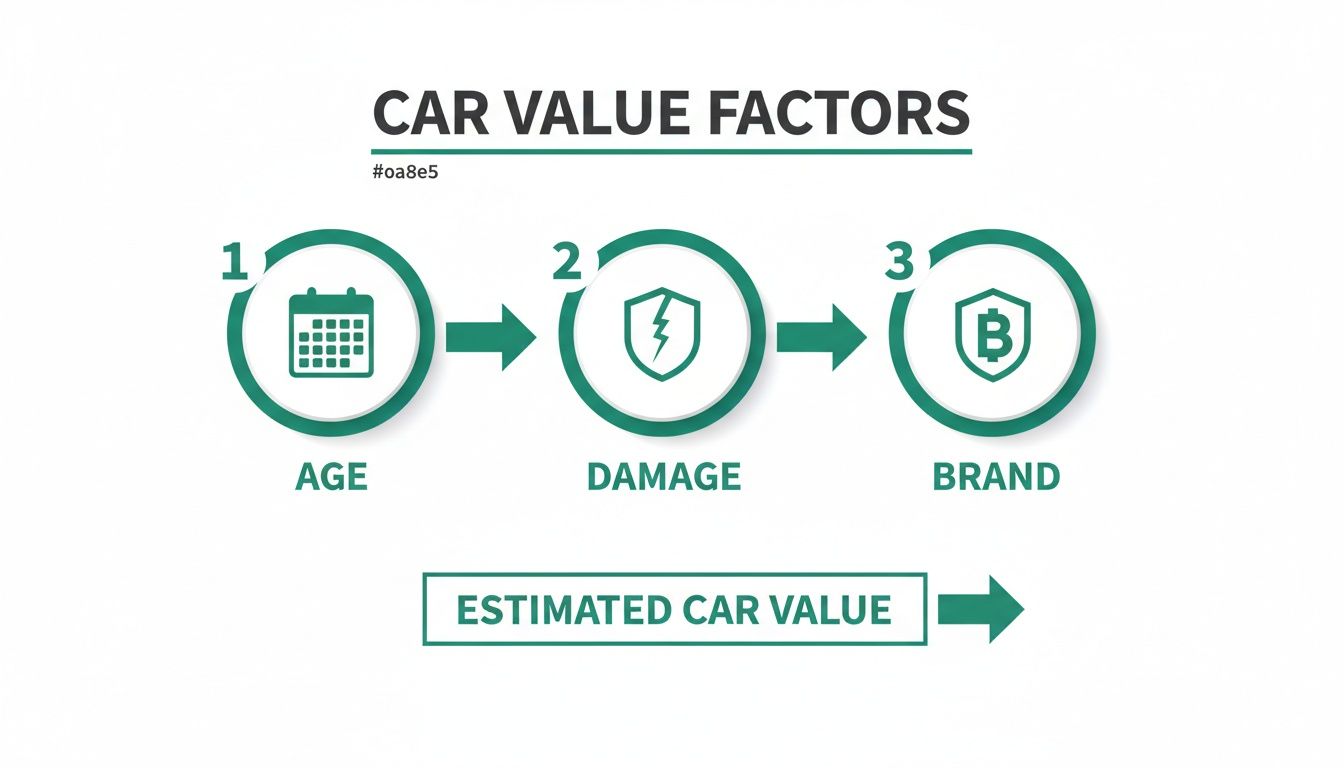
The drop in your after accident car value isn’t a random number. It’s a calculated loss based on a specific set of factors that appraisers and insurers look at closely. Understanding these variables will help you know what your claim is really worth.
Vehicle Age and Mileage
The newer your car and the fewer miles it has, the more value it has to lose. A one-year-old vehicle with only 10,000 miles has a much higher pre-accident value than an eight-year-old car with 120,000 miles.
Because of this, the diminished value hit is far more significant for a newer car. Buyers looking for premium used cars expect a clean history, and an accident record is a massive red flag that forces a steep discount.
Make and Model Popularity
The badge on the hood plays a huge role. Luxury brands, sports cars, and high-end SUVs almost always suffer a larger percentage drop in value after an accident.
Why? Buyers of these premium vehicles are extremely picky. They’re paying top dollar for performance, reputation, and perfection. An accident history—even with flawless repairs—tarnishes that image and sends those buyers looking for a different car. A common sedan will still take a hit, but the percentage drop usually isn’t as dramatic.
Severity of the Damage
The type and extent of the damage have a direct impact on your after accident car value. Was it a minor fender-bender, or a collision that required serious structural work?
- Cosmetic Damage: Scratches, dents, and bumper replacements are on the lower end of the severity scale. They still cause diminished value, but the financial impact is smaller.
- Structural Damage: If the vehicle’s frame or unibody was bent or compromised, the value loss is substantial. Frame damage raises legitimate concerns about the car’s long-term safety and integrity, even after repairs.
Any accident that adds a “structural damage” note to a vehicle history report will tank its market value. Buyers are often told to avoid these vehicles, making them incredibly difficult to sell at a fair price.
Quality of Repairs
The quality of the restoration work is another crucial piece of the puzzle. A top-notch repair job using Original Equipment Manufacturer (OEM) parts will help lessen the blow, but it won’t erase the diminished value. On the other hand, cheap, shoddy repairs will make the problem worse.
Did the body shop cut corners with aftermarket parts? Is the new paint a slightly different shade? Flaws like these create repair-related diminished value on top of the loss you already have from the accident itself.
The Vehicle’s Prior History
What did your car’s record look like before this accident? A vehicle with a squeaky-clean, single-owner history will see a much larger drop in value compared to a car that already had a previous accident on its report.
That first accident is what shatters its “clean title” reputation. While every subsequent accident adds to the negative history, that initial hit is almost always the most financially damaging.
Your Step-By-Step Guide to a Diminished Value Claim
Navigating the aftermath of an accident can feel overwhelming, but getting fair compensation for your car’s lost value is a straightforward process once you know the right steps. This guide will walk you through everything from the moment your repairs are done to filing your claim.
The key is to move past arguing with adjusters and instead present them with undeniable proof of your financial loss. The process begins once your vehicle is fully repaired, as the repair cost is crucial for assessing the drop in your after accident car value.
Step 1: Confirm Your Eligibility
First, make sure you’re eligible to file a diminished value claim. In most states, you can file a claim against the at-fault driver’s insurance policy—this is called a third-party claim.
You typically cannot file against your own insurance (a first-party claim) for diminished value, but you should always check your state’s specific laws. The other key requirement is that you were not at fault for the accident. The at-fault driver is responsible for all the damages they caused, including the permanent loss in your car’s value.
Step 2: Gather Your Essential Documents
Evidence is the lifeblood of any solid insurance claim. Before you ask for compensation, get your paperwork in order to make it difficult for an adjuster to dismiss your claim.
Here’s your document checklist:
- The Final Repair Invoice: This details the full extent of the damage and repair costs.
- Before and After Photos: Visual proof of the collision’s severity and the quality of repairs.
- The Official Accident Report: This establishes who was at fault for the crash.
- Your Vehicle’s Pre-Accident Value: Use a trusted source like Kelley Blue Book to set a clear baseline for your car’s worth.
Step 3: Obtain a Certified Appraisal Report
This is the most critical step. An independent, certified appraisal report transforms your claim from an opinion into a data-driven, factual argument that adjusters must take seriously.
A SnapClaim report analyzes real-world market data to calculate the exact drop in your after accident car value. Without an appraisal, you’re just another number in the insurance company’s formula. With one, you’re an informed car owner armed with hard evidence. To learn more, read our guide on diminished value claims.
Step 4: Submit a Formal Demand Letter
With your appraisal report in hand, it’s time to draft a formal demand letter to the at-fault driver’s insurance adjuster. Keep it professional and include all your supporting documents.
Your letter should clearly state:
- Your name and vehicle information.
- The basic facts of the accident and claim number.
- The specific amount of diminished value you are claiming, backed by your appraisal.
- A clear request for payment.
Step 5: Negotiate from a Position of Strength
Don’t be surprised when the insurance adjuster comes back with a lowball offer or tries to dismiss your claim. It’s a standard tactic.
Stay calm and professional. Use your certified appraisal as the anchor for the negotiation. When they give you a low offer, politely reject it and point them back to the market data in your report. For a full walkthrough on getting your car’s lost worth back, see this guide on how to file a diminished value claim.
Remember, you aren’t just asking for money—you’re presenting solid proof of a real financial loss. Following these steps helps you build a case that’s tough to ignore.
How a Certified Appraisal Unlocks a Fair Settlement
Trying to argue with an insurance adjuster using a flawed formula is a losing battle. They rely on their internal calculations to generate a lowball offer, hoping you’ll get tired and accept it.
To get a fair settlement, you have to change the game by bringing undeniable proof of your actual loss to the table.
This is where a certified appraisal becomes your most powerful tool. It’s not just a printout from a website—it’s a comprehensive, evidence-based report that insurance companies and courts are obligated to take seriously. It shifts the negotiation from their opinion to objective, verifiable facts.
The Power of Data-Driven Evidence
An independent appraisal report from SnapClaim completely flips the script. It replaces the insurer’s self-serving formulas with real-world market data and a court-accepted methodology.
A SnapClaim report is built on:
- Deep Market Analysis: We analyze sales data from your local area, showing what identical vehicles without an accident history are selling for.
- Comparable Vehicle Sales: The report points to specific examples of cars just like yours, giving concrete proof of market value before and after the damage.
- A Defensible Valuation: Every number is backed by hard evidence, creating a logical and transparent calculation that an adjuster can’t easily dismiss.
This approach proves your loss with facts, not feelings. It gives you the concrete evidence you need to challenge a low settlement and fight for the fair after accident car value you’re owed. You can learn more about making sense of these documents in our guide on how to read an appraisal report.
Why a Certified Report Changes the Conversation
Handing an adjuster a certified appraisal immediately changes the dynamic. You’re no longer just another claimant complaining about an offer; you are an informed vehicle owner who has invested in professional validation of your loss.
A certified appraisal forces the insurer to respond to your evidence directly. They can no longer hide behind their internal formulas. If they want to dispute your claim, they must provide specific, data-backed reasons for disagreeing with the appraisal’s findings.
This is what levels the playing field. It allows you to negotiate from a position of strength, not desperation.
A Risk-Free Path to Fair Compensation
We understand that paying for an appraisal can feel like a risk, especially when you’re already dealing with repair bills. That’s why SnapClaim removes the risk with our Money-Back Guarantee.
Our promise is simple: “If your insurance recovery from the claim is less than $1,000, SnapClaim refunds the full appraisal fee — guaranteed.”
This ensures your investment in proving your claim is protected. You can pursue the compensation you deserve with total confidence, knowing you have nothing to lose. Get your free estimate today or order a certified appraisal report to strengthen your insurance claim.
Frequently Asked Questions About After Accident Car Value
Navigating a diminished value claim often brings up questions. Below are straightforward answers to the most common concerns vehicle owners have about their car’s after accident car value.
Can I claim diminished value if the accident wasn’t my fault?
Yes. In most states, you are entitled to claim diminished value from the at-fault party’s insurance company. This is because the other driver’s negligence caused your financial loss, and their insurance is responsible for making you whole—which includes compensating you for the drop in your car’s resale value.
Can I claim diminished value if the accident was my fault?
Typically, no. Standard auto insurance policies (first-party claims) are designed to cover the cost of repairs to your vehicle, not the loss of market value that occurs after an accident. The right to claim diminished value almost always rests with the not-at-fault party in a collision.
How long do I have to file a diminished value claim?
Every state has a legal deadline for filing property damage claims, known as the statute of limitations. This window is typically two to three years from the date of the accident. It’s critical to act quickly, as gathering evidence and negotiating with an insurer takes time. Missing the deadline means losing your right to recover any compensation.
Is an appraisal worth it for an older car?
While newer cars often see the largest drop in value, a well-maintained older vehicle can also lose a significant amount of money after an accident. The best way to know if a claim is worthwhile is to get a data-backed assessment. A free estimate can quickly show you the potential loss, helping you decide if a full certified appraisal makes financial sense for your situation.
About SnapClaim
SnapClaim is a premier provider of expert diminished value and total loss appraisals. Our mission is to equip vehicle owners with clear, data-driven evidence to recover the full financial loss after an accident. Using advanced market analysis and industry expertise, we deliver accurate, defensible reports that help you negotiate confidently with insurance companies.
With a strong commitment to transparency and customer success, SnapClaim streamlines the claim process so you receive the compensation you rightfully deserve. Thousands of reports have been delivered to vehicle owners and law firms nationwide, with an average of $6,000+ in additional recovery per claim.
Why Trust This Guide
This guide was reviewed and verified by SnapClaim’s auto appraisers, who specialize in diminished value and total loss disputes.
Our team continually updates every article to reflect current insurer guidelines, valuation standards, and court-accepted appraisal practices, ensuring that you’re relying on information trusted by professionals nationwide.
Get Started Today
Whether you’re challenging a low total loss settlement or proving your vehicle’s post-repair loss in value, SnapClaim makes it simple to take the next step.
Generate a free diminished value or total loss estimate in minutes and see how much compensation you may be owed.
👉 Get your diminished value or total loss appraisal now