
Your car has been repaired and it drives fine. It is still worth less than it was, because the accident is now on its history report and buyers pay less for a car that has been hit. If a Progressive driver caused the crash, that loss is theirs to cover. This guide covers who qualifies, what evidence works, how Progressive arrives at its number, and what to do when the offer comes in low.
Are You Eligible to File?
Run through this before you spend any time on paperwork.
| Factor | What it means for your claim |
|---|---|
| Who was at fault | The Progressive driver must be at fault. If you share blame, expect the payout to be reduced or refused. |
| Vehicle age | Newer cars lose the most. Under roughly seven years old is the strongest case. |
| Mileage | Low mileage for the age means more value to lose in the first place. |
| Prior history | A clean record before the crash. A car with an existing accident on file has already taken the hit. |
| Damage severity | Structural or frame work makes the case. A scuffed bumper does not. |
| Your state | Rules vary. Some states restrict third-party diminished value recovery — check yours before you build the file. |
Third-party vs. first-party, and why it matters
You file a third-party claim against the at-fault driver’s Progressive policy. That is the route that works.
Claiming diminished value from your own insurer is a different matter, and Progressive is the reason there is settled law on it. In Siegle v. Progressive Consumers Insurance Co. (Florida Supreme Court, 2002), a policyholder sued her own insurer for the value her car lost after Progressive repaired it. The court held that where a policy promises to “repair or replace with other of like kind and quality,” the insurer that completes a proper repair does not also owe money for the drop in market value. Repair and payment are alternatives, not both.
So first-party diminished value is largely a dead end. The notable exception is Georgia, where Mabry v. State Farm established that policyholders can recover diminished value from their own insurer.

How Progressive Arrives at Its Number
Insurers commonly use a capped formula called 17c, named after paragraph 17(c) of the assessment method that came out of the Mabry litigation in Georgia. It is worth seeing the arithmetic, because the problem is structural rather than a matter of the adjuster being stingy.
- Start with a 10% cap. A car worth $30,000 before the crash has its maximum possible diminished value set at $3,000 — before anything else happens.
- Apply a damage modifier. The adjuster grades the severity. Moderate damage might carry a 0.50 multiplier: $3,000 becomes $1,500.
- Apply a mileage modifier. 40,000 miles might carry 0.80: $1,500 becomes $1,200.
The offer is $1,200. Nothing in that calculation looked at what comparable cars are actually selling for near you. A car carrying documented structural damage can lose several times that at resale, and the formula has no way to see it.
This is the leverage point. You are not arguing that the adjuster applied the formula wrongly. You are arguing that the formula is not a valuation.
Building the Evidence
- Police or accident report — establishes fault, from the department that responded.
- The detailed repair invoice, not the insurer’s summary — ask the body shop for the itemised version. Severity is what drives the size of the loss.
- Photos before and after — shoot the post-repair set from the same angles as the damage photos.
- A vehicle history report — Carfax or AutoCheck showing the accident on record. This is the loss, in writing.
- Pre-accident service records — evidence the car was well kept, which raises the baseline you are measuring from.
- An independent appraisal — the number everything else supports.
Why the appraisal is the piece that matters
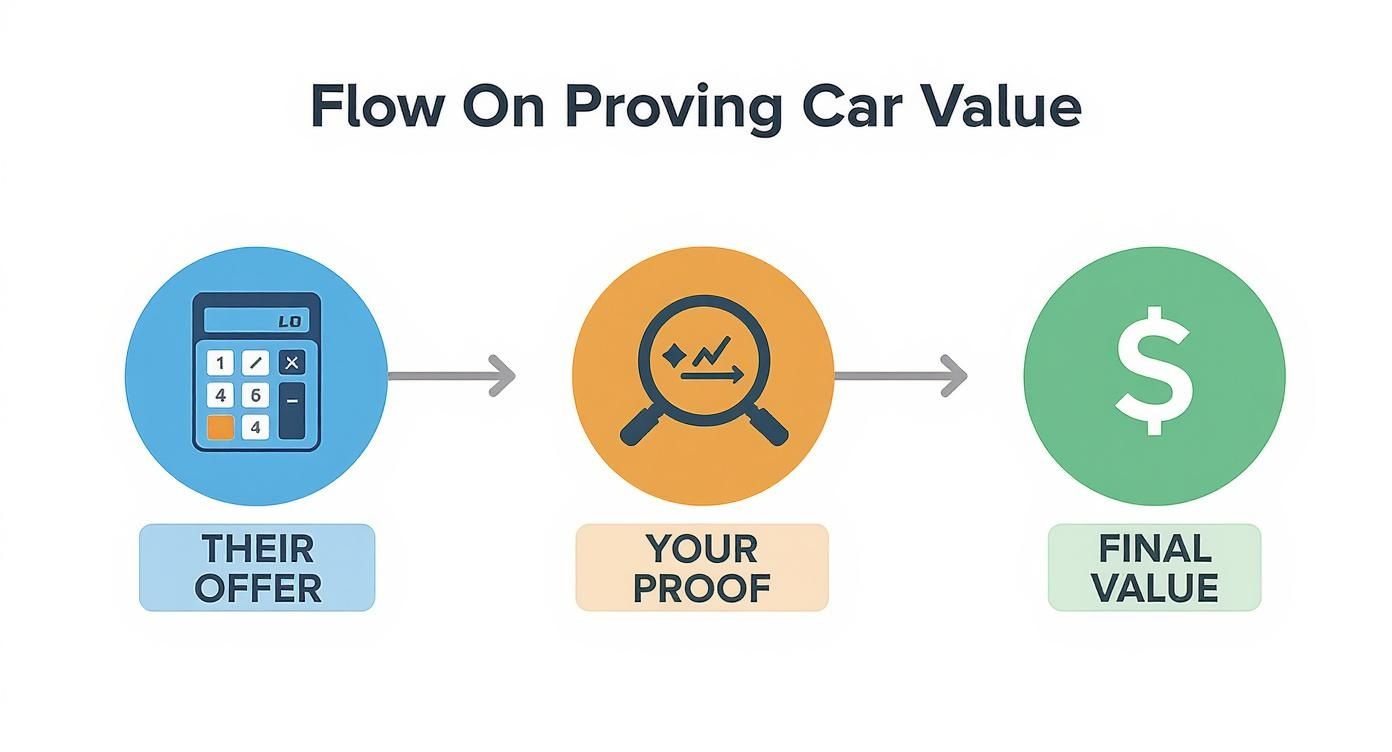
Without it, the exchange is your opinion against Progressive’s formula, and the formula wins by default. A USPAP-compliant appraisal from a certified appraiser puts comparable local sales behind your figure, which moves the burden: Progressive now has to explain what is wrong with the market data.
Get a free diminished value estimate before you commit to anything, so you know roughly what you are arguing for.
Submitting the Claim
Open the claim once repairs are finished, not before — you cannot document a loss that has not settled yet. Progressive handles claims through its online portal and its app, and uploading your demand package there creates a dated digital record you can point to later. For the demand letter itself, certified mail with return receipt is worth the extra step, because it proves when they received it.
What goes in the demand letter
- Your name, contact details and the Progressive claim number
- Date of loss, the at-fault driver’s name, and the police report number
- Your vehicle’s year, make, model and VIN
- The exact amount you are claiming, taken from the appraisal
- Copies — never originals — of the report, the repair invoice and the appraisal
- A response deadline. 15 to 30 days is reasonable and it sets a clock.
There is a full template here if you want to start from one: diminished value claim letter template.
Negotiating With the Adjuster
| What the Adjuster Might Say | How to Respond (Using Your Appraisal) |
|---|---|
| “Our 17c formula is the industry standard.” | “That formula is an internal tool and doesn’t reflect my vehicle’s specific market. This appraisal analyzes real-time sales data, which is a more accurate measure of my loss.” |
| “The car was repaired to pre-accident condition, so there’s no loss.” | “While the repairs are excellent, the vehicle now has a permanent accident history. This report proves its market value has dropped, which is a separate and recoverable loss.” |
| “We can’t rely on a report you paid for.” | “This is a USPAP-compliant report from a certified appraiser based on objective market data. I expect you to consider the expert evidence it presents.” |
| “You haven’t sold the car, so you haven’t realized a loss.” | “The loss occurred at the moment of the accident. Diminished value is the immediate drop in fair market value, regardless of when I plan to sell.” |
| “Your state doesn’t require us to pay diminished value.” | “Could you point me to the specific statute you’re referencing? My understanding is that a third-party claimant can recover all damages caused by your insured, including the loss of market value.” |
One question does more work than any script: “Can you send me the market data you used to arrive at that offer?” A formula-derived number has no comparable sales behind it, and asking for them in writing tends to expose that quickly.
Follow every call with an email summarising what was said. If you reach a wall, say so plainly and put it in writing: “It seems we’re at an impasse. I’ll send a follow-up email summarising our discussion.” That record is what makes the next step possible.
If Progressive Denies or Stalls
- Get the denial in writing, with the specific reason. This alone resolves more claims than people expect.
- Ask for a supervisor. Adjusters have settlement authority limits; the person above them has more.
- File a complaint with your state’s Department of Insurance, which you can find through the NAIC directory. It is free, insurers must respond in writing, and saying you intend to file is sometimes enough on its own.
- Small claims court. Most diminished value claims fall under the limit, which runs roughly $5,000 to $15,000 depending on the state. You represent yourself, fees are low, and a judge weighing a certified appraisal against an internal formula is a favourable comparison. See our guide to diminished value in small claims court.
Deadlines and State Rules
Your deadline is your state’s statute of limitations for property damage, and it varies widely — commonly two to six years from the date of the accident. The clock starts at the crash, not when repairs finish.
It also changes. Florida cut its negligence limitations period from four years to two for claims accruing on or after 24 March 2023, so older guidance found online is now wrong for Florida drivers. Check your own state’s current limit rather than relying on a general range, and if your accident was in Florida see our Florida Progressive diminished value guide. Our state-by-state diminished value laws page covers the rest.
This is general information, not legal advice. For anything turning on your state’s law, speak to an attorney licensed there.
Frequently Asked Questions
Can I file a diminished value claim if I caused the accident?
Almost always no. Diminished value is recovered through a third-party claim against the at-fault driver’s insurer. Your own collision coverage pays to repair the car, not to compensate you for its drop in market value — a point the Florida Supreme Court settled in Siegle v. Progressive (2002). Georgia is the main exception.
How long do I have to file my claim?
It is set by your state’s statute of limitations for property damage, commonly two to six years from the date of the accident. It does change — Florida cut its negligence period to two years for claims accruing on or after 24 March 2023. Check your state’s current limit rather than a general range.
Will filing a diminished value claim make my own insurance rates go up?
A third-party claim is made against the at-fault driver’s Progressive policy, not your own, so it is not a claim on your record. The accident itself may still affect your premium depending on your state and carrier, but the diminished value demand is separate.
Can I file a claim if my car is leased or financed?
Yes, and you should. An accident on the record lowers trade-in and resale value, which can leave you owing more on the loan than the car is worth. On a lease it can turn into excessive wear-and-tear charges at the end of the term. Note that on a lease the titleholder is the leasing company, so check who has standing to claim before you file.
Do I need a lawyer for a diminished value claim?
Usually not. Most claims are settled directly with a certified appraisal and a clear demand letter. Consider an attorney if the vehicle is high-value, the damage was structural, or Progressive is refusing to communicate or using obvious delay tactics.
What if Progressive denies my claim outright?
Request the denial in writing with a specific reason. That single step gives you something concrete to rebut and creates the paper trail you will need if you escalate to a supervisor, your state’s Department of Insurance, or small claims court.
About SnapClaim
SnapClaim is a premier provider of expert diminished value and total loss appraisals. Our mission is to equip vehicle owners with clear, data-driven evidence to recover the full financial loss after an accident. Using advanced market analysis and industry expertise, we deliver accurate, defensible reports that help you negotiate confidently with insurance companies.
With a strong commitment to transparency and customer success, SnapClaim streamlines the claim process so you receive the compensation you rightfully deserve. Thousands of reports have been delivered to vehicle owners and law firms nationwide, with an average of $6,000+ in additional recovery per claim.
Why Trust This Guide
This guide was reviewed and verified by SnapClaim’s auto appraisers, who specialize in diminished value and total loss disputes. Our team continually updates every article to reflect current insurer guidelines, valuation standards, and court-accepted appraisal practices, ensuring that you’re relying on information trusted by professionals nationwide.
Get Started Today
Whether you’re challenging a low total loss settlement or proving your vehicle’s post-repair loss in value, SnapClaim makes it simple to take the next step. Our certified reports provide the proof you need to negotiate fairly.
And remember our Money-Back Guarantee: If your insurance recovery from the claim is less than $1,000, SnapClaim refunds the full appraisal fee — guaranteed.