


Yes, you absolutely can—and should—negotiate an insurance payout. The initial settlement offer from an adjuster is just that: an offer. It’s their starting point, not the final word, and it’s almost always lower than what your vehicle is actually worth.
Understanding how to effectively counter this first offer is the key to recovering the compensation you rightfully deserve, whether your car is a total loss or just needs repairs. This guide will walk you through the process step-by-step.
Why Your First Insurance Offer Is Just a Starting Point
Here’s a hard truth: for a totaled car, initial offers can come in significantly below fair market value. Insurers are businesses, and their goal is to close claims quickly while minimizing their costs. That lowball number is a calculated business decision.
To prepare your counteroffer, you need to understand two key concepts that determine what you’re really owed:
- Fair Market Value (FMV): This is what your car was worth on the open market the moment before the accident happened. It’s the foundation of any insurance total loss payout.
- Diminished Value (DV): This is the permanent loss in your car’s resale value after it’s been perfectly repaired. An accident on its record means a future buyer simply won’t pay as much, and you deserve to be compensated for that loss.
Understanding the Insurer’s Mindset
Think from the adjuster’s perspective. They handle a massive caseload and rely on standardized software to value your car. This software often misses the mark—it can’t account for your recent tire upgrade, the pristine condition you kept it in, or what similar cars are actually selling for in your city.
Their primary goal is to settle the claim efficiently. The first offer is designed to be just tempting enough that many people will take it and walk away, no questions asked.
Key Takeaway: An insurer’s initial offer isn’t a final decision; it’s an invitation to negotiate. By treating it that way, you immediately put yourself back in control of the claim.
The negotiation process, when backed by evidence, can significantly change the outcome of your insurance claim.
Insurer’s Initial Offer vs. Negotiated Payout
| Claim Stage | Insurer's Perspective | Your Goal |
|---|---|---|
| Initial Offer | Close the claim fast with a low payout based on their software. | Recognize this is a starting point, not the final number. |
| Your Counter | Expects you to accept. May be surprised by a well-researched rebuttal. | Present a detailed counter-demand with market-based evidence. |
| Negotiation | Aims to meet somewhere in the middle, still below true value. | Use your appraisal report to anchor the discussion to real data. |
| Final Payout | Settle the claim with the lowest possible payment. | Secure a settlement that reflects your vehicle’s true pre-loss value. |
Pushing back with your own evidence isn’t being difficult—it’s a standard part of the process. In fact, adjusters fully expect savvy vehicle owners to come back with a counteroffer. For a detailed playbook on how to negotiate with insurance companies, this is an excellent resource to guide you.
Gathering Evidence to Build Your Counteroffer
A successful negotiation isn’t about arguing—it’s about presenting cold, hard facts the insurance adjuster can’t ignore. This is how you shift the conversation from a subjective disagreement to an objective, evidence-based discussion.
Your counteroffer needs to be built on a foundation of solid proof, forcing the insurer to justify their lowball offer against real-world data.
Proof for a Total Loss Payout
If your car is totaled, the insurance company owes you its Actual Cash Value (ACV). That’s just industry jargon for what it would cost to buy an identical replacement in your local market right now. Your job is to prove what that value truly is.
Don’t just accept generic book values from sources like Kelley Blue Book. They’re often outdated and don’t reflect the reality of your local market. Instead, you need to find comparable vehicles—or “comps.”
- Hunt for Local Listings: Scour sites like AutoTrader, Cars.com, and Facebook Marketplace for cars that are the same make, model, year, and trim level as yours. Focus on listings in your immediate area.
- Document Everything: Save screenshots of every listing. You need the asking price, mileage, condition details, and the Vehicle Identification Number (VIN).
- Factor in Your Car’s Specifics: Did you just put $800 worth of new tires on it? Have a premium sound system or a recent major service? List every upgrade and recent maintenance item that adds value. The insurer’s initial report almost certainly missed these.
As you collect documents, you might need notarization. Services from an Acceptance Agency Insurance and Notary can be helpful. Keeping your paperwork in order is a critical part of building a strong case.
Evidence for a Diminished Value Claim
If your car was repaired instead of totaled, the negotiation is over its loss in resale value. This is where a diminished value claim comes in. It’s not enough to just say your car is worth less now that it has an accident history. You need an expert to calculate and certify that loss.
The single most powerful piece of evidence you can have is an independent, certified appraisal report.
An insurer’s valuation is created by someone who works for them. A third-party appraisal from SnapClaim provides the objective, market-verified proof you need to level the playing field and get what you’re rightfully owed.
A data-driven report gives your claim instant credibility. It sends a clear message to the adjuster: my number isn’t just an opinion, it’s a professional analysis backed by real market data. It’s the proof you need to negotiate confidently.
How to Present Your Counteroffer with a Demand Letter
Once you’ve gathered your evidence, it’s time to formally present your case with a demand letter or email. This isn’t a complex legal document; it’s a clear, professional message that officially opens the negotiation and shows the adjuster you’re serious about a fair payout.
The Anatomy of an Effective Demand Letter
The goal is to be direct and professional, not emotional. Stick to the facts and let your evidence do the talking. Every solid demand letter needs just a few key components.
1. A Clear Opening Statement
Get straight to the point. Start by referencing your claim number and politely state that you are rejecting their first offer.
- Example: “I am writing in response to your settlement offer of [Offer Amount] for claim #[Your Claim Number]. After a thorough review of the market data, I cannot accept this amount as it does not reflect my vehicle’s true pre-loss value.”
2. A Summary of Your Evidence
Briefly explain the proof you’ve attached. For a total loss, mention the comparable vehicle listings. For a diminished value claim, point directly to your certified appraisal report.
- Example: “Attached, you will find [Number] comparable vehicle listings from local dealerships, which show an average market value of [Your Counteroffer Amount]. Additionally, I have included a certified appraisal report from SnapClaim that confirms this valuation.”
3. Your Specific Counteroffer
End with a clear, specific number directly supported by your evidence.
- Example: “Based on the attached evidence, a fair settlement for my vehicle is [Your Counteroffer Amount]. I am confident we can reach an agreement at this figure.”
Sending Your Letter and Creating a Paper Trail
Email is the most effective way to send your demand, as it creates an instant, time-stamped record. Send it directly to the adjuster and keep a copy for your records.
Pro Tip: From this point on, document every interaction. Note the date and time of phone calls, who you spoke with, and a summary of what was said. A clean paper trail is your safety net.
Many people don’t realize how much power they have. It’s shocking, but less than 1% of denied insurance claims are ever appealed, even though success rates for those who push back are high. As detailed in research on insurance claim statistics, this leaves billions of dollars in rightful payouts on the table. By sending a demand letter, you join the small group of owners who fight for what they’re owed.
Kicking Off the Negotiation Conversation
Once you’ve sent your demand letter, the real negotiation begins. The insurance adjuster will likely come back with tactics designed to question your claim. Staying calm and sticking to your facts is your biggest advantage.
Remember, adjusters are professional negotiators. They might question your evidence, argue your comps are invalid, or dismiss your appraisal. Don’t let it rattle you. Your job is to calmly steer every conversation back to the evidence you’ve presented.
How to Respond to Common Adjuster Pushback
Expect resistance. It’s part of the process. Here’s how to handle common arguments:
- “Your comparable vehicles aren’t a good match.” They might say the mileage or trim is wrong. Your response: “These were the closest available matches in my local market. Can you please send me the specific listings you’re using to justify your lower valuation?”
- “We don’t accept third-party appraisals.” This is a classic bluff. You can reply with, “This report was prepared by a certified, independent appraiser using court-accepted methodologies. It provides an objective market analysis that accurately reflects my vehicle’s value.”
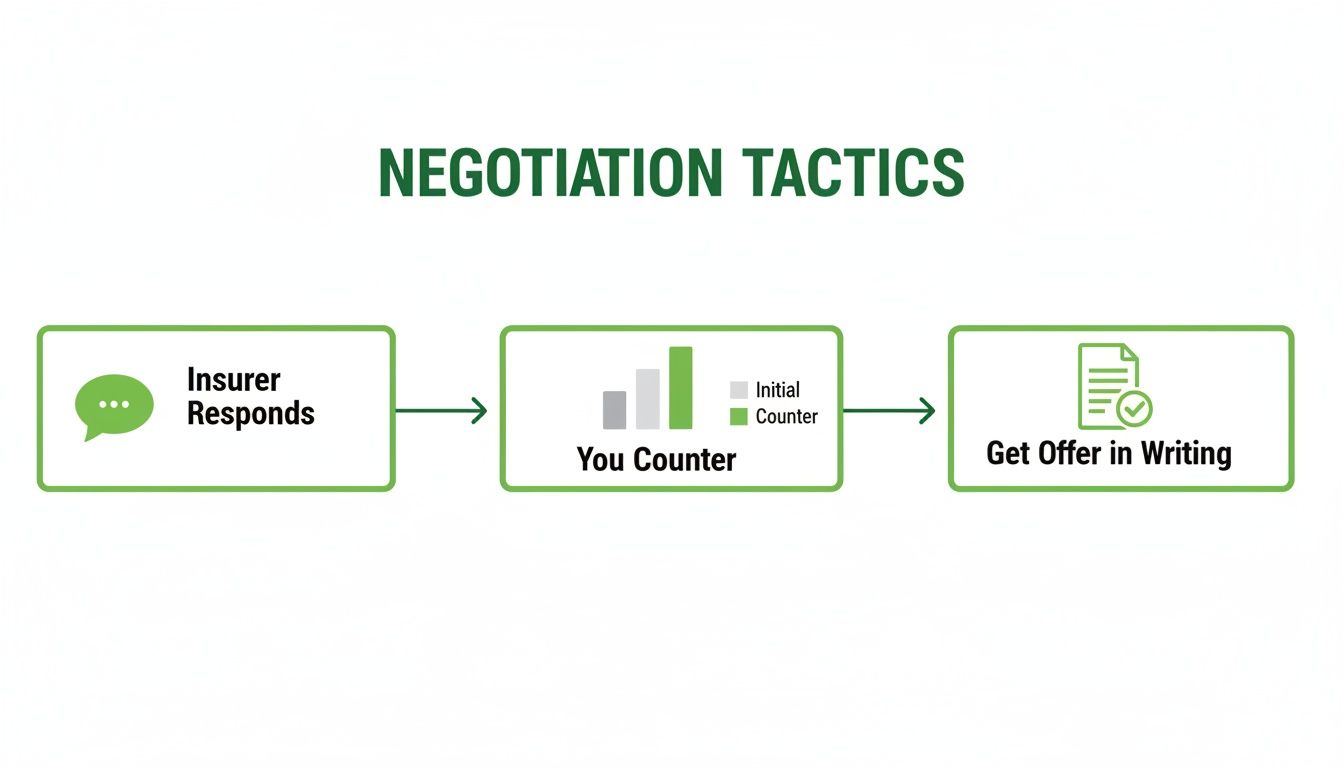
- “That’s the best we can do.” Adjusters often present a revised—but still low—offer as their “final” one. Never take this at face value. Simply state that their offer is still not supported by the market evidence and ask them to review your documentation again.
Persistence is key. The process can take several calls and emails, but your goal is to stay professional and keep pointing back to your proof. For a deeper dive, check out our guide on disputing a total loss offer for more detailed strategies.
Crucial Tip: Never accept a revised offer on the spot. Always say, “Thank you for the updated offer. Please send it to me in writing so I can review it.” This gives you time to think without pressure and creates a paper trail.
Why a Certified Appraisal Is Your Strongest Tool to Negotiate an Insurance Payout
When you negotiate an insurance payout, your most powerful asset is a certified, independent appraisal. The insurer’s valuation comes from someone on their payroll. An independent report levels the playing field with objective, data-driven evidence.
This shifts the negotiation from an argument over opinions to a factual discussion based on proof. A certified appraisal gives your claim credibility because it’s built on real-world data, not the insurer’s internal software.
From Opinion to Evidence
A professional appraisal is a detailed analysis of several key factors to determine your vehicle’s true value, whether for a total loss or a diminished value claim.
Here’s what goes into a SnapClaim appraisal:
- Real-Time Market Data: We analyze current listings for comparable vehicles in your local area, providing a realistic picture of your specific market.
- Vehicle-Specific Details: The report accounts for your car’s exact mileage, condition, trim level, and recent upgrades—details an automated system often misses.
- Dealer and Expert Insights: Our appraisers consult with dealership managers and industry experts to validate post-accident value loss, strengthening the report’s conclusions.
This detailed, court-ready report proves your counteroffer is based on expert analysis. It’s an investment in your position that forces the insurer to justify their low number against hard facts. You can learn how the appraisal process works and see for yourself.
Your Evidence vs. The Insurer’s Valuation
| Evidence Type | What the Insurer Uses | What You Should Use |
|---|---|---|
| Source | Internal valuation software (e.g., CCC, Mitchell) | Independent, certified appraiser |
| Data Basis | Historical, averaged data; often outdated | Real-time, local market data for comparable vehicles |
| Objectivity | Inherently biased to minimize their payout | Objective, third-party, and USPAP-compliant |
| Credibility | Easily challenged with external evidence | Legally defensible and court-ready |
Claimants who present data-backed counteroffers often see their payouts increase significantly. Insurers know that claimants with solid proof have high appeal success rates, which is why most cases settle before trial when faced with defensible evidence. You can discover more insights about insurance appeal statistics and see why pushing back with facts works.
A SnapClaim certified report provides the same quality of evidence that attorneys use to win cases. It’s your best tool for turning a frustrating process into a successful negotiation.
What to Do When the Insurer Won’t Budge
Most of the time, you and the adjuster will find common ground. But sometimes, you hit a brick wall. The adjuster won’t offer a reasonable amount for your insurance total loss payout or diminished value claim, and you may feel out of options.
You’re not. Knowing what to do next shows the insurance company you won’t be pushed into accepting a lowball final offer.
Invoke the Appraisal Clause
Your first and most powerful move is to invoke the appraisal clause in your auto insurance policy. Nearly every policy has one, and it’s a built-in dispute resolution tool designed for arguments over your car’s value.
When you invoke the clause, you take the decision out of the adjuster’s hands. The process is straightforward:
- You hire your own independent appraiser.
- The insurance company hires its own appraiser.
- The two appraisers then work to reach an agreement. If they can’t, they bring in a neutral third appraiser (an “umpire”) who makes the final, binding decision.
This shifts the dynamic from a negotiation with a biased party to a formal, evidence-based valuation. If you want to see exactly how to kick this off, you can learn more about invoking the appraisal clause in our detailed guide.
Know When to Consult an Attorney
While the appraisal clause usually breaks a stalemate, some situations may require legal help. The goal isn’t to start a war; it’s to protect your rights when an insurance company refuses to act in good faith. This means they have a duty to treat you fairly.
Consider talking to an attorney if you see red flags like these:
- The insurer is dragging their feet, delaying payment, or ignoring your calls and emails.
- They’re knowingly misrepresenting facts or twisting the language in your policy.
- They refuse to settle for a reasonable amount even when liability is clear.
An attorney can bring legal pressure that an individual can’t. While few claims reach this point, knowing this is an option ensures you’re ready for anything.
FAQ: Common Questions About Negotiating an Insurance Payout
Can I claim diminished value if the accident wasn’t my fault?
Yes, absolutely. If another driver was at fault, their insurance company is responsible for all damages, which includes not only repairs but also the loss in your vehicle’s resale value. This is known as a diminished value claim. Rules vary by location, so it’s wise to check your local laws on our state-specific law pages.
What if the insurer’s final offer is still too low?
Don’t panic—”final offer” is often just a negotiation tactic. If you’ve presented solid evidence and they still won’t agree to a fair insurance total loss payout, it’s time to invoke the appraisal clause in your policy. This formal process brings in independent appraisers to determine your vehicle’s value, taking the decision out of the adjuster’s hands and breaking the stalemate.
Is an independent appraisal really worth the cost?
Think of it as an investment in getting the full compensation you are owed. An independent appraisal from SnapClaim provides the unbiased, data-backed proof you need to turn the negotiation into a factual discussion about your car value after an accident. It gives your counteroffer the professional weight it needs to be taken seriously.
Plus, with the SnapClaim Money-Back Guarantee, it’s a risk-free step. If your insurance recovery from the claim is less than $1,000, SnapClaim refunds the full appraisal fee—guaranteed. It’s the smartest way to ensure you don’t leave money on the table.
About SnapClaim
SnapClaim is a premier provider of expert diminished value and total loss appraisals. Our mission is to equip vehicle owners with clear, data-driven evidence to recover the full financial loss after an accident. Using advanced market analysis and industry expertise, we deliver accurate, defensible reports that help you negotiate confidently with insurance companies.
With a strong commitment to transparency and customer success, SnapClaim streamlines the claim process so you receive the compensation you rightfully deserve. Thousands of reports have been delivered to vehicle owners and law firms nationwide, with an average of $6,000+ in additional recovery per claim.
Why Trust This Guide
This guide was reviewed and verified by SnapClaim’s auto appraisers, who specialize in diminished value and total loss disputes.
Our team continually updates every article to reflect current insurer guidelines, valuation standards, and court-accepted appraisal practices, ensuring that you’re relying on information trusted by professionals nationwide.
Get Started Today
Whether you’re challenging a low total loss settlement or proving your vehicle’s post-repair loss in value, SnapClaim makes it simple to take the next step.
Generate a free diminished value or total loss estimate in minutes and see how much compensation you may be owed.
👉 Get your Total loss or diminished value Appraisal Today