
Was your car just declared a total loss? Your insurance company likely sent you a CCC ONE Market Value Report along with a settlement offer that seems too low. Understanding this document is the first step to fighting for the fair compensation you deserve.
Think of this report as an automated estimate, not a final, unchangeable fact. It’s the primary tool insurers use to determine your vehicle’s Actual Cash Value (ACV), but it’s often filled with errors that can cost you thousands. This guide will show you how to decode your report, spot common mistakes, and build a strong case for a higher payout.
What Is a CCC ONE Market Value Report?
When an insurer declares your car a total loss, they are required to pay you its fair market value from the moment right before the accident. To calculate this amount, they use software platforms like the one from CCC Intelligent Solutions. The CCC ONE Market Value Report is the document this system produces.
It’s crucial to understand that this is not an unbiased, independent appraisal—it’s an algorithmic valuation. The software scans a large database of vehicle listings and sales data, selects a few cars it considers “comparable” to yours, and calculates a value based on them. The process looks official, but it is far from perfect.
Why Accurate Data is Crucial
The used car market is constantly changing. Vehicle values can shift dramatically due to supply chain issues, changing consumer tastes, or economic trends. For example, a popular SUV model might see a sudden spike in demand, increasing its value in your local market.
Because of this volatility, the data feeding the CCC ONE algorithm must be recent, local, and perfectly accurate. If the data is flawed, the valuation will be too. You can learn more about how market trends impact car values in our detailed guide.
Why This Report Is Your Starting Point for Negotiation
Understanding the CCC ONE report is your most important step toward getting a fair insurance total loss payout. While it may look objective, its conclusions are only as reliable as the data behind them.
Keep these three key points in mind:
- It’s an opening offer. This report is where the negotiation begins, not where it ends.
- Mistakes are common. We consistently find reports with the wrong trim package, missing options, or “comparable” cars that are in worse condition or located hundreds of miles away. These errors almost always benefit the insurer.
- You have the right to challenge it. Never simply accept the number they provide. You can, and should, question their valuation and provide your own proof of a higher value.
This guide will walk you through how to analyze your report, identify common errors, and build a solid case for the money you are rightfully owed.
How Your CCC ONE Market Value Report Is Calculated
When an adjuster processes your total loss claim, they don’t guess your car’s value. They rely on software like CCC ONE to generate a number. Understanding how this system works is key to disputing a low settlement offer.
The process starts when the adjuster inputs your vehicle’s information—like the VIN, mileage, and their assessment of its pre-accident condition—into the system. The CCC ONE algorithm then searches a massive database for what it considers “comparable vehicles” or “comps.” These comps form the entire basis for your car’s valuation.
This is a simplified look at how the CCC ONE process works.
As you can see, the final report is the result of an automated system. This means the valuation is only as good as the input data and the software’s programming—and this is where problems often arise.
The Flaw in “Comparable” Vehicles
In theory, using comps sounds fair. In practice, the way CCC ONE selects them often drives your settlement value down. The software is programmed to find matches, but its definition of “comparable” can be loose and almost always seems to work in the insurance company’s favor.
Here are a few common issues with the comps they choose:
- Geographic Mismatches: The report may use cars from dealerships hundreds of miles away, where market conditions and prices are completely different from your local area.
- Incorrect Features: Your car may have a premium sound system, sunroof, and leather interior, but the comps used are base models. These missing options can devalue your vehicle by thousands.
- Lower-Than-Market Prices: The algorithm often appears to favor vehicles with the lowest asking prices, even if they aren’t true matches for your car’s condition or trim level.
How Adjustments Reduce Your Payout
After selecting comps, the software applies “adjustments” to account for differences in mileage, options, and condition. An adjustment is a dollar amount—positive or negative—added to a comp’s price to make it more like your vehicle. For instance, if your car has lower mileage than a comp, a positive adjustment should be made.
The problem is that these adjustments are often subjective and used to systematically lower the final value. Minor scratches or normal wear and tear can trigger large negative condition adjustments. Insurers also consider a car’s roadworthiness, often verified by its official state inspection status. Each small deduction chips away at your settlement, turning an objective process into a one-sided negotiation.
This is why it’s so important to understand your car’s true value before accepting an offer.
CCC ONE Report vs. Independent Appraisal
It’s helpful to see the differences side-by-side. The CCC ONE report is the insurer’s tool, while an independent appraisal is your tool.
| Feature | CCC ONE Market Value Report | SnapClaim Independent Appraisal |
|---|---|---|
| Purpose | To generate a value for the insurer, often aimed at minimizing payout. | To determine the fair, unbiased market value for the vehicle owner. |
| Method | Automated algorithm using a proprietary database of dealer listings. | Certified appraiser analysis using real-world market data (NADA, KBB, local listings). |
| Comparables | Often uses geographically distant or poorly matched vehicles (wrong trim/options). | Focuses on hyper-local, closely matched vehicles to reflect the true replacement cost. |
| Adjustments | Subjective, often negative adjustments for minor wear and tear. | Objective, USPAP-compliant adjustments based on industry standards. |
| Bias | Inherently biased toward the insurance company’s financial interests. | Independent and unbiased, representing only the vehicle owner’s interests. |
| Credibility | Often challenged and disputed by consumers and attorneys. | Court-ready, USPAP-compliant, and accepted as expert evidence in negotiations. |
A CCC ONE report is a starting point for the insurer’s negotiation, not the final word. An independent appraisal gives you the evidence needed to negotiate fairly and demand what you’re truly owed.
Spotting Common Errors in Your CCC ONE Market Value Report
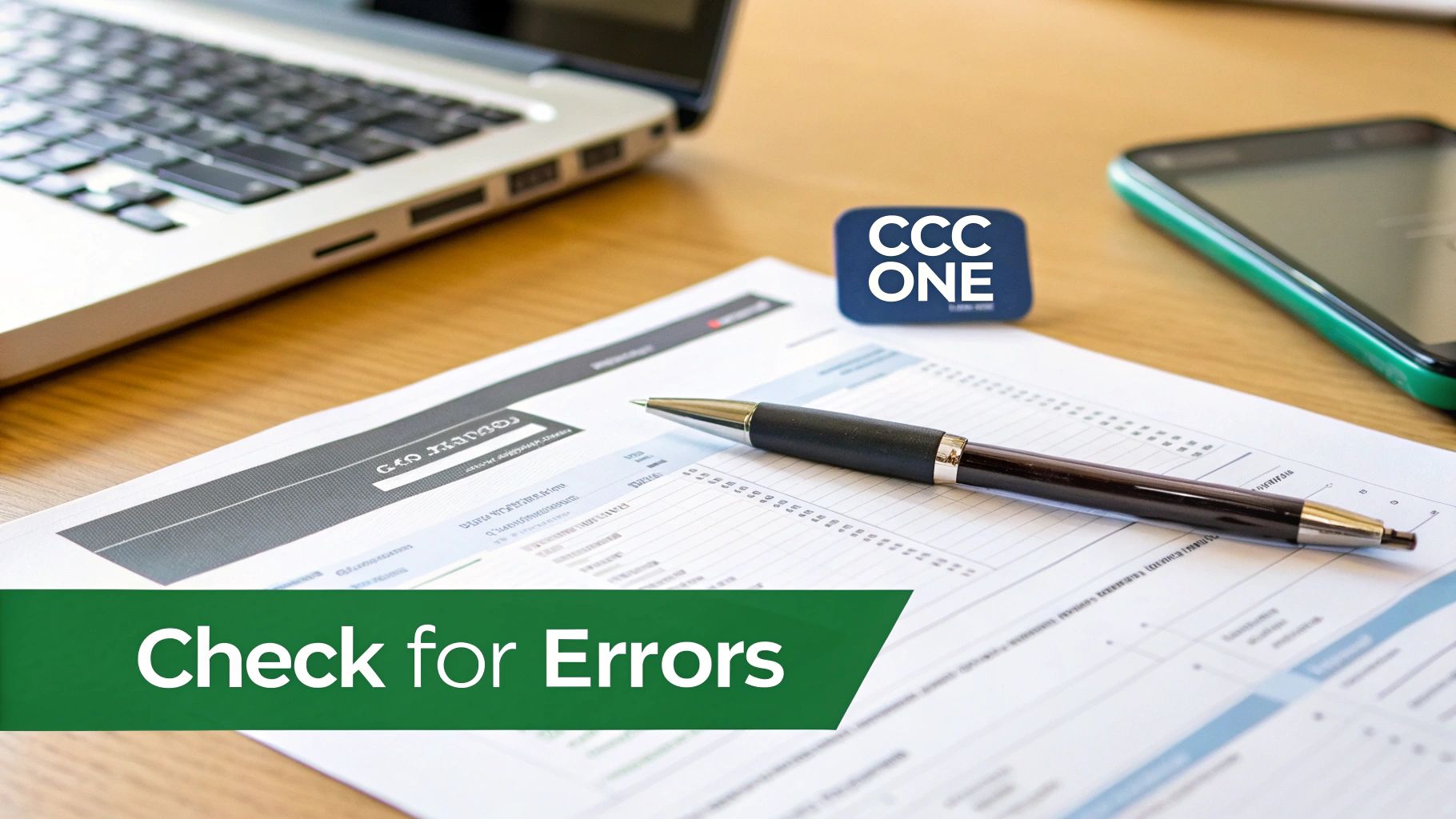
Treat your CCC ONE market value report as the insurance company’s opening bid, not the final decision. Although it looks official, it’s an automated valuation that is often filled with errors that can lower your payout. Knowing where to look is your best defense.
The good news is you don’t need to be an auto expert to find these mistakes. Most red flags fall into a few common categories. By learning what to look for, you can challenge an unfair insurance total loss payout with confidence.
Incorrect Vehicle Options and Trim
This is the most frequent and costly mistake we find. The CCC ONE system often defaults to a base model, ignoring valuable upgrades and packages your vehicle had. Every missed feature is money the insurer keeps.
For example, did your car have a premium technology package, sunroof, and leather seats? The report might value it as a basic model with cloth seats. This difference could easily be worth $2,000 or more.
Check for these commonly missed features:
- Premium Packages: Such as a sport, technology, or towing package.
- Upgraded Wheels & Tires: Custom or factory-upgraded wheels are almost always overlooked.
- Advanced Safety Features: Blind-spot monitoring and adaptive cruise control add real value.
- Engine Type: It’s surprisingly common for a V8 to be misidentified as a V6, or a turbo model as a standard engine.
Unfair Condition Adjustments
The adjuster assesses your vehicle’s pre-accident condition, and the CCC report subtracts money for any noted “flaws.” The problem is these adjustments are highly subjective. Normal wear and tear, like minor scuffs on interior plastic, should not lead to large deductions on a vehicle of its age.
Real-World Example: We’ve seen adjusters deduct $500 for “excessive interior wear” on a five-year-old family SUV, even when its condition was normal for its mileage. This is often a tactic used to lower your payout.
Flawed Comparable Vehicles
The entire valuation rests on the “comparable” vehicles the report uses. Unfortunately, these “comps” are often deeply flawed. An insurer might use comps from hundreds of miles away in a different market where car values are lower. A car sold in a rural area doesn’t have the same market value as the same car sold in a major city.
Beyond location, check if the comps are true “apples-to-apples” comparisons. A vehicle with a branded title (like salvage or rebuilt) is not a fair comparable for a car with a clean history. If you see comps that don’t match your car’s location, history, or features, you’ve found a major red flag.
To learn more about what determines your car’s value, check out our complete guide to understanding total loss claims.
How to Read Your CCC ONE Market Value Report Line by Line
At first glance, a CCC ONE market value report can seem confusing. It’s dense with codes, tables, and industry jargon. This complexity often makes it harder for you to find flaws in the insurer’s logic—or their settlement offer.
This section is your guide to translating the report. We’ll walk through the key areas to focus on, because understanding this document is the most important step in building your counter-offer. Once you break it down, you’ll see exactly how they calculated their valuation and where they went wrong.

Every detail, from your car’s options to the “comparable” vehicles chosen, directly impacts the final dollar amount. Let’s decode it together.
Verifying Your Vehicle’s Details
Start with the summary page, where the report lists your vehicle’s specifications. This is where many costly mistakes happen. Check every single line item carefully against what your car actually had.
- Vehicle Identification Number (VIN): Is it 100% correct? A single wrong digit could pull data for an entirely different car.
- Trim Level and Options: Did they list your car as a base model when it was the fully loaded premium version? Make sure every feature is there—from the sunroof and leather seats to the upgraded sound system.
- Mileage: Double-check that the mileage is accurate as of the date of the accident.
- Condition Rating: Find the pre-accident condition grade (e.g., “Average” or “Dealer Ready”). This subjective rating is a primary tool adjusters use to reduce value.
Analyzing Comparables and Adjustments
Next is the core of the report: the list of comparable vehicles and the adjustment grid. This is where the insurance company builds its case. The CCC system selects several “comps” and then applies adjustments—adding or subtracting money—to account for differences between those cars and yours.
Look for a line item called a “Proximity Factor” adjustment. This is a common tactic. It’s a deduction they apply to comparable cars sold far from your local market. Their logic is that a distant vehicle is less relevant, but in reality, it often just serves to drag down the average value.
Pay close attention to the dollar amounts in the adjustment columns. This is where you can see how much value is being added or, more often, taken away for things like mileage and condition. When you know how to read these line items, the report stops being an intimidating document and becomes your roadmap for negotiation.
A Step-by-Step Guide to Challenging a Low Offer
You’ve found errors in your CCC ONE market value report and know the insurer’s offer is too low. Now what? Taking action is what gets you a fair settlement.
It can feel daunting to challenge a large insurance company, but it’s a manageable process if you follow a clear plan. This guide provides the exact steps to build a powerful, evidence-backed case to get the money you deserve.
First, demand the full report from your adjuster, not just the summary page. You have a right to see all the data they used. Once you have it, it’s time to build your counter-offer.
Gather Your Own Evidence
Your goal is to prove their valuation is incorrect with real-world facts. The best way to do this is by finding better, more accurate comparable vehicles for sale in your local area.
Use websites like AutoTrader, Cars.com, and Kelley Blue Book to find listings that truly match your vehicle, paying close attention to:
- Year, make, and model
- Trim level and specific option packages
- Mileage (get as close as possible)
- Condition and accident history
Take screenshots or print each one. These listings are hard proof of what it would cost to replace your car on the local market today. It’s much harder for an adjuster to argue with that than your opinion.
Invoke the Appraisal Clause
What if the adjuster won’t negotiate? If you’re at a standstill, it’s time to use a powerful tool built into most auto insurance policies: the Appraisal Clause.
This provision gives you the right to hire your own certified, independent appraiser to value your vehicle. When you invoke the clause, both you and the insurer hire an appraiser. If their values don’t match, they select a neutral third appraiser (an umpire) to make a final, binding decision.
This is often a game-changer. You can learn more about how the Appraisal Clause works and how to use it to force a fair resolution.
Present a Professional Counter-Offer
Armed with your own evidence—and especially a certified independent appraisal—you are ready to submit a formal counter-offer. This is not just about asking for more money; it’s about showing them why their first offer was flawed with clear data.
Your counter-offer should be professional, organized, and data-driven. A certified report from a service like SnapClaim provides the objective proof needed to level the playing field. It changes the conversation from your word against theirs to your expert evidence against their flawed report.
A generic CCC ONE market value report can’t keep up with real-time, local market dynamics, which is why a data-driven independent appraisal is so effective in supporting your claim.
Gain Your Advantage with an Independent Appraisal
Challenging a CCC ONE market value report on your own can be difficult. The most effective tool you can use is an independent, certified appraisal. It shifts the negotiation from the insurance company’s biased algorithm to hard, market-driven facts that an adjuster cannot easily dismiss.
Unlike the CCC ONE system, which may use a broad and sometimes outdated pool of data, a SnapClaim appraisal focuses on your specific local market. We determine exactly what your car was worth, in your area, right before the accident. That is the true definition of Actual Cash Value.

Why a SnapClaim Report Is Different
Our reports are built on industry-standard appraisal practices and are designed to be defensible and court-ready. This gives you a professional valuation that helps strengthen your claim and provides the leverage you need.
An independent appraisal provides the data-backed proof you need to negotiate fairly. It moves the discussion away from the insurer’s flawed report and toward a settlement based on your vehicle’s true market value.
A SnapClaim report delivers:
- Hyper-Local Comparables: We find true “apples-to-apples” vehicle matches for sale in your immediate area.
- Certified Methodology: Our process is reviewed by licensed appraisers and follows recognized valuation standards.
- Objective Adjustments: We account for your car’s specific options, upgrades, and pre-accident condition using fair market data, not an adjuster’s subjective opinion.
This expert evidence provides the proof you need to negotiate a fair insurance total loss payout.
Frequently Asked Questions (FAQ)
Is the CCC ONE report legally binding?
No, it is not. The CCC ONE Market Value Report is the insurance company’s opening offer, not the final word. You have the right to dispute it and negotiate for a fair settlement by presenting your own evidence, such as an independent appraisal.
What if the comparable vehicles in the report are a bad match?
This is a very common issue. If you notice that the “comps” are from distant locations, have fewer options than your car, or are in worse condition, document it. Present your adjuster with better, more accurate local comps to prove your vehicle’s higher value.
Can I hire my own appraiser to get a second opinion?
Yes, and it is highly recommended. Most auto insurance policies contain an Appraisal Clause, which gives you the right to hire your own certified appraiser if you disagree with the insurer’s valuation. An independent report from SnapClaim provides the expert evidence needed to strengthen your negotiating position.
What happens if I can’t afford an appraisal?
We understand that an unexpected expense is the last thing you need. That’s why we offer a Money-Back Guarantee. If your insurance recovery from the claim is less than $1,000, SnapClaim refunds the full appraisal fee — guaranteed. This ensures you can fight for a fair settlement without any financial risk.
About SnapClaim
SnapClaim is a premier provider of expert diminished value and total loss appraisals. Our mission is to equip vehicle owners with clear, data-driven evidence to recover the full financial loss after an accident. Using advanced market analysis and industry expertise, we deliver accurate, defensible reports that help you negotiate confidently with insurance companies.
With a strong commitment to transparency and customer success, SnapClaim streamlines the claim process so you receive the compensation you rightfully deserve. Thousands of reports have been delivered to vehicle owners and law firms nationwide, with an average of $6,000+ in additional recovery per claim.
Why Trust This Guide
This guide was reviewed and verified by SnapClaim’s auto appraisers, who specialize in diminished value and total loss disputes.
Our team continually updates every article to reflect current insurer guidelines, valuation standards, and court-accepted appraisal practices, ensuring that you’re relying on information trusted by professionals nationwide.
Get Started Today
Whether you’re challenging a low total loss settlement or proving your vehicle’s post-repair loss in value, SnapClaim makes it simple to take the next step.
Generate a free diminished value or total loss estimate in minutes and see how much compensation you may be owed.
👉 Get your total loss appraisal today