

After a car accident, getting your vehicle repaired is the first step. But even with perfect repairs, the accident leaves a permanent mark on your car’s history report, hurting its resale value. This loss is called diminished value, and if you want to recover that money from the at-fault driver’s insurance, finding a qualified diminished value appraiser near me is essential.
Why Your Choice of Appraiser Is So Critical
When another driver is at fault for an accident, their insurance company is responsible for making you whole. This doesn’t just mean paying the body shop; it also means compensating you for the loss in your car’s market value.
However, insurance companies aim to minimize their payouts. They won’t voluntarily offer a fair payment for your car’s reduced value, often called the car value after accident.
This is where a certified appraiser becomes your most important ally. Without expert proof, you’re left arguing with an insurance adjuster who holds all the cards. They might offer a low, arbitrary amount or use a misleading internal formula like 17c, which is designed to justify unfairly small offers. To negotiate effectively, you need objective, data-backed evidence.
You can find diminished value appraiser near you here.
The Power of Data-Driven Proof
A professional appraisal is not just an opinion; it’s a detailed report built on real-world market data. This report provides the concrete evidence needed to strengthen your diminished value claim and compel the insurer to negotiate fairly.
While free online calculators can offer a rough estimate, they lack the credibility and in-depth analysis to hold up against an insurance company’s scrutiny.
A credible report from a service like SnapClaim provides a comprehensive analysis, including:
- Your vehicle’s specific year, make, model, mileage, and pre-accident condition.
- The severity of the damage and the quality of the repairs.
- Recent sales data for comparable vehicles in your local market.
The impact of a professional appraisal can be significant. See how settlement offers can vary based on the quality of the evidence presented.
As shown, a certified appraisal delivers a valuation that is substantially higher and more accurate than both the insurer’s lowball offer and a generic online tool. The expert you choose directly influences how much compensation you recover.
Identifying a Truly Qualified Diminished Value Appraiser Near Me
Searching for a “diminished value appraiser near me” is simple, but finding a qualified one is the real challenge. The expertise of your appraiser directly impacts the strength of your claim and your final payout.
Not all appraisers are the same. A weak, poorly researched report gives an insurance adjuster an easy reason to dismiss your claim. You need an expert who produces airtight, defensible documentation that can withstand professional scrutiny.
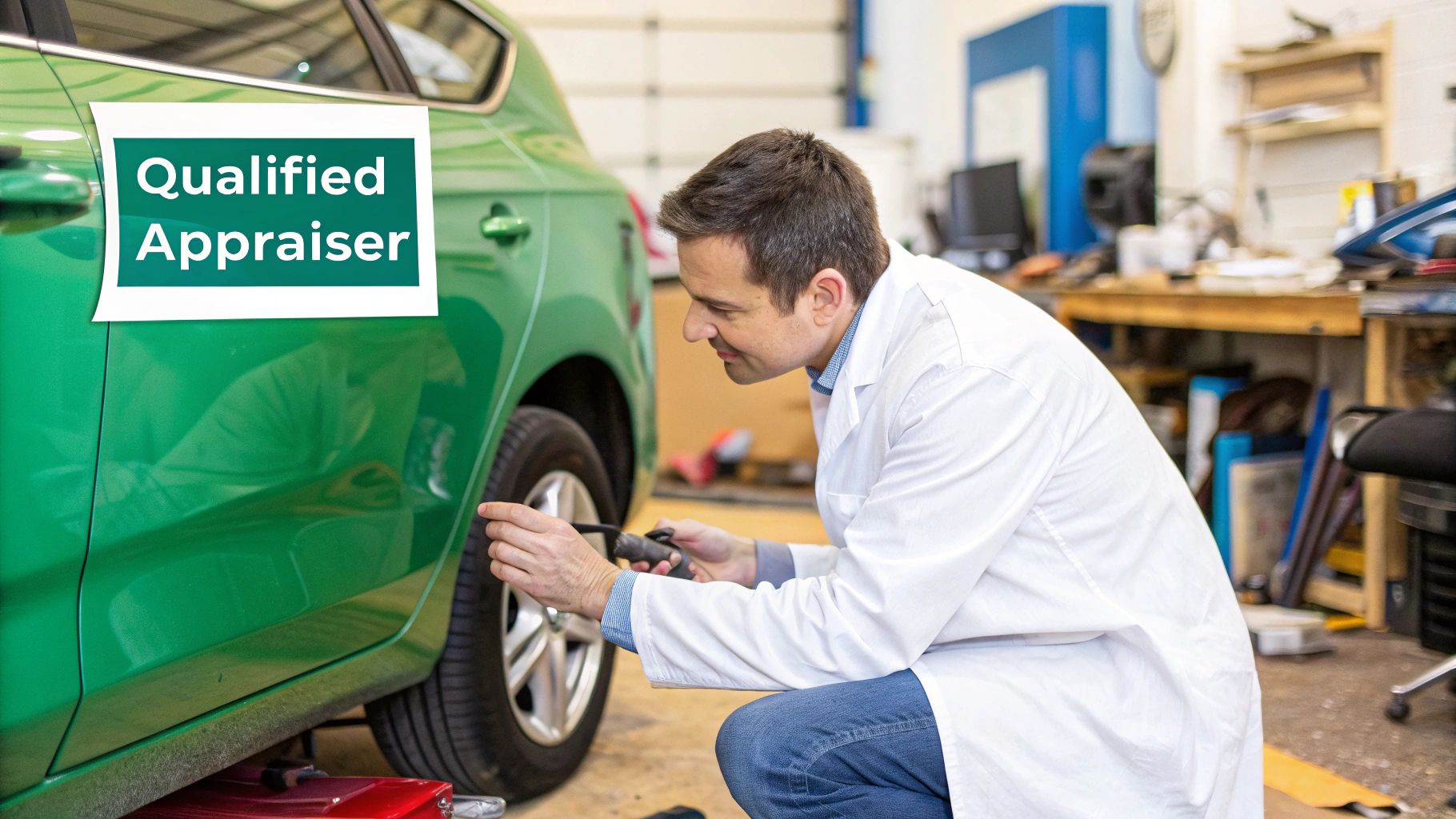
Many general auto appraisers, such as those who value classic cars, lack the specialized knowledge required for diminished value claims. You need an appraiser who specializes in accident-related valuations and understands the tactics insurance companies use to undervalue claims.
The Credentials That Matter
When evaluating a potential appraiser, focus on their specific qualifications. For example, an appraiser with a background in collision repair has a practical understanding of how accident damage affects a vehicle’s structural integrity and long-term value.
Here is a quick guide to the credentials that make a difference.
Key Credentials for a Diminished Value Appraiser
| Credential or Quality | Why It’s Important | What to Look For |
|---|---|---|
| Diminished Value Specialization | A true specialist is current on insurer tactics and legal standards in your state. | Their website should focus primarily on diminished value and total loss, not various other appraisal types. |
| Industry Certifications | Credentials from respected bodies like I-CAR prove deep knowledge of vehicle repair standards. | Look for certifications from I-CAR (the Inter-Industry Conference on Auto Collision Repair). |
| USPAP Compliance | USPAP (Uniform Standards of Professional Appraisal Practice) is the national standard for ethics and performance, making reports credible and defensible. | The appraiser must state that their reports are USPAP-compliant. This is essential. |
A report from a qualified appraiser is a piece of evidence, not just an opinion. It must be built on a solid foundation that a seasoned insurance adjuster cannot easily dismiss.
Why Methodology Is Everything
Beyond certifications, the appraiser’s methodology is the most critical factor. Many insurance companies use the flawed “17c formula,” an arbitrary calculation designed to produce a low number. A true expert will never use it.
Instead, a qualified appraiser conducts a comprehensive market analysis. At SnapClaim, our certified methodology analyzes real-time sales data for comparable vehicles in your local area. We consider your car’s pre-accident condition, mileage, and the severity of the collision damage to provide undeniable proof that challenges an insurer’s low offer.
This detailed, evidence-based approach gives you the leverage to demand fair compensation. You can learn more in our complete guide to Diminished Value.
What Exactly Is Diminished Value?
Before you can argue for the money you’re owed, it’s important to understand what you’re claiming. “Diminished value” has a few distinct types that a professional diminished value appraiser near me will analyze.
Understanding these types gives you an advantage when negotiating with the insurance company.
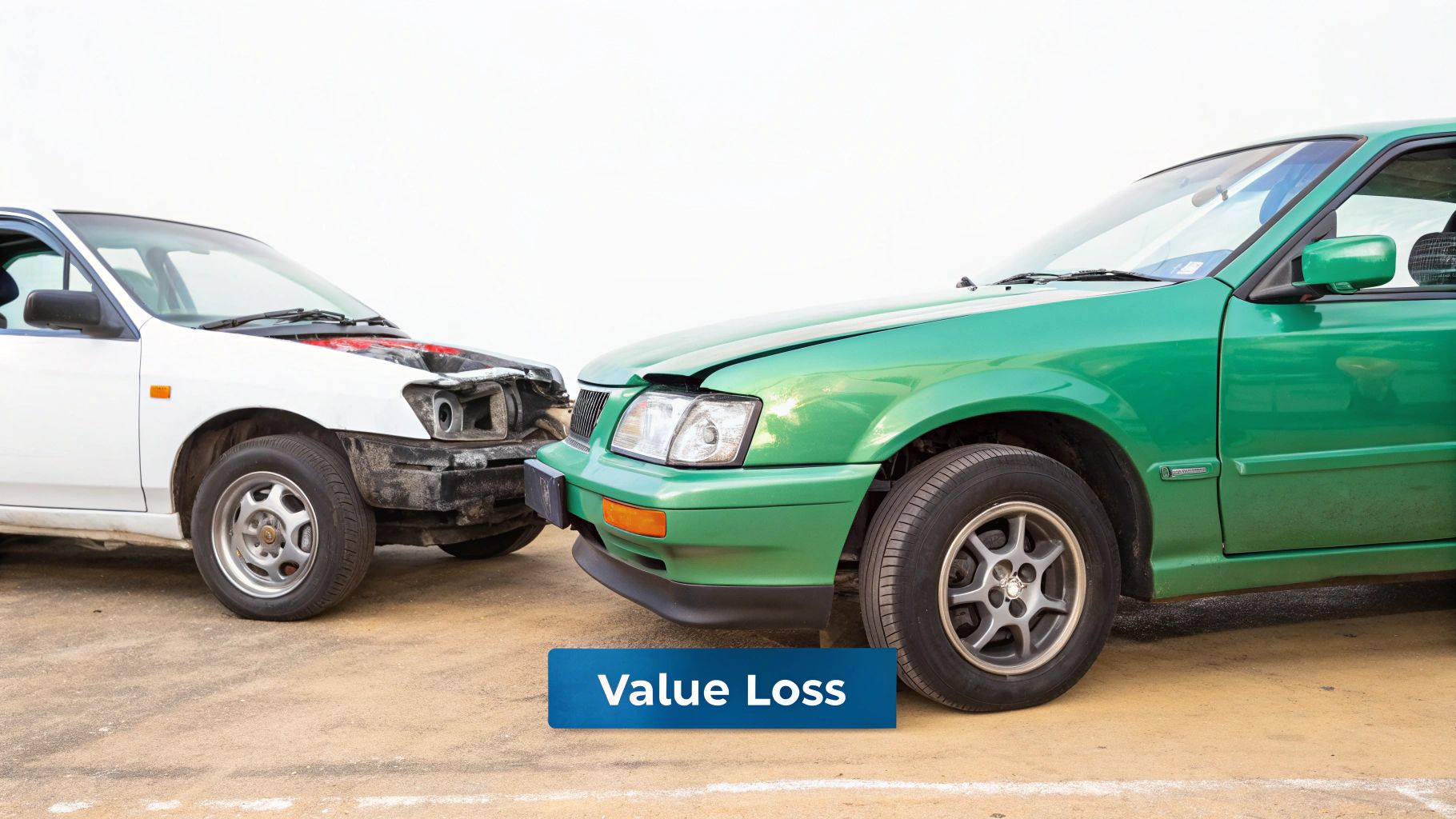
The most common type is Inherent Diminished Value. This is the automatic loss in your car’s market value simply because it now has an accident on its history report. Even with perfect repairs, your vehicle is less desirable to potential buyers.
Imagine you are a buyer looking at two identical used cars. One has a clean history, while the other has a recorded accident. Most buyers would choose the one with a clean history or demand a significant discount for the one that has been in an accident. That discount represents the inherent diminished value.
When Repairs Cause More Problems
Another critical category is Repair-Related Diminished Value. This occurs when the repairs are subpar, causing an additional financial loss on top of the value already lost from the accident history.
Common issues that cause repair-related diminished value include:
- Poor paint matching that is visible in different lighting.
- Using aftermarket (non-OEM) parts that do not fit or function as well as original factory components.
- Uneven gaps in body panels compared to the rest of the car.
- Lingering mechanical issues that were not present before the accident.
An experienced appraiser will look for both inherent and repair-related diminished value, checking for signs of structural damage, airbag deployment, and shoddy repairs. Industry professionals at companies like SnapClaim see how dealerships reduce trade-in offers by thousands for these very reasons.
A thorough appraisal documents both types of diminished value to build the strongest possible case. The accident causes the initial loss, and poor repairs compound it. Having an expert identify and assign a dollar value to these losses provides the clear evidence you need.
Curious about how much your car’s value may have dropped? Use our diminished value claim calculator to get a free, instant estimate before ordering a certified report.
Crucial Questions to Ask Before Hiring an Appraiser
Hiring a professional is an investment in your claim’s success. Before committing, ask the right questions to ensure you are partnering with a true expert.
Think of it as a job interview. Their answers will reveal their ability to help you secure a fair settlement. A competent appraiser will welcome your questions with clear, confident answers.
Vetting Your Appraiser
Start by asking about their methodology, as it is the foundation of their valuation.
- “What methodology do you use to calculate diminished value?” If they mention the “17c formula,” move on. This is an outdated, insurer-friendly calculation. A credible expert will describe their market analysis process, which compares your repaired vehicle to similar sold vehicles in your specific area.
- “Are your appraisal reports USPAP compliant?” The only acceptable answer is a confident “yes.” USPAP is the national standard for ethical guidelines in the appraisal industry, and non-compliant reports are often dismissed by insurers.
- “Do you have experience dealing with [Your Insurance Carrier]?” An appraiser familiar with your insurance company’s tactics will be better prepared to counter their arguments and build a report that addresses common objections.
Finally, discuss their track record and the final report. A professional service like SnapClaim creates court-ready reports packed with data, giving you the leverage you need. Understanding the cost of a diminished value appraisal is also important; a quality report is an investment that often pays for itself.
Local Appraisers vs. National Digital Services
When you search for a “diminished value appraiser near me,” you will find two main options: traditional local appraisers and national, data-driven services like SnapClaim.
While a local appraiser physically inspecting your car might seem reassuring, this approach often overlooks the most important factor in a modern diminished value claim.
A hands-on inspection is good for identifying poor repairs but does little to quantify inherent diminished value—the automatic drop in value from the accident history alone. This loss is determined by market perception, not just repair quality.

Data Overcomes Opinion
The main weakness of relying solely on a local appraiser is that their report often comes down to personal opinion. When an insurance adjuster challenges it, the argument becomes subjective.
A national, data-powered service offers a more robust solution. SnapClaim’s methodology is built on a massive, updated database of vehicle sales data from your local market. We analyze real-world transactions to determine how much less a vehicle like yours sells for after an accident, providing objective proof that insurers cannot easily dismiss.
- Local Appraiser: Their report is based on a physical inspection and personal experience, making it subjective and easier for an insurer to challenge.
- National Digital Service (SnapClaim): Our report is built on comprehensive, real-time market data specific to your area. It is objective evidence that carries more weight in negotiations.
This data-backed approach is crucial. For example, a 3-year-old SUV worth $32,000 before an accident might only sell for $28,400 after repairs—a $3,600 diminished value loss. The only way to recover that loss is with hard market evidence.
The Best of Both Worlds
Today, the most effective “local” expert is one who combines deep industry knowledge with extensive, market-specific data.
A service like SnapClaim provides a more accurate and defensible appraisal because it is based on what thousands of buyers and sellers are actually doing in your area. This is the kind of evidence that helps you secure a fair settlement for your diminished value claim.
How to Use Your Appraisal Report to Win Your Claim
With a certified appraisal report, the dynamic of your claim shifts. You are no longer just asking for compensation—you are demanding it with documented, professional proof.
The burden of proof now falls on the insurance adjuster. Your report presents a clear, data-driven valuation of your loss. To counter it, they must provide an equally detailed report justifying their lower offer.
Presenting Your Case
Formally submit the appraisal report to the insurance adjuster in writing, such as via email, to create a clear record.
Keep your message professional and concise. State that you have obtained a professional appraisal to determine your vehicle’s diminished value and are submitting the report to substantiate your claim for that amount.
During discussions, be prepared to highlight key factors from the report, such as the permanent accident history on the vehicle’s record. You can also discuss the role of OEM versus aftermarket parts in vehicle repairs and how non-original parts can reduce its long-term value. A SnapClaim report supports your case with certified data, turning the negotiation from your opinion against theirs to verifiable market data against their unsupported offer.
Navigating the Negotiation
If the adjuster pushes back, stay firm. A SnapClaim report is designed to be defensible and provides the hard evidence needed to negotiate with confidence. You can review the entire process in our guide on getting a car appraisal after an accident.
And remember our promise: if your insurance recovery from the claim is less than $1,000, SnapClaim refunds the full appraisal fee — guaranteed. This makes your decision to get a certified report completely risk-free.
Frequently Asked Questions (FAQ)
Can I claim diminished value if the accident wasn’t my fault?
Yes. In most states, you can only file a diminished value claim against the at-fault driver’s insurance policy. If you caused the accident, your own insurance policy typically does not cover your vehicle’s loss in value. It’s always a good idea to check your specific state’s laws, as regulations can vary.
What should a diminished value appraisal cost?
The cost of a diminished value appraisal typically ranges from a few hundred to several hundred dollars, depending on the complexity of your claim. Think of this fee as an investment. A data-backed appraisal report helps strengthen your claim and can lead to recovering thousands more than the insurer’s initial lowball offer.
What if the insurance company ignores my appraisal report?
This is a common negotiation tactic. A well-constructed report, like those from SnapClaim, is built on solid market data and a certified methodology that is difficult to dispute. If an adjuster rejects your report, calmly ask them to provide their reasoning in writing, along with their own detailed report showing the data and methods they used to arrive at their valuation. Having a professional appraisal gives you the leverage to demand they justify their position with evidence.
Why not just use a free online diminished value calculator?
Free online calculators can provide a rough estimate, but they are not a substitute for a certified appraisal. These tools lack the detailed market analysis, vehicle-specific data, and professional credibility required to stand up to an insurance company’s scrutiny. To successfully negotiate a fair settlement for your insurance total loss payout or diminished value claim, you need a defensible report prepared by a qualified expert.
About SnapClaim
SnapClaim is a premier provider of expert diminished value and total loss appraisals. Our mission is to equip vehicle owners with clear, data-driven evidence to recover the full financial loss after an accident. Using advanced market analysis and industry expertise, we deliver accurate, defensible reports that help you negotiate confidently with insurance companies.
With a strong commitment to transparency and customer success, SnapClaim streamlines the claim process so you receive the compensation you rightfully deserve. Thousands of reports have been delivered to vehicle owners and law firms nationwide, with an average of $6,000+ in additional recovery per claim.
Why Trust This Guide
This article was reviewed by SnapClaim’s team of certified auto appraisers and claim specialists with years of experience preparing court-ready reports for attorneys and accident victims. Our content is regularly updated to reflect the latest industry practices and insurer guidelines.
Get Started Today
Ready to prove your claim? Get your free estimate today or order a certified appraisal report to strengthen your insurance claim. 👉 Get Your Free Estimate Today