

Are you staring at a lowball insurance offer after a car accident, feeling like you have no power to fight back? You know your car was worth more, but proving it can be tough. This is exactly where an independent appraisal for a car becomes your most important tool for getting a fair settlement.
An independent car appraisal is a professional, unbiased valuation that determines your vehicle’s true worth before the accident or its loss in value after repairs. It replaces the insurance company’s opinion with hard facts, giving you the leverage you need to negotiate confidently.
Understanding What an Appraisal for a Car Is
So, what is an appraisal for a car? It’s a formal report created by a certified expert that pinpoints your car’s true value. Whether your vehicle was repaired or declared a total loss, this document provides the proof you need to secure a fair payout.
There’s a critical difference between the insurance adjuster’s estimate and an independent appraisal. The adjuster works for the insurance company and aims to keep costs down. An independent appraisal is done on your behalf to determine the vehicle’s accurate pre-accident value or calculate its diminished value after repairs.
A proper car insurance appraisal is more than just a number. It’s a detailed report that includes:
- Vehicle Condition Analysis: A thorough review of your car’s pre-accident condition, including its mileage, maintenance history, and any special features.
- Local Market Data: The appraiser finds recent sales of cars just like yours in your area to establish a realistic, local market price.
- Damage Assessment: A detailed look at the severity of the accident damage and the quality of the repairs performed.
Armed with this data-driven report, you can shift the negotiation from a subjective argument to a factual discussion, empowering you to challenge a low offer and recover the money you’re owed.
Why You Need an Appraisal After a Collision
After an accident, your car is never worth the same, even with perfect repairs. This drop in value is called diminished value, and insurance companies rarely volunteer to pay for it. They will only take your claim seriously if you provide solid proof. An independent appraisal is that proof.
The stakes are even higher if your car is declared a total loss. In this case, the insurance company’s goal is to offer the lowest possible insurance total loss payout, which is often much less than what you need to buy a similar replacement vehicle.
Securing Your Fair Financial Recovery
An independent appraisal establishes your car’s true Actual Cash Value (ACV)—what it was worth on the open market right before the crash. This prevents the insurer from dictating the value and helps ensure your settlement is fair.
An appraisal isn’t just another piece of paper; it’s your most important tool for a fair financial recovery. It shifts the negotiation from the insurer’s opinion to verifiable market facts.
Even a minor collision can cause a significant financial loss. According to industry data, a vehicle with an accident history can lose 10-25% of its value. On a $30,000 car, that’s a $3,000 to $7,500 loss you might not recover without a certified appraisal. You can explore market trends from reputable sources like J.D. Power to understand how these values are determined.
Proving Your Claim with Data
A professional appraisal provides undeniable evidence for two key situations:
- For a Diminished Value Claim: It calculates the exact amount of resale value your repaired car has lost due to its accident history.
- For a Total Loss Payout: It determines the real pre-accident value to ensure your settlement offer is fair and reflects the true car value after accident.
A SnapClaim report provides the certified data needed to negotiate from a position of strength. Don’t let the insurance company undervalue your vehicle—back up your claim with proof.
Diminished Value vs. Total Loss Appraisals
After an accident, your car is either repaired or declared a total loss. The path you take determines the type of appraisal needed to secure a fair payout. While both scenarios involve valuing your vehicle, they require different reports to build a strong claim.
Diminished Value Appraisal for Repaired Cars
A Diminished Value Appraisal is used for vehicles that have been repaired after an accident. Its sole purpose is to calculate how much market value your car lost simply because it now has an accident on its record.
Even with flawless repairs, a car with a collision history is worth less to a potential buyer. That difference is your diminished value, and you have a right to claim that loss from the at-fault party’s insurance.
This flowchart shows how a professional appraisal proves your loss in value, bridging the gap between the collision and a fair settlement.

Without an appraisal, you are forced to absorb that financial hit yourself when you eventually sell or trade in your car.
Total Loss Appraisal for Wrecked Cars
A Total Loss Appraisal is needed when the repair costs exceed the car’s pre-accident value. When an insurer declares your car a total loss, they owe you its Actual Cash Value (ACV) from the moment before the crash.
Unfortunately, their first offer is often a lowball figure based on internal formulas, not what it actually costs to buy a similar car in today’s market. An independent total loss appraisal provides a data-backed report establishing your car’s true fair market value, giving you the evidence needed to negotiate a proper insurance total loss payout. Learn more in our Diminished Value and Total Loss guides.
Key Differences: Diminished Value vs. Total Loss
| Appraisal Type | Purpose | When It’s Used | What It Proves |
|---|---|---|---|
| Diminished Value | To calculate the loss in resale value on a repaired vehicle due to its accident history. | After your car has been repaired following an accident caused by someone else. | The difference in market value between your car’s pre-accident condition and its post-repair condition. |
| Total Loss (ACV) | To establish the fair market value of your vehicle before it was declared a total loss. | When the insurance company determines your car is not repairable or “totaled.” | The true cost to replace your vehicle with a comparable one, challenging the insurer’s low initial offer. |
How Professionals Calculate Your Car’s Value
A certified car appraisal isn’t based on a quick online search. It’s a methodical process that uses verifiable market data to determine your car’s true worth and present it in a clear, defensible report.
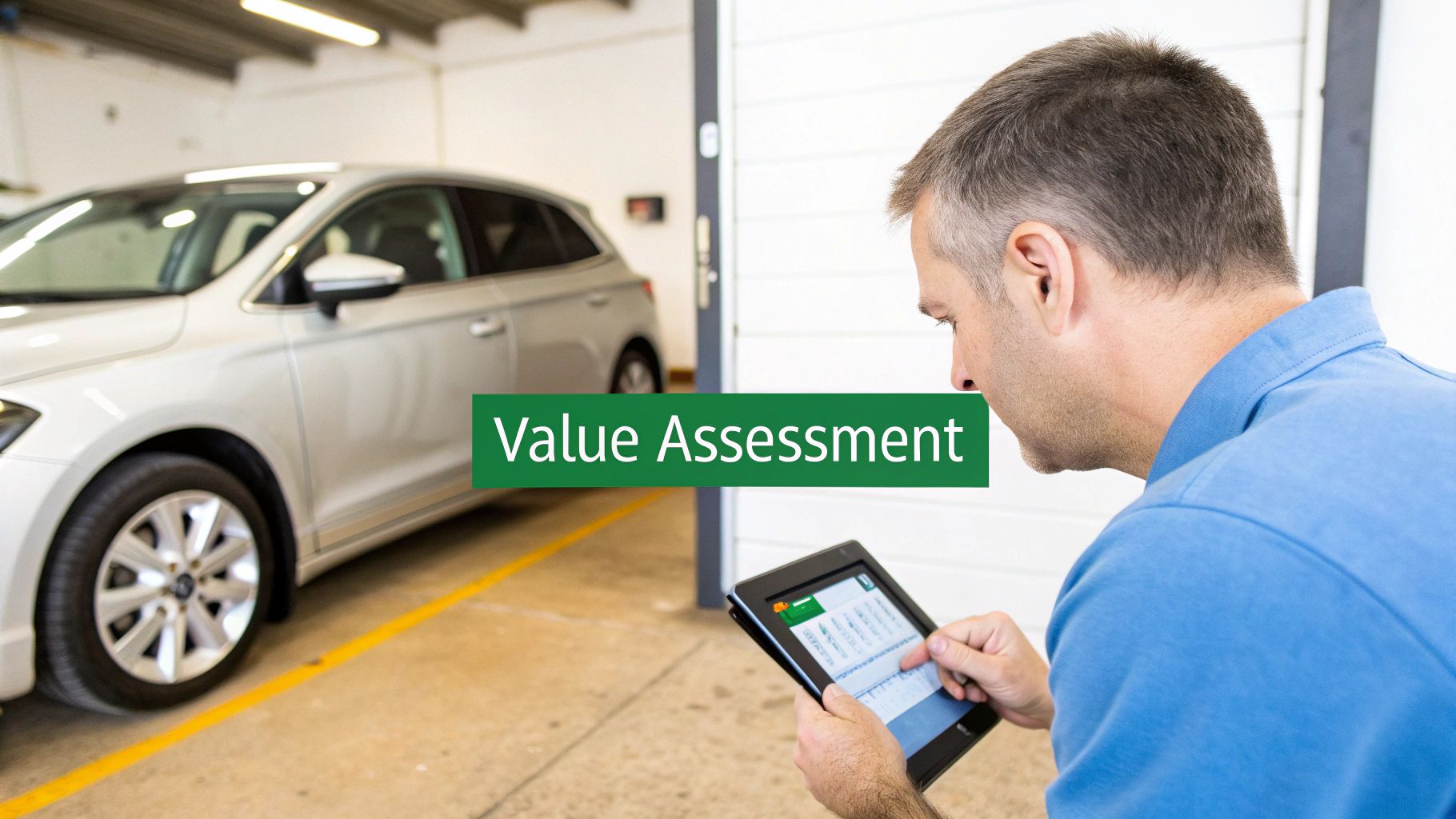
First, the appraiser documents your vehicle’s specific trim level, factory-installed options, mileage, and overall pre-accident condition. This creates an accurate baseline for the valuation.
Finding Comparable Vehicles
Next, the appraiser researches comparable vehicles (“comps”) that have recently sold in your local area. A true comp must be a near-perfect match to your vehicle.
The appraiser looks for matches in:
- Year, Make, and Model: The starting point for any comparison.
- Trim and Options: Features like a sunroof or premium sound system affect value.
- Mileage and Condition: The cars must have similar wear and tear.
- Geographic Location: A car’s value can vary significantly by region.
By analyzing what buyers in your area are actually paying for similar cars, the appraiser builds a fair market value grounded in reality, not just an insurer’s estimate.
Analyzing Damage and Repairs
For a diminished value claim, the severity of the damage and the quality of repairs are critical. An appraiser assesses how the accident’s impact and repair history will be perceived by a future buyer, as this perception directly affects the car value after accident.
SnapClaim’s certified methodology packages all these data points into a report that insurance adjusters can’t easily dismiss. To make the most of your report, learn how to read an appraisal report and confidently argue your case.
Using Your Appraisal to Negotiate a Fair Settlement

Armed with a certified appraisal, you can completely change the dynamic of your negotiation with the insurance adjuster. You are no longer just asking for more money—you are presenting market-based evidence that proves your claim is valid. The conversation shifts from opinions to objective facts.
Simply send the report to the adjuster with a letter explaining why their initial offer is insufficient. Your appraisal now serves as the foundation for your counteroffer.
A Risk-Free Path to a Fair Payout
Confidence is key in any negotiation, and SnapClaim’s guarantee provides just that. You can stand firm knowing your investment in the appraisal is protected.
Our Money-Back Guarantee: If your insurance recovery from the claim is less than $1,000, SnapClaim refunds the full appraisal fee — guaranteed.
This guarantee removes the financial risk, allowing you to challenge a low insurance total loss payout or pursue a diminished value claim without worry. If the adjuster refuses to negotiate in good faith, you can use another powerful tool: the appraisal clause. Learn more about invoking the appraisal clause in your policy.
Frequently Asked Questions About Car Appraisals
Can I claim diminished value if the accident wasn’t my fault?
Yes, absolutely. A diminished value claim is made against the at-fault driver’s insurance policy to compensate you for the loss in your vehicle’s resale value after repairs. It is a recognized loss that you are entitled to recover.
Can I get an appraisal if I was at fault for the accident?
Generally, you cannot file a diminished value claim against your own insurance policy if you were at fault. Your collision coverage is designed to pay for repairs, not the subsequent loss in market value. However, insurance laws vary by state, so it’s always wise to review your policy and check your state-specific law pages.
Who pays for an independent car appraisal?
The vehicle owner is responsible for the cost of an independent appraisal. However, think of it as an investment in your claim. A high-quality report provides the proof needed to recover what you’re truly owed, which is often far more than the appraisal fee. SnapClaim’s Money-Back Guarantee also protects your investment, ensuring you can challenge a lowball offer with confidence.
Is an insurer’s valuation the same as an appraisal?
No, they are very different. An insurance adjuster’s valuation is created to serve their employer’s financial interests—settling for as little as possible. An independent appraisal is an unbiased, third-party report from a certified expert whose only goal is to determine your car’s true fair market value using objective data.
About SnapClaim
SnapClaim is a premier provider of expert diminished value and total loss appraisals. Our mission is to equip vehicle owners with clear, data-driven evidence to recover the full financial loss after an accident. Using advanced market analysis and industry expertise, we deliver accurate, defensible reports that help you negotiate confidently with insurance companies.
With a strong commitment to transparency and customer success, SnapClaim streamlines the claim process so you receive the compensation you rightfully deserve. Thousands of reports have been delivered to vehicle owners and law firms nationwide, with an average of $6,000+ in additional recovery per claim.
Why Trust This Guide
This guide was reviewed and verified by SnapClaim’s auto appraisers, who specialize in diminished value and total loss disputes.
Our team continually updates every article to reflect current insurer guidelines, valuation standards, and court-accepted appraisal practices, ensuring that you’re relying on information trusted by professionals nationwide.
Get Started Today
Whether you’re challenging a low total loss settlement or proving your vehicle’s post-repair loss in value, SnapClaim makes it simple to take the next step.
Generate a free diminished value or total loss estimate in minutes and see how much compensation you may be owed.
👉 Get your appraisal report today