

Your car is repaired and looks fine. It is still worth less than it was, because the accident is now on its history report and buyers pay less for a car that has been hit. That gap is diminished value, and if a State Farm driver caused the crash, State Farm owes it to you. This guide walks through how to file a State Farm diminished value claim, what evidence actually moves an adjuster, and what to do when the first offer comes in low.
Why State Farm Disputes These Claims
Knowing the three arguments you are going to hear makes them much easier to answer.
“The repairs were done properly”
This is the most common opening, and it misses the point. Repair quality is not the issue. The accident record is. A buyer comparing two identical cars will pay less for the one with a collision on its Carfax or AutoCheck report, no matter how good the bodywork is.
The 17c formula
Insurers often calculate diminished value with a capped formula known as 17c, named after paragraph 17(c) of the assessment method that came out of the Mabry v. State Farm litigation in Georgia. It starts from a ceiling of 10% of the car’s pre-accident value, then applies further reductions for mileage and damage severity.
It is a formula, not a valuation. It never looks at what comparable cars are actually selling for in your market, which is why its output is usually far below the real loss.
Shifting the conversation to actual cash value
Adjusters sometimes redirect to the car’s actual cash value, which is the measure used when a vehicle is totaled. If your car was repaired rather than written off, ACV is the wrong yardstick. Say so, and bring the conversation back to market value before and after.
Does Your Claim Qualify?
Not every repaired car has a claim worth filing. Yours is strongest when it:
- Is a newer model, usually under about seven years old
- Has low mileage for its age
- Had a clean history before the crash
- Took significant damage, particularly to the frame or other structural parts
A scuffed bumper on a twelve-year-old sedan with 150,000 miles is not much of a case. A two-year-old SUV with 20,000 miles that needed a new door and quarter panel is a very different conversation.
Who you file against, and the Georgia exception
Almost always you file a third-party claim against the at-fault driver’s State Farm policy. Most auto policies do not cover diminished value on your own car, so a first-party claim against your own insurer usually goes nowhere.
Georgia is the exception that matters. Because of Mabry v. State Farm, Georgia policyholders can pursue diminished value from their own insurer. If your accident happened in Georgia, read our Georgia diminished value guide before you file — the rules there work differently.
Two kinds of lost value
- Inherent diminished value — the loss caused purely by having an accident on record, even after flawless repairs. This is what nearly every claim is about.
- Repair-related diminished value — additional loss from poor workmanship: mismatched paint, aftermarket parts instead of OEM, panel gaps, frame work that was not quite brought back to spec.
Step 1: Gather Your Evidence
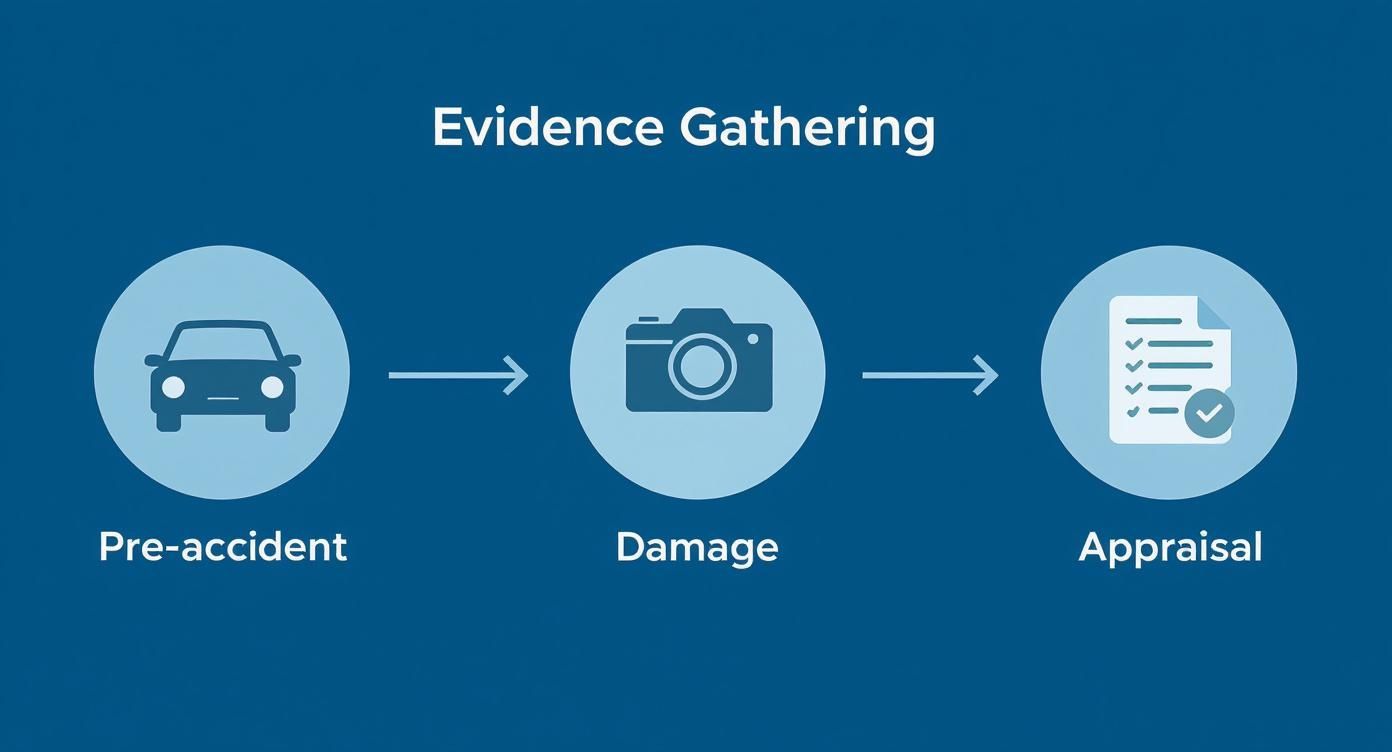
Adjusters settle on paper, not on argument. Collect these before you contact anyone.
| Document | Why it matters |
|---|---|
| Police or accident report | Establishes fault, which is the foundation of a third-party claim |
| Final repair invoice | Shows what was damaged and what it cost — severity drives the size of the loss |
| Photos, before and after | Shoot the post-repair photos from the same angles as your damage photos; the side-by-side makes the extent of the work obvious |
| Vehicle history report | Carfax or AutoCheck showing the accident is now on record — this is the loss, in writing |
| Title or registration | Confirms you own the car and have standing to claim |
| Independent appraisal | The number the whole claim rests on. See below. |
The document that decides it
Without an independent appraisal, the claim is your opinion against the adjuster’s formula, and the adjuster wins that every time. A USPAP-compliant appraisal report puts a defensible number on the loss using comparable sales from your local market, and it shifts the burden: State Farm now has to explain why the market data is wrong.
Get a free diminished value estimate to see what your loss looks like before you commit to anything.
Step 2: Submit the Claim
How to reach State Farm
- By phone: 800-SF-CLAIM (800-732-5246), open around the clock. Use it to open the claim and get a claim number — not to argue the value.
- Online: through the State Farm auto claims portal or the mobile app, which is where they prefer to handle documents.
- By certified mail, return receipt requested. Slower, and worth it for the demand package — you get a dated, verifiable record that State Farm received it.
If an adjuster asks you to complete a specific form, our guide to the State Farm diminished value claim form covers what they ask for and how to fill it in.
Your demand letter
Keep it short and factual. State the loss, attach the proof, name a number.
RE: Demand for Diminished Value
Claim Number: [Claim #]
Date of Loss: [Date]
At-Fault Party: [Name of State Farm’s insured]This letter is my formal demand for compensation for the inherent diminished value of my vehicle, a [Year, Make, Model, VIN], following the accident on [Date of Loss]. The collision was a direct result of the negligence of your insured, [At-Fault Driver’s Name].
The vehicle has been fully repaired at a cost of [$ repair total]. It now carries a permanent accident record, and an independent appraisal dated [Date] places the resulting loss in market value at [$ amount]. A copy of that report, the repair invoice and the vehicle history report are enclosed.
I am requesting payment of [$ amount] within 30 days. Please direct all correspondence in writing to the address above.
If you would rather start from a full template, we have one here: diminished value claim letter template.
Step 3: Negotiate the Offer
The first number is rarely the last one. Here is what you will hear and what to say back.
| What the adjuster says | What to say back |
|---|---|
| “The repairs restored the vehicle to pre-accident condition.” | “Repair quality isn’t what I’m claiming for. The accident is now on the vehicle history report, and that is what reduces what a buyer will pay.” |
| “Our valuation shows a much lower figure.” | “Can you provide comparable sold vehicles from my local market that support your valuation?” |
| “We don’t pay diminished value.” | “My understanding is that the at-fault party is responsible for making me whole, which includes the documented loss in resale value. Are you stating that State Farm’s position is to deny this category of property damage claim?” |
| A flat lowball offer. | “Thank you for the offer. It’s well below the [$ amount] identified in my certified appraisal, which is based on comparable vehicles in my local market. Can you explain how your valuation accounts for those sales?” |
Two habits that matter more than any script: get everything in writing, and follow up every phone call with an email summarising what was said. A paper trail is what makes escalation possible later.
If State Farm Denies the Claim
A denial is often an opening position rather than a final answer. Take it in order:
- Ask for the denial in writing, with the specific policy language it rests on. This alone resolves a surprising number of claims.
- Escalate to a claims manager. “I’m calling to request a manager review my diminished value claim, which was denied. I have professional documentation that I believe was overlooked.”
- File a complaint with your state’s Department of Insurance. Find yours through the NAIC directory. Insurers answer these in writing, and the tone usually changes once one is open.
- Consider small claims court. Most diminished value claims fall inside small claims limits, and a certified appraisal is exactly the kind of evidence these courts are built to weigh. See our guide to diminished value in small claims court.
The Law Behind Your Claim
In 2001 the Supreme Court of Georgia decided Mabry v. State Farm, holding that an insurer’s obligation is to pay the difference in a vehicle’s market value immediately before and after the loss — even where repairs are perfect. It is the case that established diminished value as real, recoverable damage, and by 2005 State Farm had paid out over $130 million in Georgia diminished value claims as a result.
Mabry binds Georgia. Elsewhere, whether and how you can recover depends on your own state’s law, which is why the state you crashed in matters as much as the carrier you are dealing with.
How long you have to file
The deadline is set by your state’s statute of limitations for property damage, and it varies — commonly somewhere between two and six years from the date of the accident. Georgia allows four. Check your own state’s limit early rather than late; the clock starts at the crash, not at the repair.
This is general information, not legal advice. For a decision that turns on your state’s law, talk to an attorney licensed there.
What an Appraisal Changes
DIY Claim vs. SnapClaim-Supported Claim
| Aspect | Filing on Your Own | Filing with a SnapClaim Report |
|---|---|---|
| Evidence Quality | Relying on online calculators or dealer quotes, which are easily dismissed by adjusters. | Presenting a USPAP-compliant report with verifiable market data and comparable sales. |
| Negotiation Leverage | Limited. The adjuster holds the power and can dictate terms based on their biased internal formulas. | Significant. The burden of proof shifts to the insurer to disprove your professionally calculated valuation. |
| Credibility | Low. Your claim may be seen as subjective, making it easy for State Farm to offer a minimal settlement. | High. Your claim is treated as a serious, professional demand backed by an accredited appraiser. |
| Typical Outcome | Often results in a lowball offer, a denied claim, or a frustrating negotiation. | Higher settlement offers that more accurately reflect the true loss in your car’s value. |
| Effort & Stress | High. You spend hours arguing and trying to justify your position with weak evidence. | Lower. The report does the heavy lifting, providing a clear, factual basis for your claim. |
Frequently Asked Questions
Can I file a diminished value claim if I was at fault?
Usually not. Diminished value is normally recovered through a third-party claim against the at-fault driver’s insurer, and most auto policies exclude diminished value on your own vehicle. Georgia is the significant exception: because of Mabry v. State Farm, Georgia policyholders can pursue diminished value from their own insurer.
How long does a State Farm diminished value claim take?
Expect an initial response within one to three weeks of submitting a complete demand package. Start to finish, most claims settle in 30 to 90 days, depending on how complex the case is and how strong your evidence is.
What should I do if State Farm denies my claim?
Ask for the denial in writing with the specific policy language behind it. That creates the paper trail everything else depends on. From there you can escalate to a claims manager, file a complaint with your state’s Department of Insurance, or take it to small claims court.
How long do I have to file?
It depends on your state’s statute of limitations for property damage — commonly two to six years from the date of the accident, with Georgia allowing four. The clock runs from the crash, not from when repairs finished.
Will filing a diminished value claim raise my insurance rates?
A third-party claim is made against the at-fault driver’s policy, not your own, so it is not a claim on your record. The accident itself may still affect your premium depending on your state and carrier, but the diminished value demand is a separate matter.
Is a certified appraisal really necessary?
In practice, yes. Without one your claim is your word against the adjuster’s formula. An independent, USPAP-compliant report puts verifiable market data behind your number and turns a request into a demand State Farm has to answer on the evidence.
About SnapClaim
SnapClaim is a premier provider of expert diminished value and total loss appraisals. Our mission is to equip vehicle owners with clear, data-driven evidence to recover the full financial loss after an accident. Using advanced market analysis and industry expertise, we deliver accurate, defensible reports that help you negotiate confidently with insurance companies.
With a strong commitment to transparency and customer success, SnapClaim streamlines the claim process so you receive the compensation you rightfully deserve. Thousands of reports have been delivered to vehicle owners and law firms nationwide, with an average of $6,000+ in additional recovery per claim.
Why Trust This Guide
This guide was reviewed and verified by SnapClaim’s auto appraisers, who specialize in diminished value and total loss disputes.
Our team continually updates every article to reflect current insurer guidelines, valuation standards, and court-accepted appraisal practices, ensuring that you’re relying on information trusted by professionals nationwide.
Get Started Today
Whether you’re challenging a low total loss settlement or proving your vehicle’s post-repair loss in value, SnapClaim makes it simple to take the next step.
Generate a free diminished value or total loss estimate in minutes and see how much compensation you may be owed.
👉 Get your free diminished value estimate today