

After a car accident, even perfect repairs can’t erase the damage history, and that history costs you money. This loss in resale value is called diminished value, and it can shave thousands of dollars off your vehicle’s worth. A skilled diminished value lawyer in Texas knows exactly how to fight for that lost value, ensuring insurance companies don’t pay you a penny less than you’re owed.
Why You Need a Diminished Value Lawyer in Texas
Insurance companies are notorious for using their own secret formulas—like the infamous “17c” method—to slash your claim’s value by as much as 70%. It’s a lowball tactic that works far too often, leaving vehicle owners shortchanged on their car value after accident.
While a typical Texas auto settlement can vary, a successful diminished value claim can add an extra $2,000–$5,000 on top of repair costs for a mid-range vehicle. That’s money you’re legally entitled to, but you often have to fight for it.
How a Lawyer Strengthens Your Claim
A skilled attorney doesn’t just ask for more money; they build an undeniable case. They gather repair invoices, expert appraisals, and real market data to prove your loss and negotiate from a position of strength.
It makes a huge difference. In one recent Texas case, a driver with $15,000 in repairs was offered a measly $1,300 for diminished value. After hiring a lawyer and getting a professional appraisal, they walked away with $3,800—a 192% increase.
An experienced lawyer brings several key advantages:
- They know how to dismantle an insurer’s flawed formulas.
- They understand the ins and outs of Texas’s comparative fault rules.
- They leverage certified appraisal reports as hard evidence to support your case.
- They have the negotiation power to force a fair settlement.
The table below shows how dramatic the difference can be. Hiring a lawyer armed with a professional appraisal report from SnapClaim can drastically change the outcome of your diminished value claim.
Claim Scenarios With and Without a Lawyer
| Scenario | Typical DIY Claim Result | Result With a DV Lawyer & SnapClaim Report |
|---|---|---|
| Minor dent and scratch repair | $500 | $2,800 |
| Major accident repairs ($12,000) | $1,000 | $4,500 |
| Luxury vehicle incident | $750 | $5,200 |
As you can see, going it alone often means leaving thousands on the table. The right professional support helps ensure insurers pay what they truly owe.
The Big Red Flags: When to Call an Attorney
So, how do you know it’s time to lawyer up? If the insurance adjuster is giving you the runaround or the offer feels insultingly low (think under $1,000), it’s time to get a professional involved.
Watch out for these classic signs that you need legal help:
- You received a flat-out denial of your DV claim.
- The settlement offer is less than $2,000.
- The insurer is dragging their feet or ignoring deadlines.
- The accident involves complex fault issues.
A skilled attorney can turn an insurer’s lowball offer into a fair settlement.
Understanding Your Diminished Value Claim
After a wreck, you’ll hear the term “diminished value,” but what does it actually mean for your wallet? Simply put, your car is now worth less money just because it has an accident on its record. Even with perfect repairs, that history is now permanently attached to your vehicle’s VIN.
Imagine you’re selling your car. An identical vehicle—same make, model, year, and mileage—is listed right next to yours. The only difference? Your car has a repaired accident on its CARFAX report, while the other one has a clean history. A smart buyer will almost always pay more for the one without the accident record.
That price gap is your diminished value. It’s a real financial loss you were forced to take because of someone else’s mistake, and Texas law says the at-fault driver’s insurance is responsible for making you whole again.
The Three Types of Diminished Value
To get a handle on your claim, it helps to know the specific ways your car can lose value. In Texas, a diminished value claim usually falls into one of three categories.
Inherent Diminished Value: This is the most common and largest part of your claim. It’s the automatic drop in value that happens the second an accident is reported. Even with flawless repairs, the car’s history is stained forever, making it less attractive to future buyers.
Repair-Related Diminished Value: This loss occurs when the repairs themselves are shoddy. Maybe the shop used cheap aftermarket parts, the new paint doesn’t quite match, or other imperfections are visible. This poor-quality work drives the value down even further.
Immediate Diminished Value: This is a more technical measurement of your car’s value right after the crash but before it’s repaired. It represents what your car was worth in its damaged, pre-repair state and is less common in claims.
For most people, the fight is all about inherent diminished value. That loss is a given, and it’s the core of almost every claim. A sharp diminished value lawyer in Texas will focus on proving this loss with hard market data.
Why This Loss Is So Significant
Don’t let an adjuster tell you this is a minor issue. An accident on a vehicle’s record can reduce its resale value by 10% to 30%, sometimes more. For example, a three-year-old SUV worth $32,000 before a collision might only fetch $28,400 on the open market after repairs. That’s a $3,600 loss you’ve suffered just because of the stigma.
Your vehicle’s accident history is a permanent financial liability. A diminished value claim is your legal right to recover that loss from the person who caused it.
Insurance adjusters often try to downplay this loss or pretend it doesn’t exist. They’ll say the car is “fully repaired,” so its value must be fully restored. But in the real world, an accident on a history report is a huge red flag that makes buyers offer less. This is why you need objective proof to shut them down.
For a deeper look at the process, check out this guide that explains what a diminished value claim entails in Texas. It breaks down the legal groundwork for getting the money you’re rightfully owed.
Navigating Critical Texas Laws and Deadlines
After an accident, the last thing you want to do is navigate legal jargon. But in Texas, a couple of key laws can make or break your diminished value claim. Getting these right is the difference between a successful claim and leaving thousands of dollars on the table.
Time is not on your side. Texas has a strict statute of limitations for property damage claims, including diminished value. This law gives you exactly two years from the date of the accident to file. If you miss that deadline, your right to compensation is gone forever.
The Two-Year Countdown
Think of it as a ticking clock that starts the moment the collision happens. Waiting too long is a gift to the insurance company, as it gives them a legal basis to deny your claim outright.
A good Texas diminished value lawyer ensures everything is filed long before this deadline becomes an issue, protecting your right to fight for what you’re owed. Don’t let the calendar rob you of your financial recovery.
Understanding Texas’s Fault Rules
Texas uses a system called “modified comparative fault,” or the 51% bar rule. It sounds complex, but it boils down to one simple idea: the amount of money you can recover depends on how much you were to blame for the accident.
Here’s how it works:
- If you are 50% or less at fault: You can claim damages from the other driver’s insurance. Your payout, however, is reduced by your percentage of fault. For example, if you’re found to be 20% responsible, a $5,000 diminished value payment would be cut by 20% ($1,000), leaving you with $4,000.
- If you are 51% or more at fault: You get nothing. The law bars you from recovering any money from the other driver.
This rule is why insurance companies fight hard to pin even a small amount of blame on you—it directly reduces how much they have to pay. For a deeper look at these rules, check out our complete guide on diminished value in Texas.
In Texas, being even slightly at fault can directly reduce your settlement amount. Protecting yourself from an unfair blame assessment is critical.
Because Texas is an at-fault state, your claim goes against the other driver’s liability insurance. State law requires every driver to carry at least $25,000 in property damage coverage, which is the pool of money your diminished value claim will be paid from. You can find more insights on Texas DV laws on ulg.law to see how these regulations shape the entire process.
How a Lawyer Proves and Wins Your Case
Winning a diminished value claim isn’t about just asking for money—it’s about building a rock-solid case that an insurance company can’t ignore. An experienced diminished value lawyer in Texas knows exactly how to dismantle an adjuster’s lowball arguments and secure the settlement you deserve. They turn your simple request into a professional, evidence-backed legal case.
The entire process kicks off with a deep dive into your case file. Your attorney will comb through every document, from the police report to the final body shop invoice. They’re hunting for the critical details—like the severity of the impact and the nature of the repairs—that form the foundation of a strong claim.
Gathering the Essential Evidence
Evidence is everything. Your lawyer basically becomes a detective, collecting all the proof needed to show your car’s value took a nosedive. This isn’t just a random stack of papers; it’s a curated set of facts that paints a clear picture of your financial loss.
Key evidence always includes:
- The Official Police Report: This document is crucial for establishing who was at fault in the accident.
- Photographs of the Damage: Nothing shows the pre-repair condition of your vehicle better than clear photos.
- Itemized Repair Invoices: These detail every single part replaced and every hour of labor, proving the severity of the damage.
- Vehicle History Reports: A clean pre-accident report is powerful proof that the accident is the sole reason for the drop in value.
This infographic breaks down the key legal hurdles a lawyer helps you clear under Texas law.
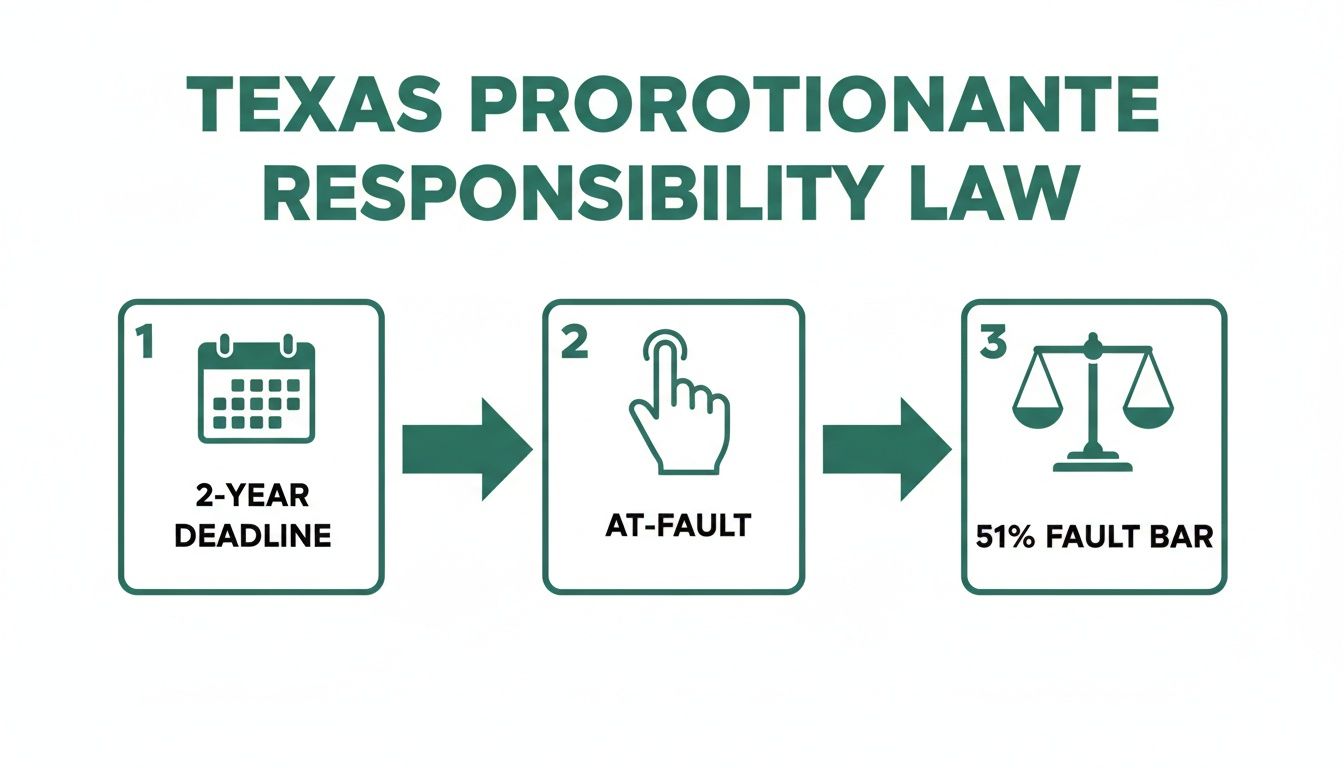
As you can see, Texas law puts a two-year deadline on these claims, requires you to prove the other driver was at fault, and bars you from recovery if you are found to be 51% or more at fault yourself.
Crafting the Demand Letter
With all the evidence in hand, your lawyer drafts the formal demand letter. This powerful legal document is sent straight to the at-fault driver’s insurance company. It’s a structured, professional argument that lays out the facts of your case clearly and persuasively.
The demand letter systematically presents:
- A summary of the accident and why their insured is liable.
- A detailed breakdown of the damages and the repairs performed.
- A specific, evidence-backed calculation of your car’s diminished value.
- The exact dollar amount you are demanding in compensation.
This letter signals to the insurer that you’re serious and have expert representation, instantly giving your claim more weight.
The Power of a Certified Appraisal
Here’s the knockout punch: a professional, independent appraisal. This is where a SnapClaim report becomes your lawyer’s most powerful tool. While the attorney constructs the legal argument, our certified appraisal provides the hard numbers that make your case undeniable. It replaces the adjuster’s flimsy formulas with real-world market data.
An independent appraisal from a reputable source like SnapClaim is the single most effective tool for proving your car’s value after an accident. It shifts the negotiation from opinions to facts.
Armed with this data-driven report, your lawyer can shut down the insurance company’s lowball offers. The SnapClaim appraisal acts as expert testimony, pinpointing exactly how much value your vehicle lost. The conversation is no longer about what they think you’re owed—it’s about what the facts prove.
Arming Your Lawyer with a SnapClaim Appraisal

A lawyer’s best arguments are only as good as the evidence they have to back them up. Think of your attorney as the architect of your legal strategy and a SnapClaim appraisal as the solid foundation it’s built on. It transforms your claim from a simple request into a data-backed demand.
Insurance companies have their own playbook, filled with self-serving formulas to calculate diminished value. The most infamous is the 17c formula, a method widely known for arbitrary deductions that almost always lead to a lowball offer. It’s designed to protect their bottom line, not reflect the true car value after accident in the Texas market.
A good diminished value lawyer in Texas knows they need a better weapon—one grounded in facts, not fiction.
The SnapClaim Advantage in a Legal Fight
A SnapClaim report isn’t just another estimate. It’s a certified, defensible document built on real-time market analysis. Our appraisers dig into comparable vehicle sales, auction data, and dealership insights to pinpoint the exact dollar amount your car lost because of its accident history.
This evidence-based approach gives your attorney the leverage needed to dismantle the insurer’s flawed math and argue from a position of strength.
An independent, certified appraisal report is the cornerstone of a successful diminished value claim. It replaces the insurer’s opinion with verifiable market data, forcing them to address the true financial damages.
When your lawyer presents a SnapClaim appraisal, the entire dynamic shifts. The adjuster is forced to explain why their offer ignores the concrete market evidence in your report. You can see why this is a crucial first step by reading our guide on how to get a diminished value appraisal.
SnapClaim Appraisal vs. Insurance Company Formula
The difference between a professional appraisal and an insurer’s shortcut is night and day. One is based on reality; the other is designed to minimize their payout.
| Feature | SnapClaim Certified Appraisal | Typical Insurer Formula (e.g., 17c) |
|---|---|---|
| Methodology | Based on real-time, local market data and comparable vehicle sales. | Relies on a generic, arbitrary formula with vague “damage modifiers.” |
| Accuracy | Precisely calculates your specific vehicle’s loss in value. | Produces a low, generalized estimate that favors the insurer. |
| Credibility | Certified, court-ready, and defensible during negotiations or litigation. | Easily challenged by legal professionals and appraisal experts. |
| Transparency | The valuation process is clear, data-driven, and easy to understand. | The calculation is often a “black box” designed to confuse you. |
This table makes it clear why a professional appraisal isn’t just helpful—it’s essential for any serious claim.
A Risk-Free Investment in Your Claim
We’re so confident in the quality of our reports that we stand behind them 100%. SnapClaim’s Money-Back Guarantee means you have nothing to lose by equipping your legal team with the best evidence available.
If your insurance recovery from the claim is less than $1,000, SnapClaim refunds the full appraisal fee—guaranteed.
This guarantee makes getting an appraisal a no-brainer. You secure the expert proof your lawyer needs to build the strongest possible case without any financial risk.
Taking the Next Step with Confidence
Deciding to pursue a diminished value claim can feel intimidating, but understanding how a diminished value lawyer in Texas works makes the process much less stressful. The goal is simple: get back the money you’re rightfully owed.
The good news is you don’t need cash upfront to hire an expert attorney. Almost every reputable lawyer in this field works on a contingency fee basis. This is a “we don’t get paid unless you get paid” arrangement.
This means you pay absolutely no upfront fees. The attorney’s fee is a percentage of the settlement they win for you. If they can’t recover any money on your claim, you owe them nothing for their time.
Questions to Ask a Prospective Lawyer
Finding the right legal partner is key. Before signing anything, it’s smart to have a quick chat to ensure they’re the right fit.
Here are a few essential questions to ask:
- What percentage of your practice is dedicated to diminished value claims? You want someone who specializes in this area.
- What is your contingency fee percentage? This usually falls between 33-40%, so it’s critical to confirm this upfront.
- Do you work with independent appraisers like SnapClaim? This shows they value data-backed evidence.
- Can you walk me through your typical process for a claim like mine? Their answer should give you a clear, step-by-step roadmap.
Your First Step is Free and Risk-Free
Before you even think about calling an attorney, you can get a huge head start on your claim. The best way to prepare for any legal discussion is to understand what your loss is potentially worth.
SnapClaim offers a free, no-strings-attached estimate that calculates your vehicle’s potential diminished value in minutes. This first step gives you a realistic baseline for what your diminished value claim could be worth, empowering you to move forward with clarity and confidence. Arming yourself with this information is the smartest way to kick off the recovery process.
Frequently Asked Questions (FAQ)
Can I claim diminished value if the accident wasn’t my fault?
Yes, absolutely. In Texas, you can only file a diminished value claim against the at-fault driver’s insurance policy. If you were not at fault for the accident, you have the legal right to be compensated for the loss in your vehicle’s market value.
Is it worth hiring a lawyer for a diminished value claim?
For newer vehicles, luxury cars, or cases involving significant damage, hiring a lawyer is often a very smart move. Insurance companies frequently use tactics to undervalue or deny these claims. A lawyer levels the playing field, handles the complex negotiations, and uses evidence like a certified SnapClaim appraisal report to fight for a fair settlement.
How much does a diminished value lawyer cost in Texas?
Most diminished value lawyers in Texas work on a contingency fee basis. This means you pay nothing upfront. The lawyer’s fee is a pre-agreed percentage (typically 33-40%) of the final settlement they secure for you. If they don’t win your case, you owe them nothing.
How much does a diminished value lawyer cost in Texas?
Most diminished value lawyers in Texas work on a contingency fee basis. This means you pay nothing upfront. The lawyer’s fee is a pre-agreed percentage (typically 33-40%) of the final settlement they secure for you. If they don’t win your case, you owe them nothing.
What if the at-fault driver’s insurance company ignores my claim?
This is a common tactic used to discourage claimants. If the insurance adjuster is ignoring your calls or delaying your claim, it’s a strong sign you need professional help. A diminished value lawyer in Texas can send a formal demand letter that insurers take seriously and, if necessary, file a lawsuit to compel them to negotiate fairly.
About SnapClaim
SnapClaim is a premier provider of expert diminished value and total loss appraisals. Our mission is to equip vehicle owners with clear, data-driven evidence to recover the full financial loss after an accident. Using advanced market analysis and industry expertise, we deliver accurate, defensible reports that help you negotiate confidently with insurance companies.
With a strong commitment to transparency and customer success, SnapClaim streamlines the claim process so you receive the compensation you rightfully deserve. Thousands of reports have been delivered to vehicle owners and law firms nationwide, with an average of $6,000+ in additional recovery per claim.
Why Trust This Guide
This guide was reviewed and verified by SnapClaim’s auto appraisers, who specialize in diminished value and total loss disputes.
Our team continually updates every article to reflect current insurer guidelines, valuation standards, and court-accepted appraisal practices, ensuring that you’re relying on information trusted by professionals nationwide.
Get Started Today
Whether you’re challenging a low total loss settlement or proving your vehicle’s post-repair loss in value, SnapClaim makes it simple to take the next step.
Generate a free diminished value or total loss estimate in minutes and see how much compensation you may be owed.
👉 Get your free estimate today or order a certified appraisal report to strengthen your insurance claim.