

Staring at a lowball offer from an insurance company after an accident is incredibly frustrating. You had your car repaired by a professional shop, but you know its resale value has taken a serious hit. This loss is called diminished value, and you have the right to demand fair compensation for it.
While you don’t always need a diminished value claim lawyer, their expertise is crucial when an insurer refuses to pay what you’re owed. If they deny your claim, hide behind confusing formulas, or ignore you completely, it’s time to bring in a professional advocate to fight for your rights.
When to Hire a Diminished Value Claim Lawyer
After an accident that wasn’t your fault, the law in most states says you have the right to be “made whole.” This means more than just fixing the dents; it means the at-fault party’s insurance should also pay for the permanent drop in your vehicle’s market value. The problem is that insurance companies are businesses focused on minimizing payouts, leaving you to fight an uphill battle alone.
This is where a diminished value claim lawyer can level the playing field. Their job is to ensure your claim is treated fairly and taken seriously. While many drivers can successfully negotiate smaller claims on their own using a solid diminished value appraisal, some situations almost demand legal support.
Key Scenarios for Legal Action
You should seriously consider hiring an attorney if the insurance company:
- Outright denies your claim: If an adjuster says diminished value isn’t real or isn’t covered, a lawyer can respond with legal precedent and state-specific laws that force them to reconsider.
- Makes a lowball offer: Insurers often use flawed internal formulas, like the infamous “17c” formula, to generate a ridiculously low settlement. An experienced lawyer knows how to dismantle these arguments and build a case based on real-world market data.
- Becomes unresponsive: “Ghosting” is a classic delay tactic. If an adjuster stops returning your calls or emails after you submit your claim, legal intervention can compel them to respond and act in good faith.
- Disputes a high-value loss: For luxury, exotic, or nearly new vehicles, the diminished value can be substantial. Insurers are more likely to fight these larger claims, making legal representation essential to protect your investment.
This simple flowchart shows the common paths that lead vehicle owners to seek legal help.
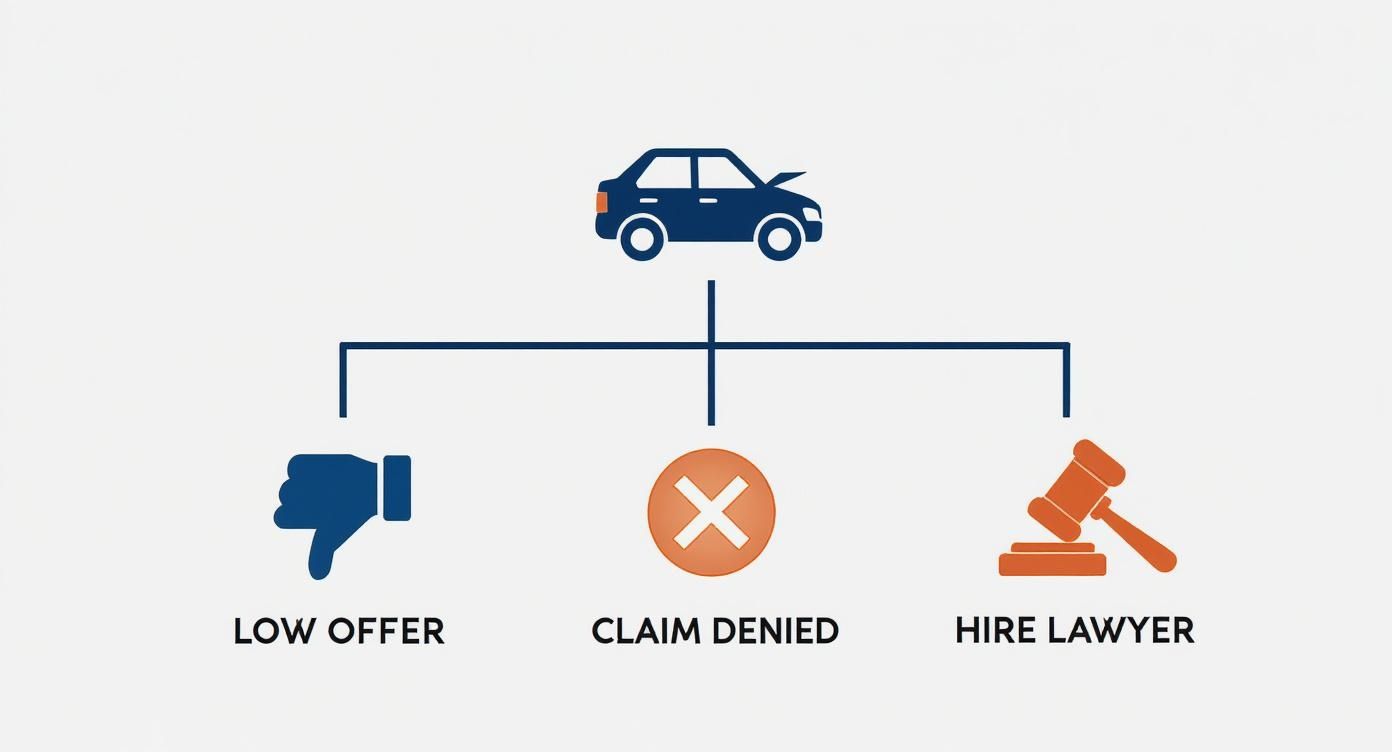
As you can see, whether you get a tiny offer or a flat denial, the next logical step is to consult a professional who can protect your financial interests.
Hiring an attorney is a strategic move that signals to the insurer that you’re serious and won’t be pushed around. If the accident also involved injuries, you might already have a lawyer. It’s important to find the right expert, so you should learn how to choose a personal injury attorney who also understands property damage to ensure your vehicle’s lost value isn’t overlooked.
What Exactly Is Diminished Value?
Even after perfect repairs, a vehicle with an accident history is worth less than an identical one without it. This permanent drop in market value is diminished value. It’s a real, tangible financial loss you suffer because someone else was negligent.

Imagine two identical cars on a dealership lot—same make, model, year, and mileage. The only difference is one has a clean history report, while the other shows a significant accident.
Which one would you buy? Most people would choose the one with no accident history. To sell the other car, the dealer would have to slash the price. That price gap is its diminished value.
Three Types of Diminished Value
To understand why your claim is legitimate, it helps to know the different kinds of diminished value. While there are a few technical types, the one that matters for your claim is inherent diminished value.
Here’s a simple breakdown:
- Immediate Diminished Value: The value lost right after the accident, before any repairs are made.
- Repair-Related Diminished Value: This occurs when repairs are subpar, such as mismatched paint or cheap aftermarket parts that further hurt the car’s value.
- Inherent Diminished Value: This is the most important type. It’s the automatic, permanent loss in value that exists simply because the vehicle now has an accident on its record—even if the repairs are flawless. This is the money your claim is designed to recover.
The law in most states is built on the principle that you must be “made whole” after an accident caused by someone else. Since your car is now worth less, you haven’t been made whole until you’re compensated for that lost value. A good diminished value claim lawyer builds their entire case on this fundamental concept.
Why Insurance Companies Push Back
So why is it a fight? Insurers often downplay or deny these claims because paying them fairly would cost them billions. A common tactic is to argue that because the car was repaired correctly, its value is fully restored—a claim that any real-world car buyer knows is false.
This is why having solid proof is non-negotiable. A professional appraisal from SnapClaim provides the hard data to prove your car value after the accident has dropped. When a diminished value claim lawyer presents this evidence, it changes the entire dynamic of the negotiation.
Red Flags That Signal You Need a Lawyer
Navigating a diminished value claim on your own can feel manageable at first, but certain insurance adjuster tactics can quickly put you at a disadvantage. So, how do you know when it’s time to call a diminished value claim lawyer?
Recognizing these red flags is key to protecting your rights and ensuring you don’t leave thousands of dollars on the table.
The Insurer Denies Your Claim Outright
The most obvious red flag is a hard “no.” An adjuster might say, “diminished value isn’t covered in your state” or “since the car was repaired, its value is restored.” These are common, and often false, statements designed to make you give up.
When an insurer flatly refuses to acknowledge your claim, it’s a clear sign you’re facing a company policy of obstruction. This is the moment a lawyer becomes your most powerful asset. You can learn more about why an insurance company may deny your car accident claim and how to fight back.
They Use the “17c Formula”
If the adjuster mentions the “17c formula” or another internal calculation, treat it as a massive red flag. This formula, originating from a single Georgia court case, is widely criticized for its arbitrary caps and modifiers that almost always produce a laughably low offer.
An experienced lawyer knows how to dismantle arguments based on this flawed formula and redirect the negotiation toward what truly matters: real-world market data from a professional appraisal.
Your Vehicle Is High-Value or New
The more your vehicle was worth before the accident, the more significant its diminished value will be. For luxury cars, exotic models, or vehicles less than two years old, the financial loss can easily exceed $10,000.
Insurers are far more likely to fight these larger claims. If you’re dealing with a substantial loss in value, having a diminished value claim lawyer is essential for a fair outcome.
The Adjuster Uses Delay Tactics
Another classic red flag is the “slow roll,” where the adjuster intentionally drags their feet, hoping you’ll get frustrated and give up.
This includes tactics like:
- Becoming unresponsive and ignoring your calls or emails.
- Repeatedly asking for documents you’ve already sent.
- Claiming your file was transferred to another adjuster who is “unavailable.”
These delays are a deliberate strategy. A lawyer can cut through these games by sending a formal demand letter, setting firm deadlines, and threatening legal action if the insurer continues to act in bad faith.
Why Your Lawyer Needs an Expert Appraiser
Hiring a diminished value claim lawyer is a great first step, but even the best attorney can’t win on arguments alone. To get the insurance company to pay what you’re owed, they need hard evidence—and that’s where an independent, expert appraiser becomes their secret weapon.

Think of your lawyer as the skilled advocate who argues your case and the appraiser as the expert witness who provides the undeniable facts. The appraiser’s job is to create a certified, data-driven report that pinpoints exactly how much market value your vehicle has lost.
This professional appraisal report changes the game. It’s no longer your opinion versus the insurer’s; it’s a documented, fact-based demand that they are legally required to address.
The Appraiser Provides the Proof
A lawyer’s legal arguments are only as strong as the evidence backing them up. Without a professional appraisal, your lawyer is stuck with subjective arguments that insurers are trained to dismiss.
A certified report from an expert like SnapClaim flips the script by delivering:
- Objective Market Data: The report uses comprehensive market analysis, sales data from comparable vehicles, and industry-standard valuation methods to pinpoint the exact dollar amount lost.
- Credibility and Authority: A report from a reputable, independent appraiser carries serious weight and signals to the insurer that you are serious.
- A Clear Settlement Target: The appraisal gives your lawyer a specific, defensible number to demand, forcing the negotiation to center on a real figure.
The appraiser provides the ammunition your lawyer needs to fight effectively for you.
Lawyer vs. Appraiser Roles in a Diminished Value Claim
| Responsibility | Independent Appraiser (e.g., SnapClaim) | Diminished Value Claim Lawyer |
|---|---|---|
| Primary Function | Establishes the amount of financial loss through data. | Manages the legal process to recover the financial loss. |
| Key Deliverable | A USPAP-compliant, certified appraisal report. | Legal representation, demand letters, and court filings. |
| Area of Expertise | Vehicle valuation, market analysis, and appraisal standards. | State laws, insurance regulations, negotiation, and litigation. |
| Interaction with Insurer | Provides the factual basis for the claim’s value. | Communicates, negotiates, and litigates with the insurer. |
While the appraiser provides the “what” (the value of your loss), the lawyer handles the “how” (the legal strategy to recover it).
Strengthening the Legal Strategy
Your diminished value claim lawyer uses the appraisal report as the cornerstone of their legal strategy. It becomes the centerpiece of the formal demand letter sent to the insurance company. A demand letter from an attorney armed with a certified appraisal is infinitely more powerful than a letter from a vehicle owner alone.
This strategic partnership is what gets results. The appraiser establishes the loss, and the lawyer executes the legal process to recover it. This one-two punch is often enough to secure a fair settlement without ever setting foot in a courtroom. Our guide to the best diminished value appraisers can help you find a credible expert.
Building Your Case for a Maximum Payout
Winning a diminished value claim requires proving your loss with organized, compelling evidence. Your diminished value claim lawyer is the storyteller, and your paperwork provides the plot. The star of the show is a certified diminished value appraisal from an expert like SnapClaim, which delivers the hard numbers that quantify your loss.
The supporting documents are just as critical. Each piece adds another layer of proof, making your overall position that much stronger.

Your Essential Document Checklist
To build the strongest possible case, you and your lawyer will need to gather a few key items.
Here’s a practical checklist of what you’ll need:
- The Official Police Report: This establishes the facts of the accident, including who was at fault.
- Pre- and Post-Accident Photos: Detailed photos of the damage from every angle are powerful. Photos of your car from before the accident are even better, as they prove its excellent prior condition.
- The Final Itemized Repair Invoice: A long, detailed repair bill showing significant structural work or frame damage is direct proof of the accident’s severity, which strengthens your argument for a substantial loss in value.
- All Written Correspondence: Keep every email, letter, and text message between you and the insurance adjuster to create a paper trail.
Questions to Ask a Potential Lawyer
Not all attorneys are equipped to handle these unique claims. When you meet with a potential diminished value claim lawyer, ask these key questions:
- How many diminished value claims have you handled? You want someone with specific experience in this niche.
- What is your strategy for dealing with insurers who use the 17c formula? An experienced lawyer will have a ready-made plan to dismantle this tactic.
- Do you work with independent appraisers? Their willingness to use expert reports like those from SnapClaim is a very good sign.
- What is your fee structure? Most attorneys work on a contingency fee, but it’s vital to confirm this upfront.
Finding the right legal partner is everything. An attorney specializing in this area will know the arguments and evidence needed to shut down common insurance company tactics.
What About Legal Fees and How Long Will This Take?
Hiring a diminished value claim lawyer shouldn’t be a financial burden. The good news is that most attorneys in this field use a payment structure designed to be risk-free for you.
The vast majority of these cases are handled on a contingency fee basis. Simply put, this means you pay nothing unless your lawyer wins a settlement for you. Their fee is a pre-agreed percentage of the money they recover. This setup aligns their goals with yours—they are motivated to get you the highest payout possible.
A Quick Look at Fee Structures
- Contingency Fee (The Standard): Your lawyer takes a percentage of the final settlement, usually between 25% and 40%. There are no upfront costs, and if they don’t win, you don’t pay attorney fees.
- Hourly Rate (Rare): The attorney bills for every hour spent on your case. This is very uncommon for diminished value claims because the fees could easily exceed the settlement.
- Flat Fee (Rare): A lawyer might quote a single fixed price. This is also uncommon due to the unpredictable nature of insurance negotiations.
The contingency fee model removes the financial risk, giving you access to an expert without any out-of-pocket expense.
The Claim Timeline: What to Expect
Having a clear picture of the timeline is also important. Some claims settle fast with a powerful demand letter backed by a certified SnapClaim report, while others take longer.
Here are the typical stages:
- Case Building (1-2 weeks): You’ll consult with your lawyer, provide documents, and they will order a certified appraisal to establish your car value after the accident.
- Demand Letter & Negotiation (2-6 weeks): With the appraisal, your lawyer sends a formal demand to the insurer. This kicks off the negotiation process.
- Settlement or Lawsuit (Varies): If the insurer makes a fair offer, the case can wrap up quickly. If not, your lawyer may recommend filing a lawsuit, which often brings the insurer back to the table with a better offer.
While some claims resolve in a month, more complex cases can take longer. Your diminished value claim lawyer will keep you informed every step of the way.
FAQs: Your Diminished Value Claim Questions Answered
Navigating the aftermath of an accident is confusing. Here are straightforward answers to the questions we hear most often.
Can I claim diminished value if the accident wasn’t my fault?
Yes, absolutely. Diminished value claims are made against the at-fault driver’s insurance company. Their negligence caused your financial loss, and their liability policy is responsible for making you whole.
Can I file a diminished value claim if I was at fault?
Generally, no. You typically cannot file a diminished value claim against your own insurance policy if you caused the accident. An exception exists in some states if you have Uninsured/Underinsured Motorist (UIM) coverage and the at-fault driver has insufficient insurance. A diminished value claim lawyer can review your policy to see if this applies.
How much does a diminished value claim lawyer cost?
Most lawyers in this field work on a contingency fee basis. This means you pay nothing upfront. The lawyer takes a pre-agreed percentage—usually between 25% and 40%—of the money they successfully recover for you. If they don’t win, you don’t pay.
Is it worth hiring a lawyer for a small claim?
It depends on the numbers. If your independent appraisal shows a loss of around $2,000 or less, the lawyer’s fee might consume too much of the settlement to be worthwhile. In those cases, using your certified SnapClaim appraisal report to negotiate on your own is often the most effective route. For higher-value claims, a lawyer’s expertise can lead to a final payout that easily outweighs their fee.
Ready to fight back against a lowball offer? It starts with proving what your claim is worth. SnapClaim provides the certified, data-driven evidence you or your diminished value claim lawyer need to build a powerful case and negotiate a fair insurance total loss payout or diminished value settlement. And with our Money-Back Guarantee, there’s no risk: if your insurance recovery from the claim is less than $1,000, SnapClaim refunds the full appraisal fee — guaranteed.
Get your free estimate today or order a certified appraisal report to strengthen your insurance claim.
👉 Get Your Free Diminished Value Estimate Today
About SnapClaim
SnapClaim is a premier provider of expert diminished value and total loss appraisals. Our mission is to equip vehicle owners with clear, data-driven evidence to recover the full financial loss after an accident. Using advanced market analysis and industry expertise, we deliver accurate, defensible reports that help you negotiate confidently with insurance companies.
With a strong commitment to transparency and customer success, SnapClaim streamlines the claim process so you receive the compensation you rightfully deserve. Thousands of reports have been delivered to vehicle owners and law firms nationwide, with an average of $6,000+ in additional recovery per claim.
Why Trust This Guide
This guide was reviewed and verified by SnapClaim’s auto appraisers, who specialize in diminished value and total loss disputes.
Our team continually updates every article to reflect current insurer guidelines, valuation standards, and court-accepted appraisal practices, ensuring that you’re relying on information trusted by professionals nationwide.
Get Started Today
Whether you’re challenging a low total loss settlement or proving your vehicle’s post-repair loss in value, SnapClaim makes it simple to take the next step.
Generate a free diminished value or total loss estimate in minutes and see how much compensation you may be owed.
👉 Get your free diminished value estimate today