

Had your car repaired after an accident, but now it doesn’t feel like it’s worth the same? You’re not wrong. A car diminished value calculator is a great first step to understanding the financial loss your vehicle suffers just because it now has an accident history.
This kind of tool gives you a quick, ballpark estimate of your car’s value after an accident, helping you decide if you should pursue a diminished value claim. Think of this initial number as the starting point for getting the compensation you’re owed.
What is Diminished Value, Exactly?
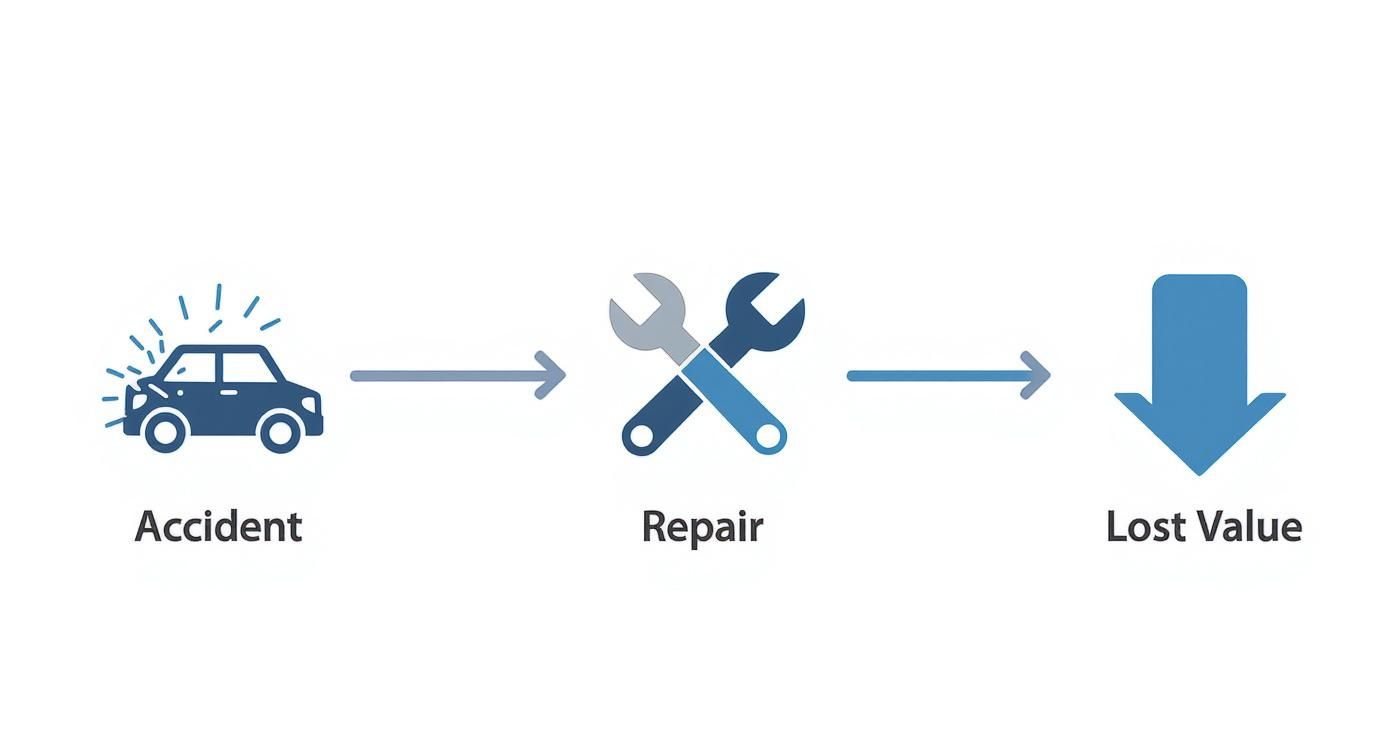
After a wreck, your priority is getting your vehicle repaired. But even with flawless repairs from the best body shop, a permanent stigma gets attached to your car’s vehicle history report. This negative mark makes future buyers nervous, forcing you to accept a lower price when you eventually sell or trade it in.
The value lost because of that accident history is called inherent diminished value. It’s a real financial loss that you can and should recover from the at-fault driver’s insurance company.
Imagine shopping for a used car. You find two identical models—same year, mileage, and features. One has a clean record, and the other has a major accident reported. Which one would you pay more for? The one with the clean history, of course. That price gap is exactly what a diminished value claim is designed to recover.
It’s All About Market Perception
It’s a mistake to think that high-quality repairs restore a vehicle to its full pre-accident worth. While the car might look and drive perfectly, the market simply doesn’t see it that way. The loss isn’t about the quality of the repair; it’s about the public’s perception of the vehicle’s history.
This drop in value can be significant, often falling between 10% to 30% of the car’s pre-accident value. For vehicles with serious structural damage, that percentage can climb even higher.
A diminished value claim holds the at-fault driver’s insurance company responsible for this loss, ensuring you’re made financially whole again. The goal is simple: get compensated for the difference between your car’s value before the accident and its lower value after repairs.
Where Does an Online Car Diminished Value Calculator Fit In?
Using a free online car diminished value calculator is an excellent first move. It provides a fast estimate of what your claim could be worth, helping you decide if it’s worth the effort to file a formal claim.
However, it’s critical to know their limits. These online tools rely on simplified formulas and can’t account for specific details that drive your car’s value, such as:
- Your Local Market: A Ford F-150 in Texas holds its value differently than one in New York City.
- Severity of Damage: A vague input like “moderate damage” doesn’t distinguish between cosmetic dings and actual frame damage.
- Repair Quality: The final value can swing dramatically based on whether the shop used OEM (Original Equipment Manufacturer) parts or cheaper aftermarket ones.
Key Takeaway: An online calculator gives you a starting point. It is not the hard evidence you need to negotiate with an insurance adjuster.
To successfully argue your case, you’ll need something much more substantial. This is where a certified appraisal report from SnapClaim comes in, providing the detailed, defensible analysis that supports your case with certified data.
Online Calculator Estimate vs. Certified Appraisal
It’s important to see the difference between a quick online guess and a professional valuation. One gets you started; the other helps strengthen your claim.
| Feature | Online Calculator | SnapClaim Certified Appraisal |
|---|---|---|
| Credibility | Low; often rejected by insurers as mere opinion. | High; USPAP-compliant and court-ready, trusted by professionals. |
| Accuracy | General estimate based on a simplified formula. | Precise valuation based on real-time market data and vehicle specifics. |
| Detail Level | Minimal; uses basic inputs like make, model, and year. | Comprehensive; analyzes repair quality, local market, and vehicle history. |
| Use Case | Quick check to see if a claim is worth pursuing. | Official documentation for negotiations and legal claims. |
| Cost | Free | A paid service that provides data-backed proof for fair compensation. |
While a free calculator is a helpful first look, only a certified appraisal from SnapClaim provides the official proof required to secure fair compensation for your car’s value after an accident.
How to Use a Car Diminished Value Calculator
Ready to get a preliminary number? A good car diminished value calculator is the perfect first stop. Before you jump in, gathering a few key details will make the process smoother and the result more accurate.
Think of it like laying out your ingredients before you start cooking. You’ll typically need your car’s VIN, its approximate mileage, and a solid idea of its value right before the accident happened.
Step 1: Find Your Car’s Pre-Accident Value
Pinpointing your vehicle’s fair market value just before the crash is the most important step. This number is the foundation of any diminished value calculation. Luckily, there are excellent, reputable resources you can use.
A great place to start is an industry-trusted site like Kelley Blue Book (KBB). You can enter your car’s details to get a reliable market value range based on its condition, mileage, and features before the accident.
Using a tool like KBB gives you a solid, unbiased starting point for your pre-accident value. This is absolutely critical for an accurate initial estimate.
Step 2: A Real-World Example Calculation
Let’s walk through a common scenario to see how this comes together.
- The Vehicle: A 2022 Honda CR-V EX-L.
- Pre-Accident Condition: Excellent, with 30,000 miles.
- Pre-Accident Value: You check KBB and find its private party value was around $28,000.
- The Accident: The CR-V was in a front-end collision with moderate damage. The repair bill came to $5,500.
With this info, you can use an online tool like SnapClaim’s free diminished value claim calculator to get an instant estimate. You’d enter the make, model, year, pre-accident value, and damage severity.
For our Honda CR-V, the calculator might estimate a diminished value of around $3,200. This number represents the likely drop in what someone would pay for it, even after $5,500 in repairs made it look new again. The key takeaway is simple: repair costs and lost value are two separate financial hits, and you’re entitled to be compensated for both.
Step 3: Understand What the Final Number Means
It is important to understand what this initial estimate represents. It is not a guaranteed payout from the insurance company. Instead, think of it as your first piece of evidence—a data point that helps you decide what to do next.
This estimate answers the most important question: Is pursuing a formal diminished value claim worthwhile?
If the calculator shows a potential loss of a few thousand dollars, that’s a strong signal that you should take the next step. An online calculator gives you a quick snapshot of your potential loss. But to actually get that money, you’ll need to back up that estimate with a professional, data-driven appraisal that can stand up to insurer scrutiny.
Key Factors That Impact Your Diminished Value Claim
A professional appraisal dives much deeper than an online calculator to uncover the true financial loss. A generic car diminished value calculator simply can’t weigh the unique variables that define your vehicle’s worth after an accident. Let’s break down the critical factors that actually move the needle.
These nuances are where a standard online tool falls short. A certified appraiser, on the other hand, examines every detail to build a data-backed case that helps strengthen your claim.
Vehicle Age, Mileage, and Pre-Accident Condition
These three elements form the baseline of your vehicle’s value. A newer, low-mileage car will naturally suffer a greater diminished value than an older vehicle with high mileage.
The pre-accident condition is just as vital. Was your car in showroom condition, or did it have existing dings and scratches? An insurer will try to argue that prior imperfections lowered its value, which is why documenting its pre-accident state with photos and service records is so important.
Severity and Type of Damage
Not all damage is created equal in the eyes of a potential buyer. There’s a massive difference between a few cosmetic touch-ups and significant structural repairs.
- Cosmetic Damage: Scratches, dents, and bumper scuffs have a relatively low impact on diminished value.
- Structural Damage: If the frame was bent, airbags deployed, or major components were replaced, the diminished value will be substantially higher. An accident history showing structural repairs is a major red flag for any savvy buyer.
A vehicle history report that notes “frame damage” can scare away over 80% of potential buyers, causing a huge drop in its market value. A certified appraisal from SnapClaim meticulously documents the type and severity of damage to accurately reflect this market perception.
A professional appraisal goes beyond a “moderate damage” label. It analyzes the repair invoice line by line to determine if critical structural components were compromised, providing the proof you need to negotiate fairly.
Quality of the Repair Work
The quality of the repairs plays a huge role in determining the final post-accident value. Did the body shop use Original Equipment Manufacturer (OEM) parts, or did they cut corners with cheaper aftermarket alternatives?
Poorly executed repairs can lead to repair-related diminished value. This happens when shoddy workmanship further reduces the vehicle’s worth beyond the hit from the accident history. An expert appraiser can often spot signs of a low-quality repair an untrained eye would miss.
Your Vehicle’s Market Desirability
Here’s something a simple calculator can never assess: your car’s popularity and market demand. A highly sought-after truck or a luxury SUV will have a very different value calculation than a common sedan.
Market dynamics are always shifting. For instance, recent data shows that while average vehicle depreciation is around -12.5% annually, the figures vary wildly by segment. You can explore more about these trends and learn how vehicle segments impact depreciation. This is why localized, model-specific market analysis is essential for an accurate diminished value report.
Common Mistakes When Using a Free Calculator
Free online tools are convenient, but relying on them as your sole source of truth can be a costly mistake. A car diminished value calculator is a great starting point, but it’s critical to understand its limitations. Falling into these common traps can weaken your claim from the start.
The core problem? These tools often use overly simplistic formulas. They can’t see the specifics of your accident, which means their calculations are educated guesses. Insurance adjusters know this, making it easy for them to dismiss any figure not backed by hard, specific market data.
The Problem with One-Size-Fits-All Formulas
One of the most common pitfalls is the infamous “17c formula.” This formula, which originated from a court case in Georgia, is widely used by insurance companies for one reason: it produces incredibly low diminished value figures. It applies a series of arbitrary caps and modifiers that often have no connection to the real used car market.
Insurers love this formula because it gives their lowball offers a false sense of legitimacy. However, no state legally requires the use of the 17c formula. You can learn more about why this method is so problematic in our detailed guide on the 17c diminished value formula.
Crucial Insight: Relying on an estimate from a calculator that uses the 17c formula is like bringing the insurance company’s own playbook to the negotiation. An independent appraisal must be based on current, local market data, not a generic, insurer-friendly calculation.
Ignoring Local Market Conditions and Repair Quality
Another massive blind spot for free calculators is their inability to account for your local market and the actual quality of your repairs. A popular truck in Texas will lose value differently than the same truck in New York after an identical accident.
Likewise, an online tool can’t look at the work done at the body shop. It has no way of knowing if the paint is perfectly matched or if OEM parts were used. These factors can sink a vehicle’s final market value, yet they are completely invisible to an automated calculator.
The Risk of an Undervalued Claim
When you add up these shortcomings, you almost always end up with an undervalued estimate. Presenting this low number to an insurance adjuster unintentionally signals that you’ll accept far less than you deserve.
With the auto market constantly shifting, having precise data is more important than ever. Industry reports show that 22.6% of all automotive losses were declared total losses through April 2025, a trend tied to fluctuating vehicle values. You can discover more in the 2025 Crash Course report. Ultimately, a free calculator can’t provide the defensible, data-driven evidence needed to challenge a low insurance total loss payout or diminished value offer.
How to Turn Your Estimate into a Successful Claim
Getting a number from a car diminished value calculator is a great first step, but it’s just a starting point. To turn that estimate into compensation, you need to build a rock-solid, evidence-based claim. This means organizing your paperwork and presenting a case so strong the insurance company can’t simply dismiss it.

Think of it as moving from an educated guess to undeniable proof. The goal is to hand the insurer a complete package that leaves no doubt about your financial loss.
Step 1: Gather Your Essential Documentation
Meticulous record-keeping is your best friend. Before contacting the insurance company, assemble a comprehensive file with every piece of relevant information.
Your documentation checklist should include:
- The Official Accident Report: This establishes the facts and who was at fault.
- All Repair Invoices: The initial estimate and the final, itemized bill prove the extent of the damage.
- Photographic Evidence: You can never have too many photos. You’ll want pictures from before the accident (if possible), right after the crash, and after repairs are finished.
- Pre-Accident Value Research: Keep records from sites like KBB that establish your car’s fair market value before the collision.
Having this organized sends a clear signal to the adjuster that you’re serious and prepared.
Step 2: Craft Your Demand Letter
With your evidence in hand, it’s time to formally notify the at-fault party’s insurance carrier of your diminished value claim. This is done with a formal demand letter. This isn’t a casual email; it’s your official request for compensation.
Your demand letter should briefly state the facts, declare that your vehicle lost value despite the repairs, and specify the amount you are claiming. It’s critical to attach copies of all your supporting documents. For more details, explore our complete Diminished Value guide.
Step 3: Use a Certified Appraisal to Strengthen Your Claim
While your own research is essential, the single most powerful tool you can use is a certified, third-party appraisal report. Insurance adjusters are trained to push back on owner estimates and online calculator results. What they have a much harder time refuting is a detailed, data-driven report from an accredited professional.
A SnapClaim certified appraisal report is like having an expert witness on your side. It uses real-time, local market data and industry-standard methods to prove your car’s post-repair loss in value. This gives you the leverage you need to negotiate effectively.
This professional report backs up your claim with hard evidence that stands up to scrutiny, whether in negotiations or even in court. It shifts the conversation from your opinion to a fact-based assertion of financial loss. For those facing a potential write-off, our Total Loss guides offer similar expert insights.
Frequently Asked Questions (FAQ)
Here are answers to some of the most common questions vehicle owners ask about diminished value claims.
Can I claim diminished value if the accident wasn’t my fault?
Yes, absolutely. In nearly every state, you can file a diminished value claim against the at-fault driver’s insurance company. Their liability coverage is responsible for making you whole, which includes compensating you for your car’s loss in market value.
Can I claim diminished value if I was at fault?
Generally, no. Your own collision coverage is designed to pay for repairs, not the drop in value that happens afterward. The one major exception is for vehicle owners in Georgia, which is the only state that allows for first-party diminished value claims. To understand the rules where you live, check our state-specific law pages.
How long do I have to file a diminished value claim?
The deadline is set by your state’s statute of limitations for property damage. This legal window varies but is typically between two to six years from the date of the accident. However, it’s always best to file your claim as soon as repairs are complete to ensure a clear link between the accident and the financial loss.
What if the insurance company denies my claim?
This is a common tactic. Insurers often deny claims or make a very low offer, arguing that their repairs restored the vehicle to its pre-accident value. This is where a certified appraisal from a provider like SnapClaim becomes essential. Our data-driven, defensible reports provide the proof you need to counter their arguments and negotiate from a position of strength.
About SnapClaim
SnapClaim is a premier provider of expert diminished value and total loss appraisals. Our mission is to equip vehicle owners with clear, data-driven evidence to recover the full financial loss after an accident. Using advanced market analysis and industry expertise, we deliver accurate, defensible reports that help you negotiate confidently with insurance companies.
With a strong commitment to transparency and customer success, SnapClaim streamlines the claim process so you receive the compensation you rightfully deserve. Thousands of reports have been delivered to vehicle owners and law firms nationwide, with an average of $6,000+ in additional recovery per claim.
Why Trust This Guide
This guide was reviewed and verified by SnapClaim’s auto appraisers, who specialize in diminished value and total loss disputes.
Our team continually updates every article to reflect current insurer guidelines, valuation standards, and court-accepted appraisal practices, ensuring that you’re relying on information trusted by professionals nationwide.
Get Started Today
Whether you’re challenging a low total loss settlement or proving your vehicle’s post-repair loss in value, SnapClaim makes it simple to take the next step.
Generate a free diminished value or total loss estimate in minutes and see how much compensation you may be owed.
👉 Get your free estimate today or order a certified appraisal report to strengthen your insurance claim.
And with SnapClaim’s Money-Back Guarantee, you can move forward with confidence. If your insurance recovery from the claim is less than $1,000, SnapClaim refunds the full appraisal fee — guaranteed.