

You get the call, and the adjuster on the other end says the two words every car owner dreads: “total loss.” It’s a gut-punch moment, but what does it actually mean? Understanding the process is the first step to ensuring you receive the fair payout you rightfully deserve.
A total loss isn’t about how crumpled your car looks; it’s a purely economic decision. The insurance company has calculated that the cost to repair your vehicle is more than its value right before the accident. This guide will walk you through how to handle the car appraisal total loss process and negotiate a fair settlement.

What Happens When Your Car Is Totaled
Once your car is declared a total loss, the insurance company is essentially saying, “It’s cheaper for us to buy you out than to fix it.” This triggers a process where they owe you one thing: the Actual Cash Value (ACV) of your vehicle.
So what is ACV? It’s the fair market price your car would have realistically sold for the moment before the crash happened. It’s not what you paid for it, and it’s definitely not the cost of a brand-new replacement. The insurer’s job is to figure out this number and make you a settlement offer.
Why the First Offer Is Just the Beginning
Here’s the thing you absolutely have to remember: the insurance company’s first offer is just that—an offer. Think of it as their opening bid in a negotiation, and you don’t have to accept it.
Too often, that initial number comes from third-party valuation reports that can miss the mark. They might use outdated sales data or compare your well-maintained vehicle to beat-up examples, all of which drives the value down.
This is where you take back control. You are never forced to accept an offer you know is too low. The trick is to come prepared with solid proof that backs up a higher, more accurate value for your car.
Your most powerful tool in this entire process is an independent car appraisal for a total loss. It provides the proof you need to negotiate fairly and supports your case with certified data.
To succeed in this negotiation, you need to understand three key things:
- Your Car’s True Worth: You know your car best. Its specific features, condition, and any recent upgrades all add to its real market value.
- The Insurer’s Methods: Adjusters often rely on automated systems. These programs are fast, but they can easily overlook the details that make your car worth more.
- Your Rights: You have the right to dispute the insurance company’s valuation. It’s up to you to present your own evidence to justify a higher payout.
By understanding what really happens when a car is a total loss, you can stop feeling like a victim and start advocating for yourself. This knowledge will light the path forward and make sure you don’t leave money on the table.
Understanding Your Car’s True Market Value
The single most important number in any total loss claim is the Actual Cash Value (ACV). It’s the fair market price someone would have paid for your car the moment before the accident—not what you paid for it, and definitely not what a new one costs today.
This ACV is precisely what the insurance company uses to calculate your settlement. The problem is, their methods don’t always work in your favor. They often lean on third-party software that pulls data from outdated sources or uses “comparable” vehicles from cheaper, entirely different markets. This is the main reason why that first offer can feel like such a gut punch.
What Makes a True Comparable Vehicle
To push back against a lowball offer, you need to know what a real “comp” actually is. The insurance company will give you a report listing cars they claim are similar to yours, but you have to check their work. A legitimate comparable vehicle must be a near-perfect match.
- Same Make, Model, and Year: This is the absolute baseline. No exceptions.
- Similar Mileage: A car with 50,000 miles isn’t the same as one with 90,000. The comps should be well within a reasonable range of your car’s final odometer reading.
- Identical Trim and Options: A base model sedan has a completely different value than the fully-loaded sport version. Every major feature, from the engine to the sunroof to the sound system, has to be accounted for.
- Located in Your Local Market: This one is huge. A car for sale 500 miles away in a different state is not a valid comp. Value is hyperlocal, and the appraisal must reflect your area’s prices.
When you scrutinize the insurer’s list of comps using these criteria, you’ll often find their valuation starts to fall apart. For a deeper look at all the factors that go into a car’s price, check out our guide on how much your car is worth.
How Insurers Can Undervalue Your Car
Adjusters aren’t usually trying to pull a fast one. Their systems are just built for speed and keeping costs down, which naturally leads to valuations that miss the mark.
The core issue is that their automated software fails to capture your vehicle’s unique story—its pristine condition, any recent upgrades, and the actual demand for it in your neighborhood. A generic report can’t tell the difference between a meticulously maintained car and one that was just driven into the ground.
A classic move we see all the time is applying unfair “condition adjustments.” The insurer will dock value for normal wear and tear—think minor scuffs or slightly worn tires—things any real-world buyer would fully expect on a used car. These little deductions can add up fast, shaving hundreds or even thousands of dollars off your final payout.
The Role of Market Trends in a Car Appraisal for Total Loss
The used car market is anything but stable. In recent years, it’s been a rollercoaster. Rising vehicle prices and increasingly complex tech mean cars are being declared total losses more often than ever. Post-COVID, used car values completely flipped the script—many vehicles stopped losing half their value in five years, rendering old tools like Kelley Blue Book less reliable on their own.
This new reality requires appraisers to be on their toes, constantly adapting to regional price swings and supply chain hiccups to capture a car’s true pre-accident worth. We’re in a “total loss boom,” and getting it right is more critical than ever.
This is where a certified car appraisal for a total loss from an independent expert like SnapClaim changes the game. It replaces the insurer’s generic, one-size-fits-all report with a detailed, defensible valuation built on real-time data from your local market. It tells your car’s actual story, giving you the hard evidence needed to negotiate from a position of strength and get the settlement you deserve.
Why Initial Insurance Offers Are Often Way Too Low
Getting a lowball settlement offer after your car is totaled can feel like adding insult to injury. But it’s rarely personal—it’s just business. Insurance companies are built to manage costs, and their initial offers are often generated by automated systems designed to find the lowest possible value for your vehicle, not its true fair market value.
These systems frequently lean on valuation reports from third-party vendors that are riddled with flaws. They might use stale sales data, completely ignore recent spikes in the used car market, or pull “comparable” vehicles from cheaper geographic areas hundreds of miles away. The whole process is built for speed and cost-cutting, not for accurately capturing what your specific car was worth moments before the crash.
Common Tactics That Shrink Your Payout
Insurance adjusters have a playbook of standard tactics that can dramatically reduce your settlement amount. Knowing what they are is the first step to fighting back.
One of the most common is hitting you with unfair “condition adjustments.” The insurer might dock value for normal wear and tear, like minor scuffs on the interior or tires with some miles on them—things any reasonable buyer would expect from a used car. While each deduction might seem small, they can add up to shave hundreds or even thousands of dollars off your insurance total loss payout.
Another classic move is using improper “comparable” vehicles. An adjuster might value your fully-loaded car against a stripped-down base model, or compare your low-mileage garage queen to a vehicle with 30,000 more miles on the clock. These are not apples-to-apples comparisons, and they’re almost always slanted in the insurer’s favor.
The Growing ‘Total Loss Crisis’
The pressure on insurers to lowball offers is getting worse, and there’s a bigger trend at play. In the last few years, the percentage of vehicles declared total losses has exploded, mostly because repair costs have gone through the roof.
One recent analysis showed the rate of total losses in non-fault claims jumped from 58% in 2019 to 66%—a staggering 8-point increase. Why? Because average repair costs shot up by nearly 25% in that same timeframe. You can explore the data on rising repair costs to see the trend for yourself.
This “total loss crisis” means insurers are cutting more checks than ever before, making them highly motivated to keep every single settlement as low as possible. That industry-wide pressure is what you’re up against when you get that first offer.
Insurer Valuation vs. Certified Appraisal: A Real-World Comparison
The difference between an insurer’s first offer and your vehicle’s actual market value can be shocking. A certified, independent car appraisal for a total loss cuts through the games and delivers a real-world valuation that can stand up to a fight.
The table below breaks down how an expert appraisal uncovers the money that insurers often leave on the table.
| Valuation Factor | Insurer’s Initial Offer | Certified Independent Appraisal |
|---|---|---|
| Base Vehicle Value | $22,500 (Based on regional, not local, comps) | $24,200 (Based on local, recent sales) |
| Mileage Adjustment | -$500 (Standard formula) | +$350 (Below-average mileage for model) |
| Options & Packages | +$750 (Missed premium sound system) | +$1,500 (All factory options accounted for) |
| Condition Adjustment | -$1,200 (Deductions for minor wear and tear) | -$400 (Fair adjustment for actual condition) |
| Recent Upgrades | $0 (New tires and brakes ignored) | +$850 (Value added for recent maintenance) |
| Final ACV Offer | $21,550 | $26,500 |
As you can see, the gap here is $4,950. This isn’t just a small disagreement; it’s thousands of dollars you’re owed. This is exactly why an independent report from SnapClaim is so critical. It provides the data-backed proof you need to negotiate fairly for the compensation you deserve.
How to Dispute a Low Total Loss Offer
That first settlement offer from the insurance company can feel like a final verdict, leaving you feeling stuck. But it’s not. Think of it as their opening bid in a negotiation—and you have way more power to counter than you might realize.
Disputing a lowball total loss offer isn’t about getting emotional; it’s about being organized, strategic, and armed with the right evidence. This guide will walk you through the exact steps to turn their low offer into the fair payout you’re actually owed.
Step 1: Start with a Formal Review
The moment you get that low offer, pause. Don’t cash the check or sign any release forms. Cashing that check can be legally interpreted as accepting their settlement, closing the door on any further negotiation.
Instead, your first move is to formally request a complete copy of the insurer’s valuation report. This document is the playbook for their offer, showing the “comparable” vehicles they used to determine your car value after accident. You need to pick it apart and look for common mistakes:
- Incorrect Mileage: Is the mileage on the report the same as what was on your odometer at the time of the wreck?
- Missing Options or Trim Packages: They often miss things. Did they account for your sunroof, that premium sound system, or the upgraded safety features? Little details add up to big money.
- Unfair Condition Adjustments: Watch out for deductions for “normal wear and tear.” A few minor scuffs on a used car are expected and shouldn’t tank its value.
- Poor “Comps”: Are the comparable vehicles they listed truly similar to yours? Check the make, model, year, trim, and mileage. Just as important, are they from your local market? A car in rural Montana doesn’t have the same value as one in Miami.
Step 2: Gather Your Own Evidence
Once you have their report, it’s time to build your counter-argument. This is where you prove what your vehicle was really worth right before the accident. Your goal is to create a detailed portrait of a well-maintained, high-value car.
Key Insight: Your personal records are your secret weapon. They tell a story about your car’s life and condition that no automated report from an insurer can ever capture.
Start digging up these essential documents:
- Maintenance Records: Every oil change, tire rotation, and service receipt proves you took excellent care of your vehicle.
- Recent Upgrades: Did you just put on new tires, replace the brakes, or install a better stereo? Pull those receipts. They represent real money you invested.
- Original Window Sticker: If you have it, this is gold. It’s the ultimate proof of every single factory-installed option and package.
- Pre-Accident Photos: Good, clear photos of your car in great shape are the perfect way to shut down any unfair claims about its condition.
Step 3: Commission an Independent Appraisal
This is the game-changer. Getting an independent car appraisal for a total loss from a certified expert like SnapClaim moves the conversation from opinion to fact. It replaces the insurance company’s biased number with an objective, data-backed Actual Cash Value (ACV) based on a real analysis of your local market.
When you submit a professional appraisal, the entire dynamic of the negotiation shifts. It’s no longer just your word against theirs. Now, it’s your certified expert’s data versus their automated estimate—and that gives the adjuster the proof they need to justify a higher payout on their end.
The need for this level of accuracy is growing. Total loss claims now make up more than 30% of all auto insurance claims in the U.S., driven by repair costs that have skyrocketed by about 40% since 2021. You can find more details on this trend over at ClaimsJournal.com.
Step 4: Renegotiate or Invoke the Appraisal Clause
Now you’re ready. Armed with your own evidence and a certified appraisal, it’s time to send your counteroffer to the insurance adjuster—always in writing. State the value you believe is fair, and attach every piece of documentation you’ve gathered to back it up. Using powerful contract negotiation strategies here can make a huge difference in the final settlement amount.
What if the adjuster still won’t budge? You have one more powerful tool in your back pocket: the Appraisal Clause in your insurance policy. This clause lets both you and the insurer hire your own independent appraisers. If those two appraisers can’t agree on a value, a neutral third-party “umpire” is brought in to make a final, binding decision. This process takes the decision out of the insurance company’s hands and ensures the outcome is based on expert analysis, not stall tactics.
The Power of an Independent Appraisal Report
Think of an independent appraisal as more than just a second opinion. It’s professional-grade evidence that levels the playing field when an insurer comes back with a lowball offer. A solid, well-researched report completely changes the negotiation. Suddenly, it’s not just your word against their software—it’s your certified expert’s data against their estimate.
This kind of documentation provides a deep dive into your local market using real-time sales data, not the stale national averages insurance companies love to use. A certified appraiser hand-picks comparable vehicles from your specific area, making sure the final value reflects what your car was actually worth right where you live.
This infographic breaks down the simple, powerful process for challenging that initial low offer.
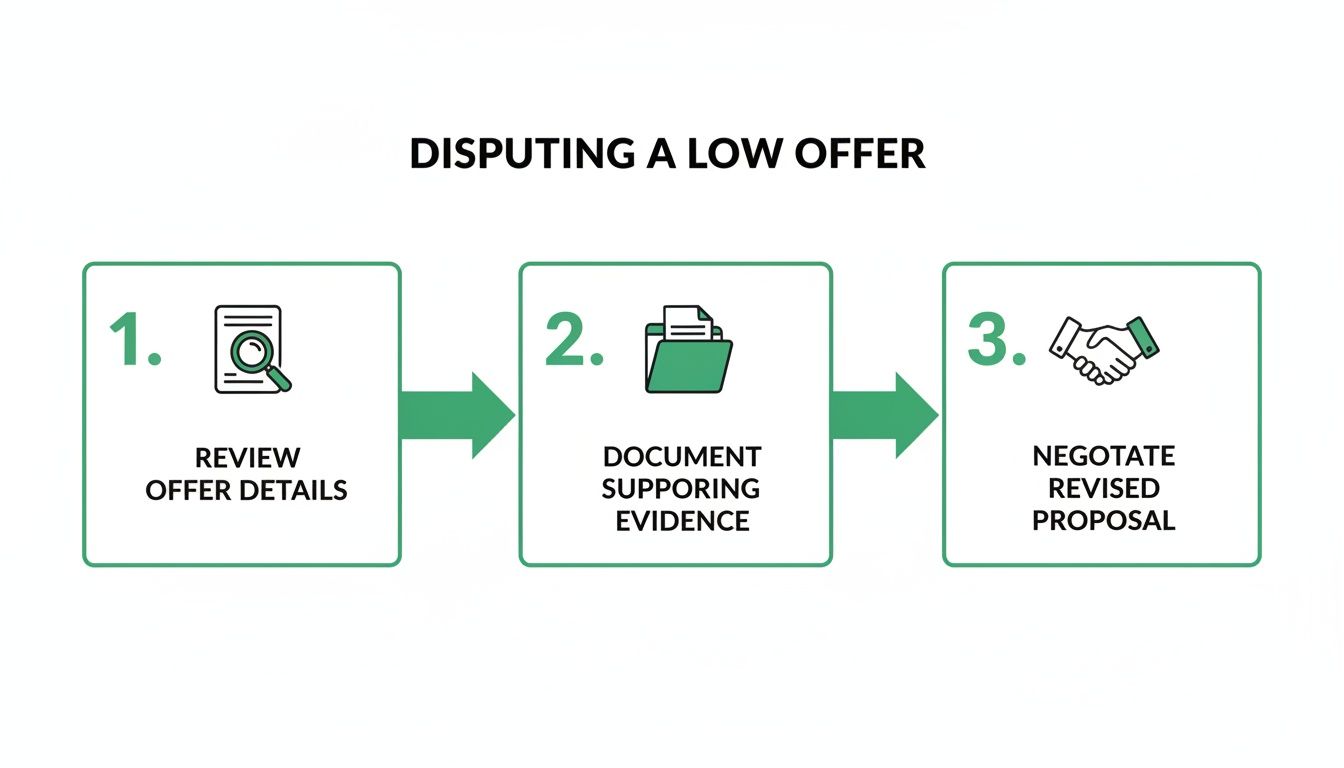
As you can see, the game plan is to move from reviewing their number to documenting the true value. That documentation is the leverage you need to negotiate successfully.
What Makes a Certified Report So Effective
A professional car appraisal for a total loss is built on a foundation of verifiable proof. Unlike the insurer’s typical one-page summary, a certified report is a detailed, multi-page document that breaks down every single component of your vehicle’s value.
A certified appraisal report gives the insurance adjuster the justification they often need to approve a higher payout. It provides a clear, documented trail of evidence that meets their internal compliance standards, making it easier for them to say “yes” to your counteroffer.
A strong report that gets the attention of adjusters and attorneys always includes a few key things:
- Detailed Market Analysis: It uses live data from local dealer sales, private party listings, and even auction results to nail down a true market value.
- Accurate Comparable Vehicles: It identifies and analyzes vehicles that are a genuine match—same make, model, year, trim, mileage, and options, all from your area.
- Fair Condition Adjustments: It applies reasonable adjustments based on industry standards, not bogus deductions for normal wear and tear.
- Defensible Final ACV: It presents a final Actual Cash Value (ACV) that is clear, logical, and backed up by all the preceding data.
Changing the Negotiation Dynamic
When you submit a certified appraisal, your role in the conversation changes instantly. You’re no longer just a claimant asking for more money; you’re a prepared party presenting a fact-based case. This professional approach almost always encourages the adjuster to take your claim more seriously. The report becomes the centerpiece of the negotiation, shifting the focus from their lowball number to your vehicle’s proven worth.
When disputing an offer, you’ll likely need to submit formal documents.
At SnapClaim, our reports are compliant with industry standards and are accepted by insurance companies across the country. They deliver the clear, defensible proof you need to negotiate with confidence.
Invoking the Appraisal Clause in Your Policy
When you’ve gone back and forth with the insurance adjuster and hit a brick wall, it’s easy to feel like you’re out of options. But you’re not.
Most auto insurance policies have a powerful, often overlooked tool designed for exactly this stalemate: the Appraisal Clause. This is your contractual right to settle a dispute over your vehicle’s value. It’s a formal process that takes the final decision out of the insurance company’s hands and puts it into the hands of neutral experts—a critical step to getting a fair insurance total loss payout.
What Is the Appraisal Clause
Think of the Appraisal Clause as the official tie-breaker. When you and the insurer just can’t agree on the Actual Cash Value (ACV) of your totaled car, this provision lets you escalate the dispute without filing a lawsuit. It’s a structured, binding arbitration process built right into your policy.
Invoking the clause kicks off a specific sequence of events:
- You hire an appraiser: First, you select and pay for a certified, independent appraiser to fight for your side.
- The insurer hires an appraiser: The insurance company then does the same, choosing their own expert.
- The appraisers negotiate: The two appraisers get together, present their evidence, and try to agree on your car’s true value.
- An umpire is selected: If they can’t reach an agreement, they jointly pick a neutral, third-party expert called an “umpire.”
- A final decision is made: The umpire looks at the facts from both sides and makes the final, binding call on the vehicle’s value.
This framework ensures the final number is based on expert analysis, not just one party’s self-serving opinion.
When to Invoke the Clause
The right time to pull this trigger is after you’ve already tried to negotiate in good faith. You’ve sent them your own evidence, maybe even an independent car appraisal for a total loss, but the adjuster still won’t budge on their lowball offer.
Key Takeaway: The Appraisal Clause is your ultimate leverage. Just the act of invoking it signals to the insurer that you’re serious and ready to defend your claim. Sometimes, that alone is enough to bring a better offer to the table before the process even gets started.
Before you officially kick things off, you need a rock-solid, data-driven report from a trusted source like SnapClaim. This report gives your chosen appraiser the undeniable proof they need to argue your case from a position of strength. A well-documented appraisal is the bedrock of a successful outcome. You can learn more about the steps to invoke the appraisal clause in our detailed guide.
The Role of a Strong Appraisal
Winning an Appraisal Clause dispute comes down to one thing: the quality of your evidence. Your appraiser’s argument is only as strong as the data backing it up. A flimsy, poorly researched report will get torn apart by the insurer’s expert or the umpire in a heartbeat.
This is exactly why a SnapClaim report is so vital. Our certified methodology arms your appraiser with:
- Localized Market Data: We pull real-time sales figures from your specific geographic area, not generic national averages that don’t apply.
- Accurate Comparables: Our system finds true “comps” that actually match your vehicle’s make, model, year, trim, and mileage.
- Defensible Valuations: Every number we provide is backed by clear, verifiable evidence that holds up under professional scrutiny.
Giving your appraiser this level of detailed proof gives them the ammunition they need to champion your claim and secure the fair resolution you deserve.
Answering Your Top Questions About Total Loss Claims
Dealing with the aftermath of a car accident is stressful enough. When your vehicle is declared a total loss, the confusion can pile up fast. Let’s clear the air and tackle some of the most common questions drivers have during this process.
Can I Keep My Car if It’s a Total Loss?
Yes, in most states, you have the option to keep your vehicle through a process called “owner retention.” If you go this route, the insurance company pays you the car’s actual cash value (ACV) minus its salvage value—what it’s worth for parts or scrap.
Just be aware, your car will be issued a salvage title. This brands the vehicle for life, making it much more difficult to insure or sell down the road. You’ll also be on the hook for all repairs needed to make it roadworthy again, which usually involves passing a strict state inspection.
What About My Recent Upgrades or Brand-New Tires?
This is a big one. Significant improvements like new tires, a recently replaced engine, or high-end custom parts can absolutely increase your car’s pre-accident value. The problem? The insurer’s automated valuation software often completely ignores them.
That’s why you need to gather every receipt and document for an independent appraiser. While the initial insurance total loss payout might not account for those investments, a certified appraisal report from SnapClaim is designed to factor in their added value, helping you get that money back.
Is It Really Worth Hiring a Professional Appraiser?
For most people, the answer is a definite yes. The gap between an insurer’s first offer and your car’s true market value can easily be thousands of dollars. An appraisal fee is a small investment that often helps strengthen your claim for a much higher settlement.
At SnapClaim, we take all the risk out of that decision. If your insurance recovery from the claim is less than $1,000, SnapClaim refunds the full appraisal fee—guaranteed. That’s our Money-Back Guarantee, so you can fight for a fair payout with nothing to lose.
What is the difference between a diminished value and total loss claim?
A total loss happens when the cost to repair your car is more than its pre-accident value. The insurance company pays you for the car’s value, and you typically hand over the vehicle. A diminished value claim applies when your car is repaired. It’s a claim for the loss in resale value your car suffers simply because it now has an accident history. Even after perfect repairs, a car with a collision record is worth less than one without, and you can claim that difference. A car appraisal for a total loss is essential for either situation, as it provides the data-backed proof you need to negotiate a fair settlement.
Get your free estimate today or order a certified appraisal report to strengthen your insurance claim.
👉 Get your free estimate today
About SnapClaim
SnapClaim is a premier provider of expert diminished value and total loss appraisals. Our mission is to equip vehicle owners with clear, data-driven evidence to recover the full financial loss after an accident. Using advanced market analysis and industry expertise, we deliver accurate, defensible reports that help you negotiate confidently with insurance companies.
With a strong commitment to transparency and customer success, SnapClaim streamlines the claim process so you receive the compensation you rightfully deserve. Thousands of reports have been delivered to vehicle owners and law firms nationwide, with an average of $6,000+ in additional recovery per claim.
Why Trust This Guide
This guide was reviewed and verified by SnapClaim’s auto appraisers, who specialize in diminished value and total loss disputes. Our team continually updates every article to reflect current insurer guidelines, valuation standards, and court-accepted appraisal practices, ensuring that you’re relying on information trusted by professionals nationwide.
Get Started Today
Whether you’re challenging a low total loss settlement or proving your vehicle’s post-repair loss in value, SnapClaim makes it simple to take the next step. Generate a free diminished value or total loss estimate in minutes and see how much compensation you may be owed.
👉 Get your free estimate today