


You’ve got the right instinct if you’re staring at a pile of listings and wondering why the adjuster keeps knocking them out. A good comparable vehicle is the difference between a claim that feels vague and one that’s anchored to real market behavior. In a diminished value claim, car value after accident dispute, or insurance total loss payout negotiation, the comp set is where the argument either holds up or falls apart.
Meta title: What Makes a Good Comparable Vehicle for Your Claim
Meta description: Learn what makes a good comparable vehicle, how appraisers choose defensible comps, and how to support a diminished value or total loss claim with local market evidence.
Why Your Comparable Vehicle Choices Can Make or Break a Claim
A lot of owners run into the same frustration. They pull a few online listings, send them to the adjuster, and hear that the cars “don’t count.” The problem usually isn’t that the listings are fake. It’s that they are not good comparable vehicles.
A comparable has to work like a real substitute, not just a car with the same badge. Appraisal guidance for total-loss and diminished-value work focuses on whether the comp matches the subject vehicle’s year, make, model, trim, mileage, options, condition, and local market (Total Loss NW). A base trim and an upper trim can’t be treated as interchangeable, because the market prices equipment, not just body style.
What the adjuster is really checking
The adjuster is usually asking a simple question, even if it gets buried in paperwork. Would a real buyer have crossed paths with this listing and seriously compared it to your vehicle?
If the listing is too old, too far away, or too different in equipment, the other side can argue that it never represented a real shopping choice. Industry guidance says the strongest comp comes from a fresh listing in the relevant local market, inside the right availability window, because a buyer wouldn’t have shopped a car listed months ago or hundreds of miles away (Car and Driver comparison tools).
A useful way to sort competing details is to ask which ones change the price tag. Mileage, trim, options, and condition usually move the number more than a color choice or a minor styling difference. If two listings are close on paper but one has a cleaner history or better equipment, that difference should be carried into the valuation instead of brushed aside. That is the point of a defensible comp set, it turns each mismatch into a clear adjustment rather than an argument about impressions.
Practical rule: the best comp is the one a real buyer would have considered if your vehicle were not in the picture.
That idea matters in both diminished value and total loss work. A weak comp set can push the conversation toward a lower number, while a tight comp set keeps the discussion tied to actual replacement cost and buyer choice. SnapClaim’s appraisal approach is built around that logic, and owners can compare their claim path with SnapClaim’s diminished value guide and Auto Appraisal Expert when they want to see how the selection process works in plain English.
When the local market is thin, the job is not to grab the nearest similar car and hope it sticks. It is to choose the closest legitimate substitute, then explain the gaps plainly. That is where sound valuation work becomes a lot like sorting apples at a market stall. If the basket only has a few close matches, you still compare size, freshness, and condition one by one instead of pretending every apple costs the same.
What a Comparable Vehicle Actually Means in Appraisal Work
A comparable vehicle is not just a car that looks close on a listing page. It is a vehicle that lines up with the subject car on the details that buyers use to judge price, including year, make, model, trim, mileage, options, condition, and local market. That matters because the comp has to answer the same buyer question your car answered, “Would I rather buy this one or that one?”
A useful way to sort this out is to start with the market, then work inward. If you pick a reference point from the wrong town, every comparison built from it can drift off course. A comp from the wrong market does the same thing, because pricing follows local shopping patterns, not just a badge on the grille.
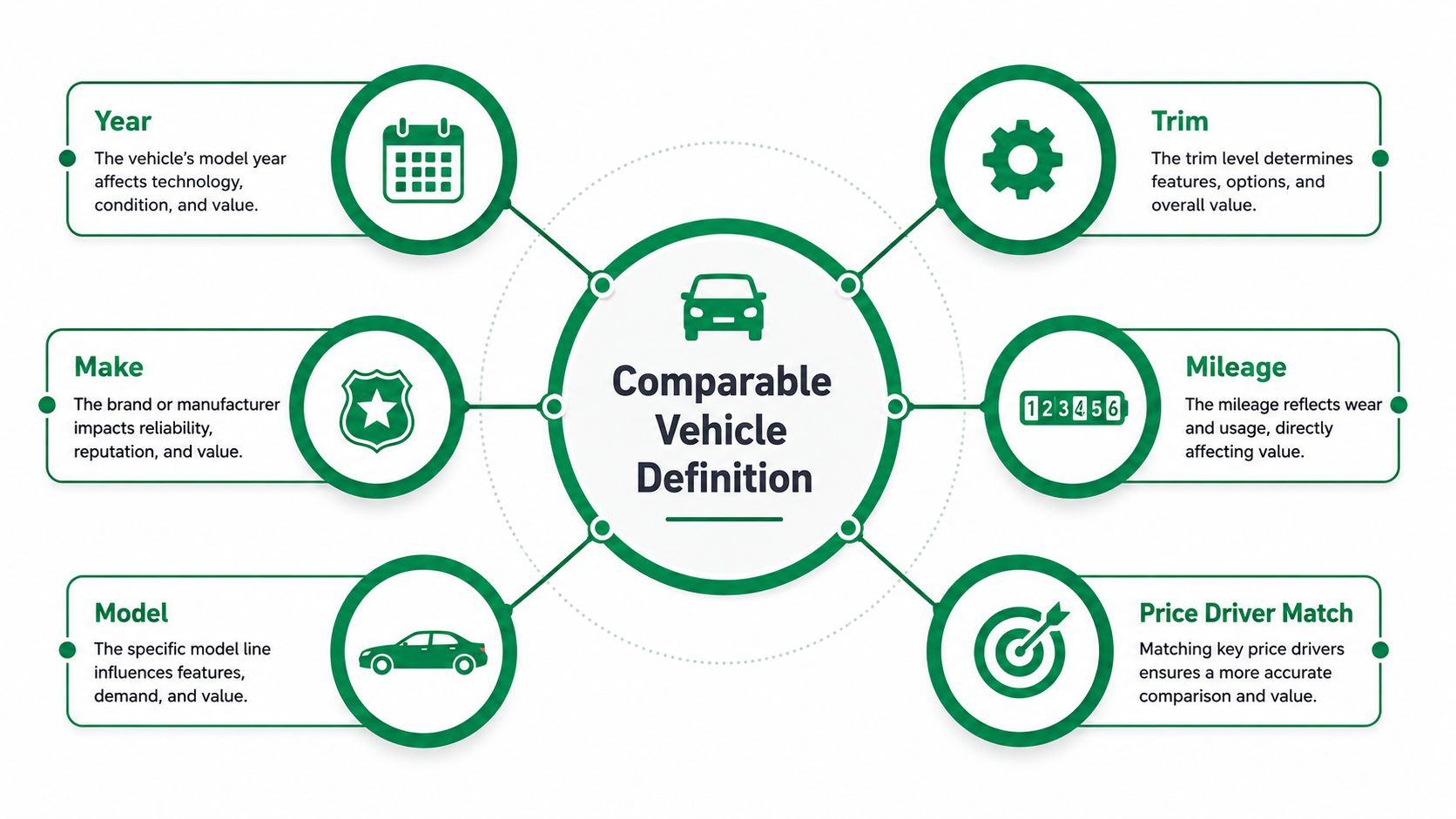
The six core matching factors
Major consumer comparison tools, including Kelley Blue Book (KBB), Edmunds, and Car and Driver, organize side-by-side vehicle comparisons around variables like price, equipment, fuel economy, and ratings. Those tools are not doing appraisal work for you, but they do show which details the market treats as meaningful.
The best way to define a good comp is to look at each factor one at a time:
- Year. The model year should line up closely, because buyers usually compare vehicles within the same generation and model cycle.
- Make and model. The vehicle should come from the same manufacturer and the same line, not just something with a similar shape.
- Trim. A base model and a higher trim can carry very different equipment and pricing, so trim needs careful attention.
- Mileage. The odometer should sit in a similar range, not merely close enough on paper.
- Options and packages. AWD, towing, leather, and tech content can all shift value in a way buyers notice.
- Condition and market. Clean local listings are not the same thing as distressed or out-of-area listings.
When these factors point in different directions, the strongest comp is the one that matches the buyer’s real decision first, then creates the fewest valuation gaps. A car with the same trim but much higher mileage may still be weaker than a slightly different trim with a much closer equipment package, depending on which difference moved the price more in your market. That is the logic SnapClaim applies when it translates each mismatch into a defensible adjustment instead of treating every difference as equal.
A good comp is one that a real buyer would’ve treated as a genuine alternative.
That standard helps explain why one listing gets accepted while another gets rejected. A vehicle can share the same badge and still be a poor match if the trim, mileage, condition, or market context is off.
Matching the Core Specs That Drive Replacement Cost
The easiest way to judge a candidate comp is to walk through the specs one by one. If the listing falls apart on any one of them, it’s not a strong substitute. The point isn’t perfection, it’s whether the vehicle sits close enough to the subject car that a normal buyer would’ve seriously cross-shopped it.
Year, make, model, and trim
Same make and model are the starting point, not the finish line. The trim matters just as much, because a Limited, SE, LX, or XLE usually includes different equipment and a different price story. The U.S. tax code’s comparable-vehicle logic also points to substitutability in weight, size, and use, which reinforces the idea that a comp has to be functionally similar, not just cosmetically similar (Cornell Law School).
A simple example helps. A 2021 Toyota Camry SE is not the same comp as a 2021 Toyota Camry XLE with the V6 if the subject vehicle is also an XLE. The second car has the closer equipment match, and that’s what a buyer would’ve noticed first.
Mileage and options
Mileage should be in a tight band, because it affects wear, remaining life, and market price. Options matter for the same reason. A towing package, all-wheel drive, leather, upgraded audio, or a driver-assist package can all move a vehicle out of the “same car” category and into “different value proposition.”
| Core Spec Match Checklist for a Defensible Comparable | What “Matching” Means | Common Mistake to Avoid |
|---|---|---|
| Attribute | Same or nearly same model-year and same line | Treating any nearby year as interchangeable |
| Trim | Equipment level matches the subject vehicle | Using a base trim against an upper trim |
| Mileage | Similar odometer range | Ignoring a big mileage gap because the body style is the same |
| Options | Same meaningful packages or features | Leaving out AWD, towing, or premium tech |
| Market | Same local shopping area | Pulling in a distant listing that local buyers wouldn't see |
For a broader consumer perspective on how equipment and market context affect comparisons, a useful contrast is the Kia EV6 price Ireland guide, which shows how trim and market conditions can change the way shoppers think about value.
A quick trim test
If you'd hesitate to tell a buyer that the two cars are equivalent, the comp probably doesn't belong in your file. That's why the strongest comparable is the one a real buyer would've viewed as a genuine alternative, not just a car with the same badge.
One more practical point. If the subject car has unusual equipment, a vanilla same-model listing can be misleading even if the photos look close. In appraisal work, the equipment list often matters more than the styling package.
Condition, Title History, and Timing of the Listing
Two cars can wear the same trim badge and still belong in different value bands. One may have a clean title, stronger service records, and tidy cosmetic condition. The other may carry prior repairs, visible interior wear, or a title event that makes buyers hesitate. In appraisal work, those differences are not decoration, they are part of the price.
Why condition changes comparability
Condition is broader than a quick glance at shiny paint or a clean cabin. It covers cosmetic wear, mechanical health, odometer credibility, and whether the title history stays clean from a buyer's point of view. A vehicle with prior accident history on a vehicle history report can price differently from an otherwise similar car, because buyers build in a risk discount. That is why a comp should be screened for disclosure details, service clues, and any signs that the market treated it as a distressed sale.
A useful outside check is to approach the listing the way a careful buyer would before committing to it. The CarForms.co.uk buying tips resource is useful because it reinforces the same habit good appraisers use, verify the car before treating it as a true substitute.
When two listings look close on paper, condition often decides whether they are comparable. A clean, well-kept car can support one value level, while a car with repair history, heavy wear, or incomplete records may need a downward adjustment. That is the practical part of SnapClaim's methodology, identify the difference, then translate it into a defensible valuation adjustment instead of pretending the cars are the same.
Fresh listings matter more than stale ones
Timing matters just as much. A valid comp should come from a fresh listing in the relevant local market and within the right availability window, because a listing from long ago or far away is not what the buyer would have shopped. That simple filter keeps the comparison tied to the market that existed at the time of valuation, instead of an old snapshot that may no longer reflect current behavior. Car and Driver comparison tools can help organize that comparison process, but the point is to avoid mixing old market signals with current ones.
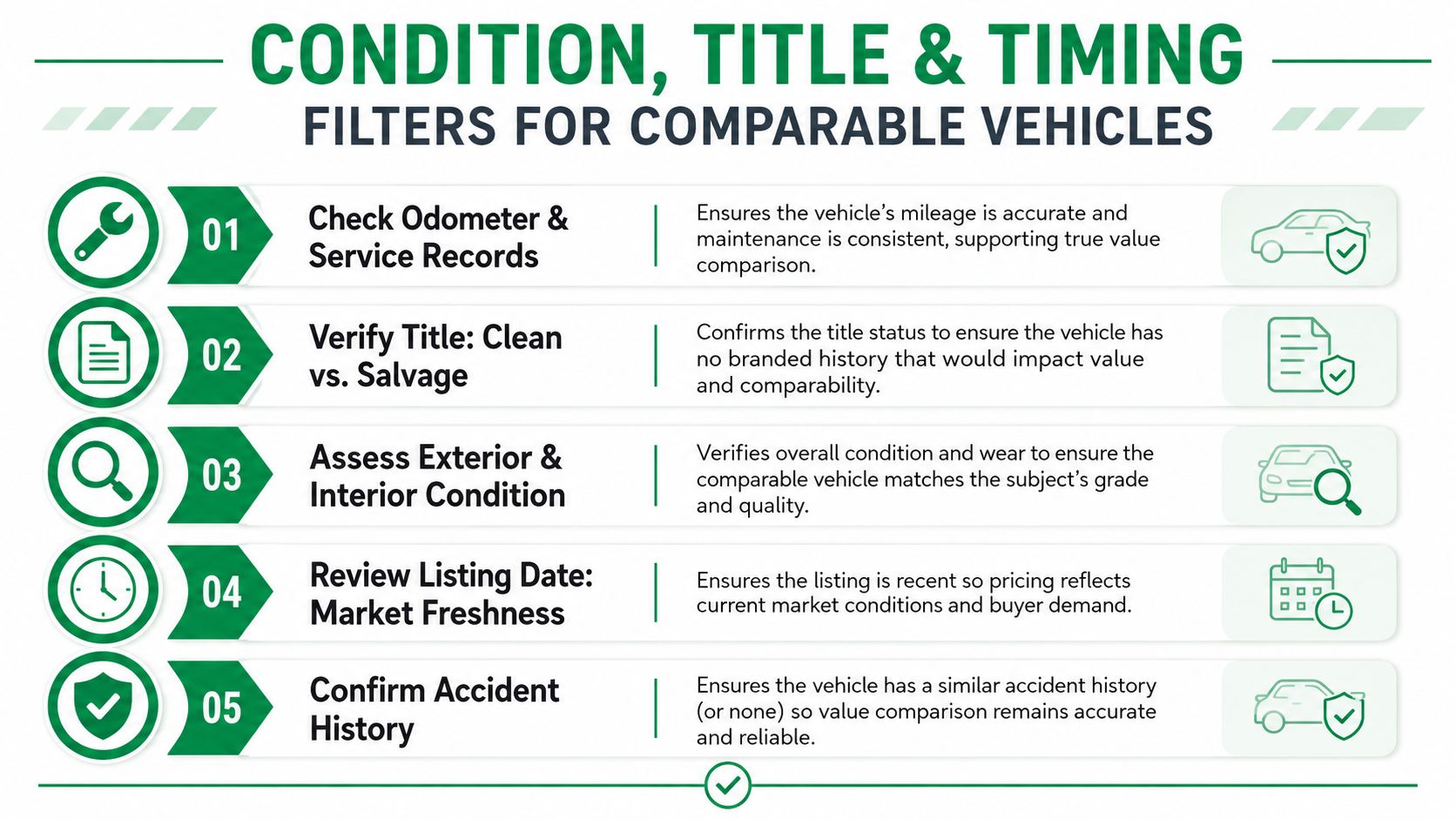
Quick screen before you submit a listing:
- Check the title status. Clean title is easier to defend than branded history.
- Review the odometer. The mileage should make sense for the car's age and records.
- Read the condition notes. Look for repair disclosures, cosmetic damage, or missing equipment.
- Note the listing date. Fresh usually beats stale.
- Confirm the geography. If the car is far outside the market, keep looking.
A short example helps here. Two SUVs can share the same trim and mileage, but if one is locally listed with a clean history and the other is an older listing from a distant market with prior body repairs, they do not carry the same weight. The first tells you what a buyer could realistically have purchased. The second needs caution, because it may reflect a different pool of shoppers, a different condition profile, or a different point in the market.
If the listing would not survive a skeptical buyer's questions, it will not survive an adjuster's either.
That is why condition and timing often matter more than casual shoppers expect. The cleaner and fresher the comp, the easier it is to defend.
Local Market Relevance and the Right Valuation Sources
Geography changes value. A car listed in the wrong region can imply a price your local market never supported, even if the spec sheet looks perfect. That's why the market context has to sit beside the car itself when you decide whether a listing is usable.
Where the best source mix comes from
In claim work, a solid valuation usually draws from a mix of dealer listings, certified pre-owned inventory, manufacturer build sheets, and reputable third-party comparison tools. The logic is straightforward. Dealer inventory shows what's available, build sheets verify what the vehicle was originally equipped with, and comparison tools help separate the important differences from the cosmetic ones.
For a claim file, provenance matters as much as the listing itself. SnapClaim's valuation workflow standardizes which sources count, how local-market adjustments are handled, and how each comp is documented so the report can be defended line by line. That's the part many owners never see. They just see the outcome.
You can also see how that documentation style is presented in SnapClaim's CCC one market valuation report, which is built to keep the comp trail organized rather than scattered across screenshots and notes.
Why source quality changes the argument
An adjuster can challenge a weak source in minutes. A listing with no clear VIN, no visible date, or no condition context creates avoidable doubt. A stronger source trail keeps the conversation focused on the actual valuation question instead of on whether the evidence is trustworthy.

That's also where market relevance shows up in practice. A vehicle that would sell quickly in one region may sit longer or price differently in another. If the comp doesn't belong to the same shopping area, the supposed “match” can mislead the settlement conversation.
For owners trying to keep the process organized, a documented report does a lot of the heavy lifting. It ties each comparable to a real source, then explains why that source belongs in the file.
Why the Wrong Comparable Can Quietly Cost You Thousands
The mistake is simple. They assume that if the year and model match, the comp is good enough. That sounds reasonable until the insurer uses the weakest listing in the pile and turns it into the anchor for the final offer.
How a weak comp set gets used against you
Say a claimant submits three vehicles that all share the same model year and model line. One is a higher trim, one has more mileage, and one comes from a different local market with softer pricing. The insurer doesn't have to accept the strongest one. It can focus on the cheapest one and argue that the market supports the lower number.
That's why the contrarian point matters so much. A same-model car can be a bad comparable if it is cleaner, better-optioned, or sold in a materially different market. Those differences can dominate price more than badge matching alone. In a dispute, the side with the tighter comp logic usually has the better footing.
What a tight set does instead
A tight comp set keeps the negotiation tied to replacement cost, not a discounted outlier. If the listings are recent, local, and close on trim and mileage, the adjuster has less room to dismiss them as cherry-picked. That matters in both diminished value claim files and insurance total loss payout disputes, because the whole argument depends on whether the market evidence reflects the car you lost.
A strong claim file usually looks boring in the best way. The listings line up cleanly, the differences are explainable, and the source trail is easy to follow. That makes it harder for the other side to substitute a cheaper but weaker comparison.
How to Source, Document, and Defend Your Comparables
The best comp search starts narrow and gets wider only if the market is thin. Begin with exact trim, similar mileage, and the same local area. If you can't find enough inventory, expand the radius and date window carefully, but only after you've confirmed that the local market doesn't have enough usable matches.
A workflow you can actually follow
- Build a shortlist. Filter dealer sites by exact trim and a realistic mileage band.
- Expand only when needed. Broaden geography or date range if local inventory is sparse.
- Document every listing. Save the VIN, the listing date, the full page, and any condition notes.
- Note the differences. Write down equipment, title, mileage, and market gaps.
- Organize for defense. Keep each comp tied to a source that an adjuster can verify.
A useful outside example of documentation discipline shows up in collector-market coverage like SwiftJet's collector guide. The vehicle type is different, but the habit is the same, strong files rely on identifiable listings, clear provenance, and a record of what was visible at the time you viewed it.
Document first, argue second. If you can't show what the market looked like on the day you built the file, you're guessing.
How a report package strengthens the file
A structured appraisal report helps. SnapClaim packages comp selection, local market validation, and transparent adjustment logic into a format that's easier to defend than a handful of screenshots. If you're learning how these reports read, SnapClaim's appraisal report guide is a useful companion.
The company also states a Money-Back Guarantee for situations where the insurer rejects the report for valuation reasons, and it says that if your insurance recovery from the claim is less than $1,000, SnapClaim refunds the full appraisal fee. That matters because it lowers the risk of getting a professional report when you're still deciding whether your claim is worth pushing.
Frequently Asked Questions About Comparable Vehicles
Can a newer model year be used as a comparable vehicle?
Sometimes, yes, if same-year inventory is thin and the newer vehicle is still close on trim, mileage, and equipment. The key is whether it still looks like a genuine substitute, not a shortcut.
What if the local market has almost no comparable listings?
That happens more often with EVs and newer used vehicles. In that case, the market window may need to widen carefully, but the report still has to show why the broader set is commercially realistic, not just convenient.
Can a Carfax or accident history report disqualify a comp?
It can make the comp much weaker. If the history changes how buyers price the car, it may not belong in the main comp set unless the subject vehicle has similar condition history.
How many comparables do I need?
Enough to show a pattern, not a one-off. A strong file usually rests on a small group of well-matched vehicles instead of a long list of loose comparisons.
If you're trying to prove fair market value, diminished value, or a stronger total loss settlement, the next step is to build the comparison the right way. SnapClaim provides free estimates and certified appraisal reports that help strengthen your claim with documented, market-based evidence. If you want to see how your own vehicle stacks up, get your free estimate today or order a certified appraisal report to strengthen your insurance claim.
About SnapClaim
SnapClaim is a premier provider of expert diminished value and total loss appraisals. Our mission is to equip vehicle owners with clear, data-driven evidence to recover the full financial loss after an accident. Using advanced market analysis and industry expertise, we deliver accurate, defensible reports that help you negotiate confidently with insurance companies.
With a strong commitment to transparency and customer success, SnapClaim streamlines the claim process so you receive the compensation you rightfully deserve. Thousands of reports have been delivered to vehicle owners and law firms nationwide, with an average of $6,000+ in additional recovery per claim.
Why Trust This Guide
This guide was reviewed and verified by SnapClaim's auto appraisers, who specialize in diminished value and total loss disputes. Our team continually updates every article to reflect current insurer guidelines, valuation standards, and court-accepted appraisal practices, ensuring that you're relying on information trusted by professionals nationwide.
Get Started Today
Whether you're challenging a low total loss settlement or proving your vehicle's post-repair loss in value, SnapClaim makes it simple to take the next step. Generate a free diminished value or total loss estimate in minutes and see how much compensation you may be owed.
👉 Get your free estimate today