

Has your insurance company declared your car a total loss? Their first settlement offer can feel disappointingly low, leaving you wondering how you’ll replace your vehicle. But that initial number isn’t final—it’s just a starting point based on an automated system that often misses what made your car valuable.
Think about it. Did you recently install new tires? Keep a perfect service record? Have a premium package that standard valuation tools overlook? These automated systems often ignore crucial details and local market conditions that determine your car’s true worth.
This is where a total loss appraisal report becomes your most powerful tool. It’s an independent, expert valuation that establishes your vehicle’s true fair market value before the accident, giving you the data-backed proof you need to negotiate a higher payout.
Challenging the Insurer’s Low Offer

An independent total loss appraisal report is your official, evidence-based counter-offer. Prepared by a certified expert, it goes far beyond the generic data points an insurer’s software uses to calculate value.
Here’s why this report is so critical for your claim:
- It Gives You Leverage: You’re no longer just disagreeing with a number. You are presenting a credible, documented alternative from an unbiased professional.
- It Documents True Value: The report meticulously records your vehicle’s specific condition, options, and recent investments, ensuring every value-adding feature is counted.
- It Levels the Playing Field: Insurance companies have teams of experts working for them. This report gives you an expert of your own, instantly strengthening your negotiating position.
Why Your Own Report Matters More Than Ever
The number of vehicles being declared a total loss is climbing. Recent industry data shows that by late 2022, a staggering 27% of all collision claims ended in a total loss—a huge jump from just a few years ago.
When policyholders fight back by invoking their policy’s appraisal clause and presenting their own report, the results are often dramatic. Final settlements frequently increase by 77% to 102%. You can learn more about how market trends are influencing total loss appraisals and see why an independent valuation is so important.
A common misconception is that the insurance company’s valuation is final. In reality, their initial offer is just the starting point of a negotiation, and your policy includes a clause allowing you to present your own appraisal.
Without a certified report, you’re stuck arguing your opinion against their so-called “data.” With one, you’re presenting cold, hard facts. That simple shift empowers you to reject a lowball offer and demand a fair insurance total loss payout. At SnapClaim, we provide the certified, data-driven reports that strengthen your claim.
What’s Inside Your Total Loss Appraisal Report?
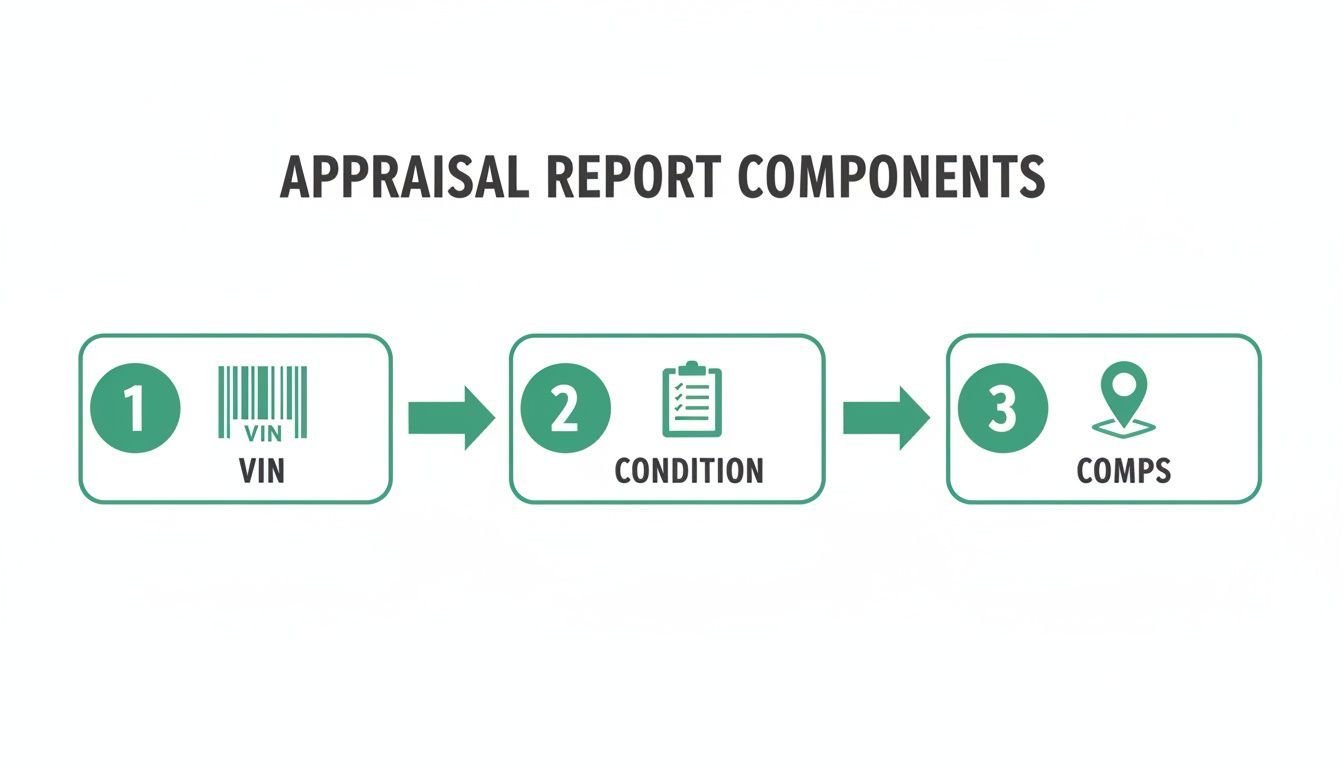
A professional total loss appraisal report is much more than a single number—it’s the detailed, evidence-backed story of what your vehicle was actually worth. Understanding its components allows you to speak confidently with any insurance adjuster because you’ll know exactly how the final value was calculated.
Think of it like a home appraisal. An appraiser doesn’t just guess a value; they analyze square footage, condition, and recent sales of similar homes in the neighborhood. A vehicle appraisal works the same way. Let’s break down the key sections you’ll find in a comprehensive report from a service like SnapClaim.
Vehicle Identification and Factory Options
The report starts with the basics, anchored by your car’s Vehicle Identification Number (VIN). This 17-digit code is like your car’s DNA, unlocking critical details straight from the manufacturer.
- VIN Decoding: This process confirms the precise year, make, model, trim level, and engine, eliminating guesswork and ensuring the valuation starts from an accurate baseline.
- Factory-Installed Options: The VIN also reveals every optional package your car came with, like a premium sound system, sunroof, or advanced safety features. These add-ons significantly impact the car value after an accident but are frequently missed by generic insurance tools.
This first step is non-negotiable. It establishes the exact version of your vehicle you owned. A “Touring” trim is worth more than a “Sport” trim, and this part of the report proves which one was yours.
Pre-Accident Condition and Recent Upgrades
Next, the report details your vehicle’s specific condition right before the crash. This is where an independent appraisal proves its worth, as it captures the human details that automated systems can’t see. An adjuster who has never seen your car has no idea how well you cared for it.
A solid condition assessment includes:
- Overall Condition Rating: Based on photos and your description, the appraiser assigns a rating (like excellent, very good, or average), supported by notes on paint quality, interior cleanliness, and mechanical upkeep.
- Recent Maintenance: Did you just spend $800 on new tires or complete a major service last month? Receipts for recent work provide hard proof of your investment, adding directly to its value.
- Aftermarket Additions: Custom wheels, an upgraded stereo, or a professionally installed remote starter all make a car more valuable. These are documented and factored into the final number.
It’s a classic insurance tactic to assume every vehicle is in “average” condition. A detailed report forces them to acknowledge your car’s superior upkeep with facts, justifying a higher payout.
Comparable Market Analysis
This is the heart of the total loss appraisal report. Here, the appraiser finds recently sold vehicles—”comparables” or “comps”—that are the closest possible match to yours. This isn’t a quick online search; it’s a careful analysis focused on your local market.
The best comps are selected based on:
- Geographic Proximity: Valuations are based on what cars are selling for in your area, not in a city hundreds of miles away with a different market.
- Similar Mileage: Comps will have mileage within a very close range of your vehicle’s odometer reading.
- Identical Trim and Options: A good appraiser hunts for exact matches to ensure a true apples-to-apples comparison.
The appraiser then makes small, documented adjustments to the comps’ prices to account for minor differences. This transparent process produces your vehicle’s fair market value and gives you the undeniable proof you need to negotiate a fair insurance total loss payout.
How a Data-Driven Appraisal Report Is Built
Building a modern total loss appraisal report is a precise science, blending huge datasets with the seasoned eye of a human expert. The goal is to construct an undeniable case for your car’s true pre-accident value, leaving no room for an insurer to lowball your payout.
Services like SnapClaim have moved away from slow, subjective methods to embrace a transparent, data-driven approach. The process involves digging through millions of data points to find out exactly what your vehicle was worth in your specific local market.
The raw data comes from sources like:
- Dealer Listings
- Private Party Sales
- Auction Results
- Classified Ad Repositories
We filter this mountain of information to find the best “comparable” vehicles—ones that are a near-perfect match for your car’s year, make, model, trim, mileage, and options.
The Human Element in a Tech-Driven World
While technology gathers and sorts data, the process is incomplete without an expert human review. This is a critical difference from the fully automated systems insurance companies often use. At SnapClaim, every data-driven valuation is meticulously reviewed by an expert to guarantee accuracy and defensibility.
This review is handled by pros with top-tier industry certifications like I-CAR (Inter-Industry Conference on Auto Collision Repair) and ASE (Automotive Service Excellence). They comb through the data, double-check the comparable vehicles, and make final adjustments based on your car’s unique story.
This blend of powerful data analysis and certified human expertise results in a “bank-grade” report—credible, transparent, and built to stand up to any scrutiny from an insurance adjuster.
Speed and Accuracy When It Matters Most
Technology is shaking up how total loss appraisals are done. Many insurers now use tools like CARFAX’s Total Loss Valuation Report, which taps into a massive database of used car listings and automates tax and fee calculations. You can read more about these advancements in valuation technology on PR Newswire.
While insurers use data to make their internal processes faster, you can use that same data-driven approach to defend your claim. An independent report levels the playing field by arming you with your own verified evidence.
Platforms like SnapClaim use a similar data-first strategy but with one huge difference: our goal is to empower you. Our unique methodology can produce a certified and defensible total loss appraisal report in under an hour. This speed allows you to counter a lowball offer almost immediately, keeping the settlement process moving without frustrating delays.
A Step-by-Step Guide to Using Your Report
Receiving your certified total loss appraisal report is a huge step, but its real power comes from how you use it. Think of it as your official evidence in a negotiation—the key that unlocks a fair settlement. This isn’t about being aggressive; it’s about being prepared, professional, and firm.
Step 1: Prepare Your Submission Package
Organize all your documents into a single package. This signals to the insurance adjuster that you’re serious and makes it simple for them to review your case.
Your package should include:
- A brief cover letter politely rejecting their initial offer.
- The insurer’s valuation report they sent you.
- Your independent total loss appraisal report from SnapClaim.
- Supporting documents, like receipts for recent tires or major service.
Step 2: Formally Submit Your Report
Email your complete package directly to the insurance adjuster. An email creates a digital paper trail. Use a clear subject line like: “Response to Total Loss Settlement Offer for Claim #[Your Claim Number]”.
In the email itself, be direct and professional.
Sample Wording for Your Email:
“Dear [Adjuster’s Name],Thank you for your settlement offer for my [Year, Make, Model], claim #[Your Claim Number]. After careful review, I must reject the offer as it does not reflect the vehicle’s true fair market value before the loss.
Attached, you will find a certified total loss appraisal report from an independent appraiser, which provides a data-backed valuation based on local market comparables and my vehicle’s specific condition. Please review this report and provide a revised settlement offer that reflects this evidence.”
The tone is firm but respectful, shifting the conversation from opinions to evidence.
Step 3: Follow Up and Stand Your Ground
Give the adjuster a few business days to review your report. If you don’t hear back, a polite follow-up email is appropriate. Expect some pushback—it’s part of their job. Your report is your anchor, so don’t get flustered. If the adjuster tries to dismiss it, ask for specific, data-based reasons in writing.
Step 4: Invoke the Appraisal Clause if Necessary
If the insurance company refuses to negotiate in good faith, it’s time to use your trump card: the “Appraisal Clause.” Found in nearly every standard auto policy, this provision is your contractual right to a formal process for settling valuation disputes.
The Appraisal Clause typically requires both you and the insurer to hire a competent appraiser. If they can’t agree on a value, a neutral third-party “umpire” makes a final, binding decision. Invoking this clause shows you’re serious and often brings the insurer back to the table with a much more reasonable offer.
How to Handle Common Insurance Company Pushback
Insurance adjusters are professional negotiators. When you hand over your independent total loss appraisal report, expect them to push back. Knowing their common tactics ahead of time gives you the confidence to stand your ground and keep the conversation focused on the facts.

Tactic 1: “Your Comps Aren’t Valid”
Adjusters often attack the comparable vehicles (“comps”) in your appraisal, presenting their own list of cars that are in worse shape or located in cheaper markets.
Your Response:
Explain that a legitimate appraisal must use comps from your local market.
Here’s what to say: “My report’s value is based on comparable vehicles sold right here in my local market, which is the industry standard for finding a fair market value. The vehicles you’ve sent over are from a different market and don’t reflect what it would actually cost me to replace my car here.”
This tells the adjuster you know the rules. Our guide on the total loss evaluation process explains why local data is crucial.
Tactic 2: “Your Car Was Only in ‘Average’ Condition”
An adjuster who has never seen your vehicle may claim it was just in “average” condition to justify a lower offer.
Your Response:
Politely point them to the “Condition Assessment” section of your total loss appraisal report.
- Use your photos: Visual proof of your car’s pristine condition is hard to argue with.
- Show the receipts: Remind them of recent service records that prove your investment in the car’s upkeep.
- Quote the appraiser: Your report contains an expert’s notes on why your vehicle was above-average. That professional opinion carries more weight than an adjuster’s assumption.
Tactic 3: “Our Software’s Number is Final”
Adjusters may claim their valuation software (like CCC ONE or Mitchell) is the “industry standard” and non-negotiable.
Your Response:
Acknowledge their tool, but pivot back to the facts. These programs are only as good as the data they’re fed.
Try this phrasing: “I understand your company uses a valuation tool, but its accuracy depends on the data it’s given. My independent report uses specific, verifiable comps and accounts for my vehicle’s exact options and condition, which your system seems to have missed. Let’s focus on the differences in the data.”
This response smartly points out the factual gaps your certified report has filled, steering the negotiation toward a fair insurance total loss payout.
Get the Fair Settlement You Deserve
Dealing with a total loss claim is stressful. You’re up against a confusing process and a settlement offer that feels wrong. But you don’t have to accept their first offer as the final word. A certified total loss appraisal report is the most powerful tool you can have in your corner.
SnapClaim replaces the insurance company’s opinions with hard, market-verified data, putting you on an equal playing field.
Your Partner for a Fair Payout
We designed our service to be fast, accurate, and credible. With SnapClaim, you get:
- Speed When It Matters: Get a certified, court-ready appraisal report in under an hour to counter a low offer immediately.
- Data-Driven Accuracy: Our system analyzes millions of real-world market data points, basing your valuation on what cars like yours were actually worth in your local area.
- Expert Credibility: Every report is reviewed by I-CAR and ASE certified professionals, giving your claim the expert backing it needs to be taken seriously.
To make the most of your appraisal, it helps to understand the full claim process. Learning how to file a car accident claim ensures you have all your bases covered.
Our Risk-Free Guarantee to You
We are so confident our reports will help you that we stand behind them with a simple, powerful promise. You shouldn’t have to risk your money to fight for what’s rightfully yours.
If your insurance recovery from the claim is less than $1,000, SnapClaim refunds the full appraisal fee—guaranteed.
This guarantee removes the financial risk from your decision. It’s our commitment to you: investing in a SnapClaim report is a no-lose step toward securing the fair compensation you’re owed.
Don’t let the insurance company dictate what your vehicle was worth. Get your free estimate or order a certified total loss appraisal report to strengthen your insurance claim.
Frequently Asked Questions (FAQ)
Here are straightforward answers to common questions vehicle owners have when dealing with a total loss appraisal report.
What if my insurance company refuses to look at my report?
This is a common fear, but you have a powerful tool called the Appraisal Clause. This standard part of most auto insurance policies is your contractual right to a formal process for settling valuation disputes. If your insurer refuses to negotiate using your report, you can formally invoke this clause, obligating them to participate in a resolution process.
Can I claim diminished value if my car is a total loss?
No, you cannot. A diminished value claim is for vehicles that have been repaired after an accident and have lost market value as a result. A total loss claim, on the other hand, compensates you for the vehicle’s entire pre-accident value because it is not being repaired. You can only file one or the other.
Is it too late to get a report if I already accepted an offer?
Unfortunately, yes. When you accept a settlement offer and sign the insurer’s release form, you legally close the claim and release them from any further financial obligation. This is why it’s so critical to challenge a lowball offer before you agree to anything or sign any paperwork.
How long does negotiation take after I submit my report?
The timeline depends on the insurance company. Some adjusters may revise their offer within a few business days after seeing the solid data in your report. Others might take one to three weeks to review it and get internal approval. Patience and polite, persistent follow-up are key during this stage.
About SnapClaim
SnapClaim is a premier provider of expert diminished value and total loss appraisals. Our mission is to equip vehicle owners with clear, data-driven evidence to recover the full financial loss after an accident. Using advanced market analysis and industry expertise, we deliver accurate, defensible reports that help you negotiate confidently with insurance companies.
With a strong commitment to transparency and customer success, SnapClaim streamlines the claim process so you receive the compensation you rightfully deserve. Thousands of reports have been delivered to vehicle owners and law firms nationwide, with an average of $6,000+ in additional recovery per claim.
Why Trust This Guide
This guide was reviewed and verified by SnapClaim’s auto appraisers, who specialize in diminished value and total loss disputes.
Our team continually updates every article to reflect current insurer guidelines, valuation standards, and court-accepted appraisal practices, ensuring that you’re relying on information trusted by professionals nationwide.
Get Started Today
Whether you’re challenging a low total loss settlement or proving your vehicle’s post-repair loss in value, SnapClaim makes it simple to take the next step.
Generate a free diminished value or total loss estimate in minutes and see how much compensation you may be owed.
👉 Get your Total loss Appraisal Today