

Hearing an insurance adjuster say your car is a “total loss” can be stressful. But all it really means is the insurance company has decided it’s cheaper to pay you for the vehicle’s value than to repair it.
The critical part most people miss is that the first settlement offer is just that—an offer. It’s their opening move in a negotiation, not the final word on what your car was actually worth. This is where a total loss car appraisal becomes your most powerful tool.
What a Total Loss Means for You
When an insurer declares your car a total loss, they are making a purely financial decision. They’ve calculated that the cost of repairs is more than the car’s Actual Cash Value (ACV)—what it was worth on the market moments before the accident. Their goal is to write you a check for that ACV (minus your deductible) and close the claim.
The problem is, their calculation of your car’s value is often too low. The initial settlement figure comes from their internal software, which is great for their efficiency but often fails to capture the true, real-world value of your specific vehicle.
Why the First Offer Is Just a Starting Point
Think of the insurance company’s first offer as their opening bid. It’s designed to protect their bottom line, which means it probably doesn’t account for your car’s excellent condition, recent upgrades, or what similar cars are actually selling for in your area.
Too many people accept that first number, leaving hundreds or even thousands of dollars on the table without ever knowing it.
This is why an independent total loss car appraisal is a game-changer. It’s a professional, data-backed report created by a certified expert who works for you, not the insurance company. Its entire purpose is to establish a fair, accurate market value, giving you the solid proof you need to challenge a lowball offer.
A certified appraisal changes the entire dynamic. It’s no longer your word against theirs. You are now having a data-driven negotiation, and you have the evidence to demand a payout that lets you buy a truly comparable replacement vehicle.
The Power of an Independent Appraisal
Getting your own appraisal is the single most effective action you can take to protect yourself financially. It signals to the insurer that you’re serious about getting paid fairly and immediately shifts the balance of power. Instead of just pleading your case, you present a defensible, expert-backed number.
This is critical for a few key reasons:
- Challenging Unfair Valuations: It provides a clear, documented counter-offer to the insurance company’s low assessment.
- Negotiating with Confidence: When you have an expert report, you can argue for what you’re rightfully owed without second-guessing yourself.
- Achieving a Fair Settlement: It levels the playing field and is often the key to unlocking a significantly higher insurance total loss payout.
Once you understand this process, you can move forward with the right tools to get the fair outcome you deserve.
How Insurers Calculate Your Car’s Value

When an insurance company gives you a settlement number, it isn’t pulled from thin air. They typically use large, third-party valuation services like CCC ONE or Mitchell to generate a report calculating your vehicle’s Actual Cash Value (ACV).
This automated process is designed for their speed and efficiency, not your fair compensation. The software scans databases for “comparable” vehicles to establish a base value, then makes adjustments for your car’s mileage, options, and pre-accident condition.
But this is exactly where things often go wrong for you. The system is built on data that can be flawed, inconsistent, and slanted to protect the insurer’s bottom line.
The Problem with Automated Valuations
Imagine trying to value your well-kept home by only looking at foreclosure sales in another town. The final number would be completely off, right? That’s what often happens with these automated valuation reports.
Here are the most common issues we see:
- Poor “Comparable” Vehicles: The report may use cars that are a lower trim level, have fewer features, or are from a different market where prices are lower.
- Unfair Condition Deductions: Adjusters often apply harsh deductions for minor, everyday wear-and-tear. You’re essentially penalized for just driving your car.
- Outdated Market Data: The system can lag behind the real world, failing to account for current market demand for your specific make and model. This almost always leads to a lowball offer.
That’s why accepting their first offer is one of the biggest financial mistakes you can make after an accident. Getting familiar with their methods is your first line of defense, and our guide on Actual Cash Value dives even deeper into how these numbers are calculated.
Decoding the Insurer’s Valuation Report
When you receive the valuation report, it’s time to review it carefully. Don’t let the dense format intimidate you. You only need to focus on a few key areas where mistakes are most common.
First, check the basics. Did they list the correct make, model, year, and trim level? A simple error here can swing the value by thousands. Next, look at the options and features. Did they miss your premium sound system, sunroof, or technology package?
Then, dig into the “comps.” Are the comparable vehicles they listed genuinely similar to yours? Check their mileage, condition ratings, and where they were sold. If the cars they’re using are lower-spec models in poor condition, they are dragging your car’s value down.
Insurance companies count on you accepting their first number without a fight. By spotting the errors in their report, you completely change the dynamic and show them you are an informed consumer.
When you push back, documentation is everything. A detailed history, perhaps using a thorough vehicle inspection checklist, can prove your car was in excellent shape before the crash. This is your evidence against unfair condition deductions.
Finally, look closely at the adjustments. Did they deduct an unreasonable amount for high mileage or a tiny scratch? These are all negotiable points, especially if you have maintenance records to prove your vehicle was meticulously cared for. Rising repair costs are pushing more cars into the total loss category. A report from CCC Intelligent Solutions highlights that total loss frequency in collision claims reached a record 22.8% in 2023. In this environment, getting an accurate, fair valuation is more critical than ever.
The table below breaks down the fundamental differences between how an insurer sees your car’s value and how a real-world, independent appraiser determines it.
Insurer Valuation vs. Independent Appraisal
| Valuation Factor | Typical Insurer Approach | Independent Appraisal Approach |
|---|---|---|
| Comparable Vehicles | Uses automated system (CCC/Mitchell) with potentially mismatched comps. | Hand-selects truly comparable vehicles from the current local market. |
| Condition Assessment | Applies standardized, often harsh deductions for normal wear. | Conducts a detailed, holistic review of the vehicle’s actual condition. |
| Data Sources | Relies on proprietary, often outdated internal databases. | Pulls real-time data from NADA, KBB, market listings, and auction results. |
| Valuation Goal | To close the claim efficiently and control payout costs. | To determine the true, fair market value a willing buyer would pay. |
As you can see, the approaches are worlds apart. The insurer’s method is built for volume and cost control, while an independent appraisal is focused solely on accuracy.
To truly challenge the insurer’s lowball offer, you need evidence they can’t ignore. This is where a total loss car appraisal from an independent expert gives you the leverage you need to get paid what you’re rightfully owed.
Building Your Case with the Right Evidence
Trying to challenge an insurer’s low settlement offer without proof is a losing battle. It’s not enough to just say your car was worth more; you need to build a solid case that tells the true story of your vehicle. Think of yourself as a detective. Every receipt, photo, and service record is a clue that strengthens your position.
The insurance company is working from a generic playbook. Your job is to paint a specific, vivid picture of your car, highlighting everything that made it better than the average vehicle their system found.
Your Essential Evidence Checklist
Gathering the right paperwork is the first—and most important—step. Before you get back on the phone with the adjuster, start collecting the documents that prove your car’s history, condition, and true value. The foundation of any strong claim rests on good records, from car accident scene documentation to a well-maintained vehicle history.
Here’s a checklist of exactly what you need:
- Maintenance and Service Records: This is proof you took care of the vehicle. Regular oil changes and timely repairs counter any unfair deductions the insurer might try to make for “poor condition.”
- The Original Bill of Sale: This document confirms the exact trim level and optional features you paid for. Adjusters often miss these details, which can add thousands to the value.
- Receipts for Recent Upgrades: Did you install new tires, a better sound system, or replace a major part? Every dollar you recently invested adds to its pre-accident value.
- A Clean Vehicle History Report: Pull a CarFax or AutoCheck report. If it’s clean, it proves your car had no prior accident history, making it more valuable on the open market.
The Power of Visual Proof
Never underestimate the impact of a good photo. Pictures tell a story that paperwork simply can’t. An adjuster can easily apply a generic deduction for “wear and tear,” but it’s much harder for them to argue with a photo that proves otherwise.
Dig through your phone and cloud storage for clear, recent photos of your car from before the accident. You’re looking for images that show:
- Pristine Exterior: Find photos that highlight clean paint and a dent-free body.
- Immaculate Interior: Look for pictures showing spotless upholstery and a well-kept dashboard.
- Special Features: Got a shot of the sunroof, navigation screen, or custom wheels? Use it.
A single photo showing your car’s clean exterior a week before the crash can be more persuasive than a dozen receipts. It provides a clear, pre-loss baseline that is difficult for an insurer to dispute.
Creating a Comprehensive Value Narrative
Once you have all your evidence, get organized. Your goal is to provide the insurance adjuster a complete file that makes it impossible for them to ignore why their first offer was too low.
Don’t just send a pile of papers. Combine your documents and photos to tell a story. For example, pair the receipt for a new set of tires with a clear photo showing the deep, fresh tread. This isn’t just about supporting your claim for a higher car value after accident; it’s a strategic move. It signals to the insurer that you are informed, prepared, and not going away quietly. An independent total loss car appraisal will use this exact type of evidence to build its valuation—by doing this work now, you’re getting a huge head start on securing the fair settlement you’re owed.
A Step-by-Step Guide to Disputing a Low Settlement Offer
Getting a lowball settlement offer can be frustrating, but it’s rarely the final word. It’s the start of a negotiation.
Challenging an insurer’s valuation is a normal part of the claims process, but you need a plan. Follow these steps, and you’ll build a powerful case that forces the insurance company to come back to the table with a fair number.
Step 1: Request the Insurer’s Valuation Report
Your first move is simple: formally ask for a complete copy of their valuation report. This is the document they used to arrive at their offer, often generated by services like CCC ONE or Mitchell. You have a right to this information.
Once you have it, go over it line by line. This report is the foundation of their offer, and it’s frequently filled with errors you can use to your advantage.
Step 2: Scrutinize the Report for Inaccuracies
Now it’s time to review the report closely. Look for specific mistakes that are dragging down your car’s value.
Here’s exactly what to look for:
- Vehicle Details: Did they get the year, make, and model right? More importantly, did they list the correct trim level? An LE model is not the same as an XLE.
- Options and Packages: Check for everything you paid extra for. Did they miss your sunroof, premium sound system, or technology package? Every feature adds value.
- Condition Adjustments: Insurers often apply vague deductions. They may have assigned a “fair” or “poor” condition rating based on assumptions. Your maintenance records and photos can prove your car was in excellent shape.
- Comparable Vehicles: This is the big one. Are the “comps” they used actually comparable to your car? Look at their mileage, condition, options, and location. If they valued your low-mileage SUV using high-mileage base models from another state, their entire valuation is flawed.
This whole process boils down to three essential pillars for building your case.
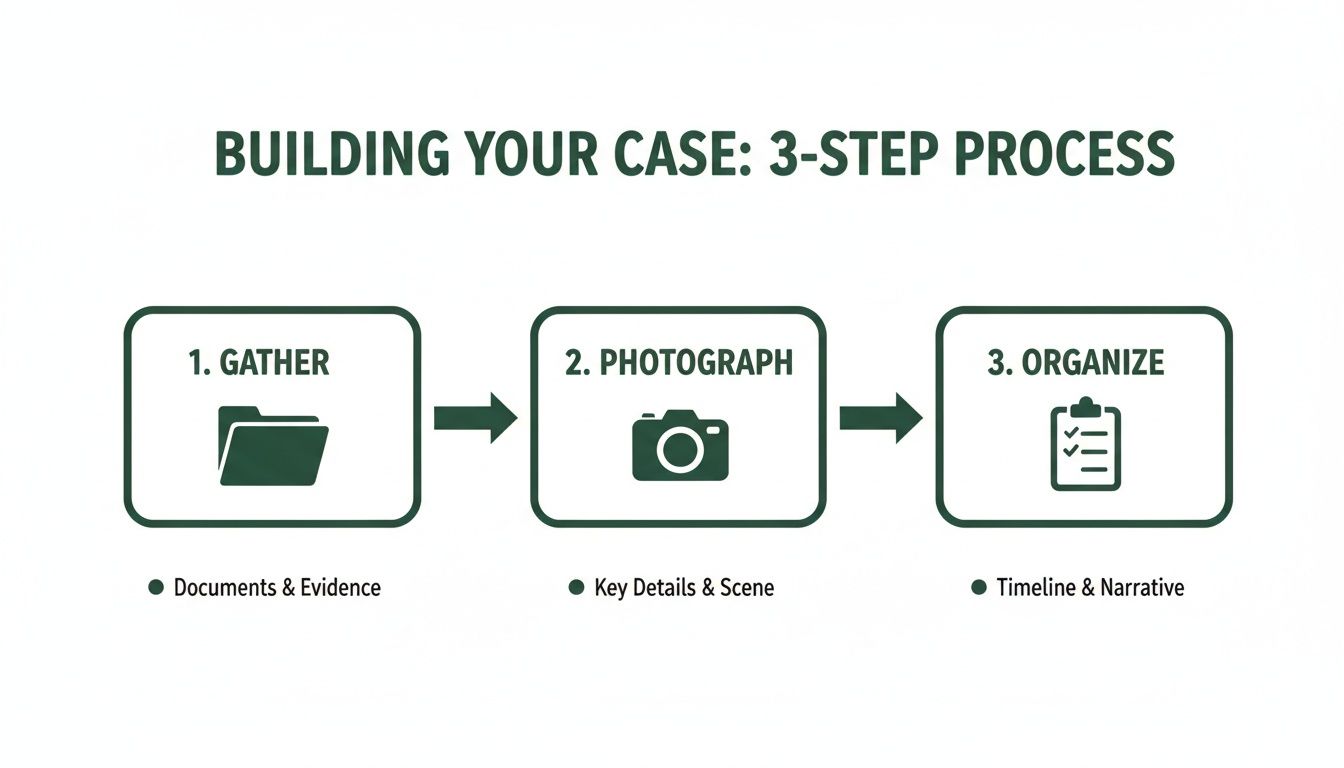
This simple framework—gather documents, photograph details, and organize your evidence—is the backbone of every successful dispute.
Step 3: Order an Independent Appraisal
Once you’ve found holes in their report, it’s time to establish the true market value with your own evidence. An independent total loss car appraisal is your single most powerful tool. A certified, data-backed report from an unbiased expert like SnapClaim provides a defensible valuation that an adjuster can’t simply ignore.
An independent appraisal completely changes the negotiation dynamic. It’s no longer your opinion against theirs; it’s your expert’s hard data versus their questionable report. This step is often enough to make insurers raise their offer significantly.
Step 4: Draft a Formal Demand Letter
With your evidence and independent appraisal in hand, you’re ready to make your counter-offer. Draft a professional demand letter and send it directly to the insurance adjuster.
Your letter should be clear, professional, and to the point. It needs to:
- Formally state that you reject their initial settlement offer.
- List the specific errors you found in their valuation report.
- Present your own proof, including maintenance records and photos.
- Attach your certified independent appraisal report as proof of the vehicle’s fair market value.
- Make a firm counter-demand for the value stated in your appraisal.
Taking this organized approach shows the insurer you’re serious and well-prepared. As more cars get totaled due to high repair costs, a well-supported dispute is more important than ever. Industry data from sources like Solera’s blog confirms this trend, making it essential to advocate for your vehicle’s true worth.
How an Independent Appraisal Strengthens Your Claim
Think of an independent appraisal as more than just a second opinion. It’s objective, defensible evidence that levels the playing field with your insurance company. When you negotiate with a certified report, you’re having a business discussion backed by data.
Unlike the insurer’s automated valuation, a true total loss car appraisal digs into real-time, local market data. This process is handled by licensed experts who work for you, not the insurance carrier. Their only job is to determine the fair market value of your specific car.
Providing Undeniable Proof
The power of an independent report is its credibility. It delivers the proof you need to push back against a lowball offer and justify your demand for a higher payout. A certified appraisal breaks down your vehicle’s value, ensuring every unique attribute is accounted for.
This means getting credit for what matters:
- Precise Condition: The report documents your car’s actual pre-accident condition, overriding the generic deductions insurers often make.
- Local Market Comps: It uses genuinely comparable vehicles that recently sold in your area, reflecting what local buyers are actually paying.
- Upgrades and Features: You get proper credit for every option, package, and recent investment you’ve made.
Handing the adjuster a professional report sends a clear signal: you’re serious about getting what your car was worth. This alone often encourages them to negotiate in good faith.
A Risk-Free Step Toward Fair Compensation
We understand that paying for an appraisal when you’re already dealing with a financial loss can feel difficult. That’s why SnapClaim offers a Money-Back Guarantee. If your insurance recovery from the claim is less than $1,000, SnapClaim refunds the full appraisal fee — guaranteed.
This makes getting a professional appraisal a completely risk-free step in your fight for a fair insurance total loss payout. It removes the financial uncertainty and lets you arm yourself with expert evidence without any downside.
An independent appraisal gives you leverage. It shifts the burden of proof back to the insurance company, forcing them to justify why their valuation is lower than a data-driven, expert-backed report.
If the insurer still refuses to negotiate, your policy likely has a built-in mechanism for resolving the dispute. Our guide on invoking the appraisal clause explains exactly how that works. An independent report from SnapClaim gives you the strong, defensible foundation you need for this process, ensuring you’re prepared to secure the compensation you deserve.
Frequently Asked Questions About Total Loss Claims
Dealing with a total loss can be overwhelming. Here are straightforward answers to common questions to help you navigate your claim with more confidence.
Can I keep my car if it’s declared a total loss?
Yes, in most states, you can choose to keep your vehicle. This is called owner retention. The insurance company will pay you the car’s actual cash value (ACV) minus its salvage value. You will then be issued a salvage title and will be responsible for all repairs needed to make the car roadworthy again, which typically requires a state inspection.
Can I claim diminished value if the accident wasn’t my fault?
If your vehicle is a total loss, you cannot also file a diminished value claim. A total loss settlement is designed to compensate you for the full pre-accident value of the car. A diminished value claim applies only when your vehicle is repaired, to compensate for the loss in resale value it suffers due to its accident history.
What if the insurance company won’t negotiate?
If the insurer rejects your evidence and refuses to offer a fair settlement, your auto policy likely includes an Appraisal Clause. This is a provision specifically designed to resolve valuation disputes. It allows both you and the insurer to hire independent appraisers, who then work to agree on a value. A certified report from SnapClaim provides the expert data needed to support your position in this process.
Does a total loss payout include taxes and fees?
This depends on state law, but in many places, the answer is yes. The insurance company is often required to include sales tax, title, and registration fees in the final settlement. The goal is to “make you whole,” meaning the payout should be enough to buy a comparable replacement vehicle. Always check your settlement breakdown and, if these costs are missing, demand they be added. For example, the Illinois Department of Insurance provides clear guidelines on this for residents.
Take Control of Your Total Loss Settlement
When an insurance company declares your car a total loss, do not treat their offer as the final word. It is their opening bid in a negotiation. You now know their initial number is just a starting point, often pulled from flawed data designed to minimize their payout. You understand how they calculate their offer and, more importantly, how to build a case to prove your vehicle was worth more.
You have the right to challenge a lowball settlement and demand the full, fair market value you’re owed. By gathering your own evidence and getting a professional, independent appraisal, you can change the dynamic of the negotiation.
Your Next Step to a Fair Payout
The fastest way to get an insurer to take you seriously is with objective proof. An independent total loss car appraisal from SnapClaim provides the hard data you need to dismantle their low offer and back up your claim with a certified, defensible valuation. This is about walking into a business negotiation armed with facts.
SnapClaim’s Money-Back Guarantee makes this a risk-free step. If your insurance recovery from the claim is less than $1,000, SnapClaim refunds the full appraisal fee — guaranteed. You have nothing to lose and potentially thousands of dollars to gain.
Ready to find out what your claim is really worth? You can learn more about finding an expert with our guide on getting a total loss appraisal near me.
Don’t leave money on the table. Get your free estimate today or order a certified appraisal report to strengthen your insurance claim.
About SnapClaim
SnapClaim is a premier provider of expert diminished value and total loss appraisals. Our mission is to equip vehicle owners with clear, data-driven evidence to recover the full financial loss after an accident. Using advanced market analysis and industry expertise, we deliver accurate, defensible reports that help you negotiate confidently with insurance companies.
With a strong commitment to transparency and customer success, SnapClaim streamlines the claim process so you receive the compensation you rightfully deserve. Thousands of reports have been delivered to vehicle owners and law firms nationwide, with an average of $6,000+ in additional recovery per claim.
Why Trust This Guide
This guide was reviewed and verified by SnapClaim’s auto appraisers, who specialize in diminished value and total loss disputes.
Our team continually updates every article to reflect current insurer guidelines, valuation standards, and court-accepted appraisal practices, ensuring that you’re relying on information trusted by professionals nationwide.
Get Started Today
Whether you’re challenging a low total loss settlement or proving your vehicle’s post-repair loss in value, SnapClaim makes it simple to take the next step.
Generate a free diminished value or total loss estimate in minutes and see how much compensation you may be owed.
👉 Get your total loss appraisal today