


Figuring out what to do after a car accident can feel overwhelming, but it comes down to three key actions: ensuring everyone’s safety, gathering information, and documenting everything. Getting these steps right in the first few minutes protects you and builds a strong foundation for a fair insurance claim. This guide will walk you through each step to avoid costly mistakes.
Your First Steps at the Scene of the Accident
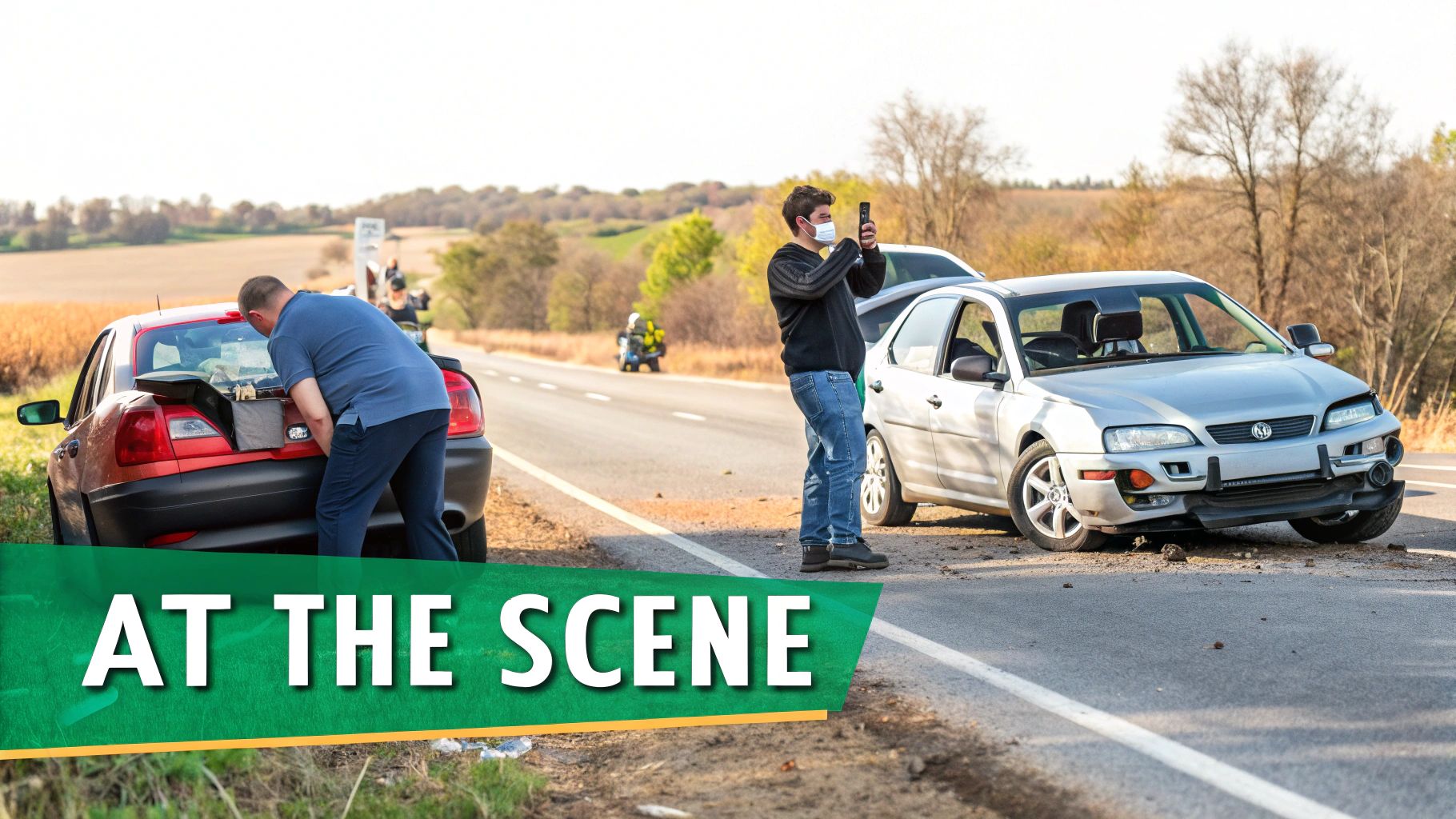
The moments after a crash are a blur of adrenaline and confusion, making it tough to think straight. However, what you do right then and there is crucial for what comes next. A clear, methodical approach will protect both your health and your finances.
Prioritize Safety Above All Else
Before worrying about the cars or insurance, check on yourself and your passengers for any injuries. Shock can easily mask pain, so take a moment to assess the situation carefully.
If it’s safe to exit your vehicle, check on the occupants of the other car. Call 911 immediately if anyone is hurt. Avoid moving an injured person unless they are in immediate danger, such as from a fire.
The road itself is now a hazard. If your car is drivable, move it to the shoulder to prevent further collisions. Turn on your hazard lights immediately to alert oncoming traffic. According to the National Highway Traffic Safety Administration (NHTSA), an estimated 17,140 people lost their lives in crashes in just the first half of 2025. You can learn more about the latest traffic safety findings on NHTSA.gov.
Gather Essential Information
Once the scene is secure, it’s time to gather facts. Every piece of information you collect is a building block for your insurance claim, especially when you need to recover your car value after accident.
Politely exchange the following with the other driver:
- Full Name and Contact Information: Get their phone number and address.
- Insurance Company and Policy Number: The easiest way is to take a clear photo of their insurance card.
- Driver’s License and License Plate Number: Snap a picture of both for accuracy.
- Vehicle Details: Note the make, model, and color of their car.
Crucial Tip: Stick to the facts when talking to the other driver. Avoid saying “I’m sorry” or admitting fault, as these statements can be used against you by an insurance adjuster. Let the police and insurance companies determine liability.
Document the Scene Thoroughly
Your smartphone is your most powerful tool at an accident scene. Photos and videos provide unbiased proof that can make or break your claim.
Take wide shots of the entire scene from different angles, capturing traffic signs, skid marks, and the final positions of the vehicles. Then, take close-up, detailed photos of the damage to both cars. This visual evidence is critical for proving the extent of the damage and supporting your case for a fair settlement, which includes any potential diminished value claim.
To make it easier, here’s a quick checklist to run through at the scene.
Post-Accident Scene Checklist
This table is a quick-reference guide for the chaotic moments right after a crash. Following these steps helps ensure you don’t miss anything important for your safety and your future claim.
| Priority | Action Step | Why It Matters for Your Claim |
|---|---|---|
| Immediate | Check for injuries and call 911 if needed. | Establishes a medical record from the outset, which is vital if injuries appear later. |
| High | Move vehicles out of traffic (if possible) and turn on hazards. | Prevents further accidents and shows responsible action, which insurers note. |
| High | Call the police to file an official report. | The police report is a key piece of objective evidence for determining fault. |
| Medium | Exchange driver and insurance information. | This is the core information needed to initiate a claim with the other party’s insurer. |
| Medium | Take photos/videos of the scene and damage. | Visual proof is your strongest tool against disputes over the severity or nature of the damage. |
| Medium | Get names and numbers of any witnesses. | Independent witness statements can strongly support your version of events. |
| Low | Avoid discussing fault with the other driver. | Prevents your words from being used against you during the claims process. |
Remember, a little organization at the scene can save you a mountain of headaches down the road.
Reporting the Accident to Police and Insurers
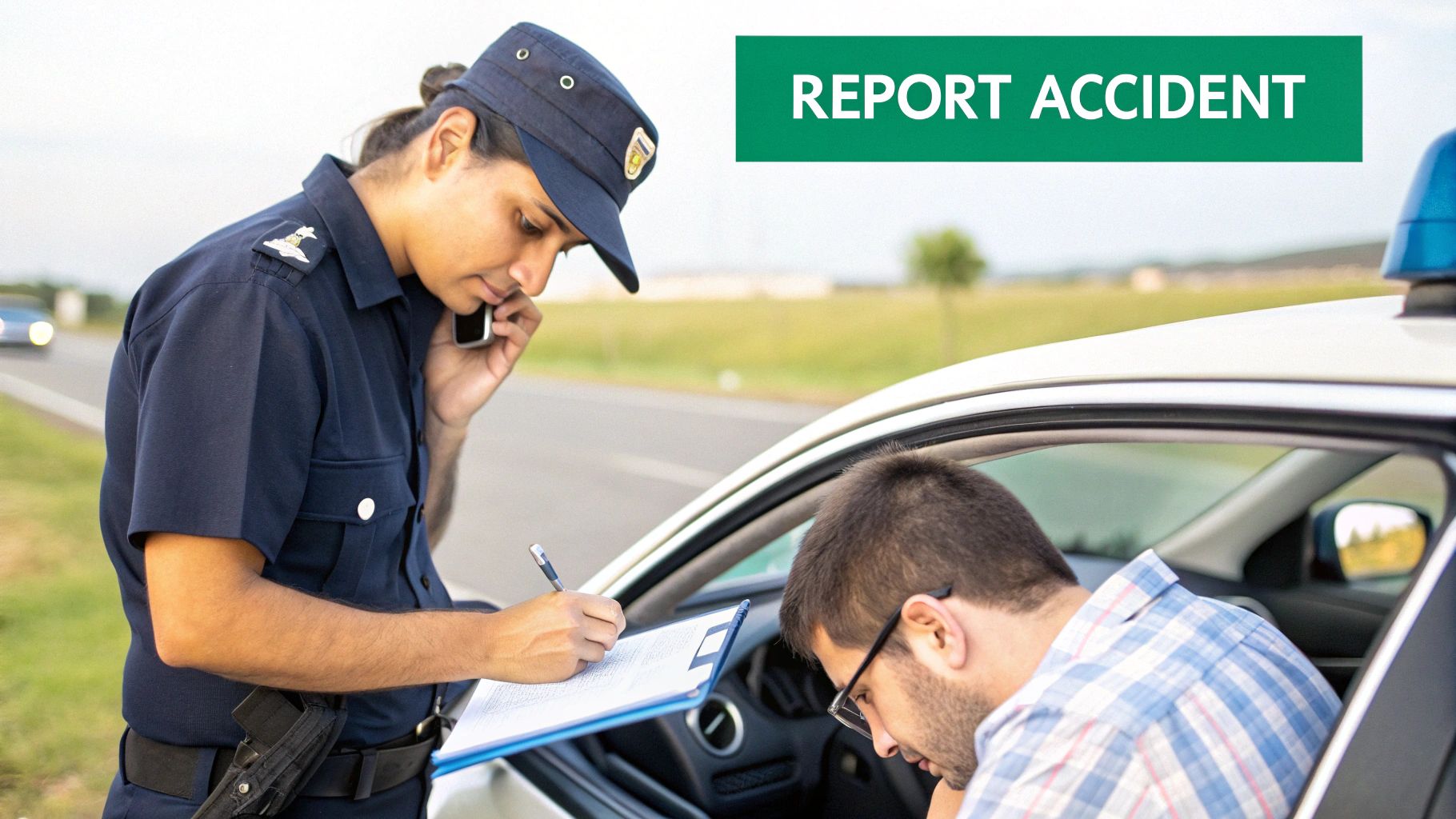
After ensuring everyone is safe and you’ve documented the scene, it’s time to create the official record. Handling these next steps correctly lays the groundwork for your insurance claim and helps prevent future complications.
A common question is, “Do I really need to call the police for a minor fender-bender?” The answer is almost always yes. A police report provides an impartial, third-party account of the incident that insurance companies rely on.
First Things First: Contact Law Enforcement
Even if the damage seems minor, call the police. Many states legally require you to report any accident with damages over a certain amount, which can be as low as $1,000. The police report becomes a foundational piece of evidence for your claim, officially verifying the accident’s time and location.
When the officer arrives, provide a clear, factual summary of what happened. Stick to what you know for certain and avoid guessing about speeds or distances. Your job is to provide facts, not theories.
Making That First Call to Your Insurance Company
Calling your insurance company is a required step, and being prepared makes it simple. Most policies require you to report an accident promptly, often within 24 to 48 hours. Don’t delay this call.
Industry data shows that waiting too long to report a crash can lower your claim approval rate. Acting fast shows you are proactive and allows your insurer to start the process without raising red flags.
Before you dial, have this information ready:
- Your Policy Number
- The Police Report Number, if available
- The other driver’s name, contact info, and insurance details
- A simple summary: date, time, and location
When you speak to a claims representative, report the facts without admitting fault or blaming the other driver. Simply state what happened from your perspective. Having a basic grasp of your policy helps; you can learn more about what liability insurance covers on our blog. Keeping it clean and factual starts your claim on the strongest possible footing.
Prioritizing Your Health After a Crash
In the stress of an accident, it’s easy to overlook your own physical well-being. But your health is your most important asset. Cars can be fixed or replaced; you can’t be.
Adrenaline is a powerful chemical that can mask pain. You might walk away from the scene feeling fine, only to wake up the next day with severe neck or back pain. That’s why getting a medical evaluation is critical, no matter how minor the accident seems.
The Danger of Delayed Symptoms
Common crash-related injuries like whiplash, concussions, and soft tissue damage often don’t show symptoms for hours or even days. In fact, CDC data shows that 30% of people in minor crashes suffer from these types of delayed-onset injuries.
Skipping a medical check-up is a risk. What feels like a small ache could signal a bigger problem. Furthermore, a doctor’s visit creates an official medical record linking your injuries to the accident, which is essential if you need to file a personal injury claim.
A prompt medical evaluation isn’t just about your health—it’s crucial evidence. If you wait, the insurance company may argue that your injuries happened after the crash, which can seriously weaken your claim.
Documenting Your Injuries for Your Claim
When you see a doctor, be as detailed as possible. Mention every ache, pain, or unusual feeling, even if it seems minor. This creates a clear medical baseline that can be invaluable later on.
Neck pain is a frequent complaint after a collision. If you’re dealing with persistent discomfort, it’s smart to understand all available treatment options. Learning about methods like effective neck pain relief through cervical spine decompression can offer valuable insight into managing your recovery.
According to the World Health Organization, road traffic accidents injure between 20 and 50 million people every year. Seeking immediate medical care is the best way to protect your health while building a solid foundation for fair compensation.
Recovering Your Vehicle’s Full Financial Loss
Once you’ve handled the immediate safety and medical concerns, your focus will shift to your car. This is where many people unknowingly leave money on the table. An insurance company’s job is to pay for visible repairs, but that’s only part of the story.
Even with perfect repairs, your car now has an accident history that permanently lowers its resale value. This loss is called diminished value.
Your total financial loss isn’t just the repair bill. It’s the repair bill plus the permanent hit your car’s market value has taken. Most initial insurance offers conveniently ignore this second part.
The Two Values You Have to Understand
To avoid being short-changed, you must understand two key terms that are central to your vehicle’s claim.
- Diminished Value (DV): This is the automatic drop in your car’s market value after it’s been in an accident and repaired. You wouldn’t pay the same price for a car with an accident history as you would for an identical one with a clean record. That price difference is diminished value, and you are often entitled to compensation for it from the at-fault party’s insurance.
- Fair Market Value (FMV): Also called Actual Cash Value (ACV), this is what your vehicle was worth the moment before the crash. If your car is declared a total loss, the insurance payout should match this number, allowing you to buy a comparable replacement. Insurers often use their own methods to calculate this, which can result in a lowball offer.
The full financial impact of an accident often shows up in ways you don’t see right away.
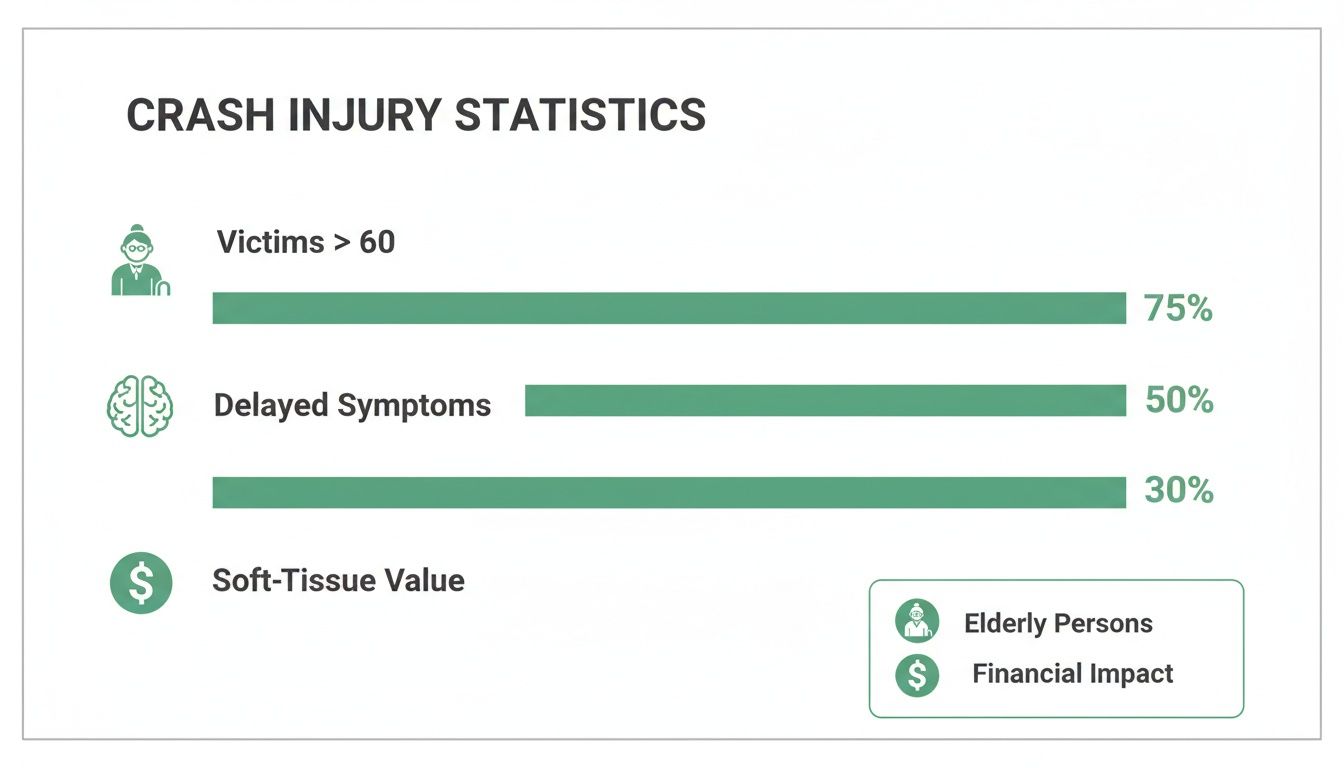
This data proves that the full consequences of a crash aren’t always obvious at the scene.
Repair Costs vs. Your Total Financial Loss
Let’s look at the difference between what an insurer typically pays and what your actual financial damage is.
| Financial Impact | What Insurance Covers by Default | What You Are Actually Owed |
|---|---|---|
| Direct Repairs | Cost to fix or replace damaged parts. | The full, documented cost of quality repairs. |
| Loss of Value | Usually $0, unless you fight for it. | The drop in your car’s market value (diminished value). |
| Total Loss | Their calculated “Actual Cash Value.” | The true Fair Market Value needed to replace your car. |
As you can see, the initial offer rarely covers your complete financial loss.
Why Data-Driven Proof Is Your Best Friend
An insurer’s first offer is a starting point for negotiation, not the final word. To successfully claim what you’re owed for diminished value or a total loss, you have to prove it with objective, data-backed evidence.
This is where a certified appraisal report from SnapClaim becomes your most powerful tool. A professional appraisal analyzes specific sales data for your vehicle’s exact year, make, and model in your local market. For a deeper dive, check out our guide on what is a diminished value claim. A SnapClaim report provides the hard evidence you need to turn your request into a documented, defensible demand for fair compensation.
How a Certified Appraisal Strengthens Your Claim
Accepting the insurance company’s first offer is one of the biggest mistakes you can make. Think of their number as an opening bid, not the final verdict. To take control of the negotiation, you need a tool that speaks their language: a certified appraisal.
A SnapClaim report is objective, data-driven proof of your vehicle’s true loss in value. It’s a court-ready document built on real market data that becomes the bedrock of your negotiation. You’re no longer just asking for more money; you’re demanding what the evidence proves you’re owed.
Moving Beyond the Insurer’s Estimate
An insurance adjuster’s goal is to close your claim quickly and for the lowest possible cost. They rely on internal valuation software that often fails to capture a true picture of your local market or your car’s pre-accident condition.
A professional appraisal levels the playing field. It provides an unbiased, third-party valuation that carries real weight because it’s based on a transparent methodology and verifiable market data—not a hidden algorithm.
Presenting a certified report shows the adjuster you’ve done your homework and are serious about fair compensation. It forces them to justify their lowball offer against your hard evidence. You can see the difference for yourself once you understand how to read an appraisal report. This documentation is exactly what you need to challenge a low insurance total loss payout or prove your diminished value claim.
Presenting Your Report for Maximum Impact
Once you have your SnapClaim appraisal, present it effectively. A professional, fact-based approach works best.
Here’s a simple strategy:
- Email the Adjuster: Attach the full appraisal report to a polite but firm email.
- State Your Position Clearly: Use straightforward language like, “Thank you for your initial assessment. I have attached an independent, certified appraisal to document my vehicle’s full financial loss. The report documents a diminished value of $X.”
- Request a Revised Offer: Ask for a new settlement offer based on the evidence. Try this: “Please review the attached report and provide an updated offer that reflects this documented loss.”
This approach reframes the discussion around your evidence, not their initial low number.
Best of all, you can do this with zero financial risk. If your insurance recovery from the claim is less than $1,000, SnapClaim refunds the full appraisal fee—guaranteed. It’s our way of making sure you have the confidence and support to fight for what you rightfully deserve.
Common Questions After a Car Accident
Navigating the aftermath of a collision brings up many questions. Here are answers to some of the most common concerns to help you understand your rights and get a fair settlement.
Can I claim diminished value if the accident wasn’t my fault?
Yes, absolutely. In most states, you have the legal right to claim your car’s lost value from the at-fault driver’s insurance. Their client’s actions damaged your property and made it worth less, even after perfect repairs. A certified appraisal from a service like SnapClaim provides the hard data needed to prove this loss.
What if my insurer’s total loss offer is too low?
Never accept the first insurance total loss payout without doing your own research. An insurer’s offer is often calculated using models that favor them. You have the right to challenge it with an independent, certified Fair Market Value appraisal that proves the real cash value your vehicle held just before the crash, giving you the evidence to negotiate a higher payout.
How long do I have to file an insurance claim?
The statute of limitations varies by state, but you should always report the accident to your insurer immediately—ideally within 24 hours. Prompt reporting prevents claim denial issues and ensures that all evidence and witness memories are fresh. Acting quickly is always the best strategy when figuring out what to do after a car accident.
Do I have to use the body shop my insurer recommends?
No. You have the right to choose your own repair shop. Insurance companies have “preferred” shops because it benefits them, but you are not obligated to use one. Getting an estimate from a mechanic you trust provides an honest second opinion and ensures quality parts are used. It’s always a good idea to check your state-specific repair laws to know your full rights.
About SnapClaim
SnapClaim is a premier provider of expert diminished value and total loss appraisals. Our mission is to equip vehicle owners with clear, data-driven evidence to recover the full financial loss after an accident. Using advanced market analysis and industry expertise, we deliver accurate, defensible reports that help you negotiate confidently with insurance companies.
With a strong commitment to transparency and customer success, SnapClaim streamlines the claim process so you receive the compensation you rightfully deserve. Thousands of reports have been delivered to vehicle owners and law firms nationwide, with an average of $6,000+ in additional recovery per claim.
Why Trust This Guide
This guide was reviewed and verified by SnapClaim’s auto appraisers, who specialize in diminished value and total loss disputes.
Our team continually updates every article to reflect current insurer guidelines, valuation standards, and court-accepted appraisal practices, ensuring that you’re relying on information trusted by professionals nationwide.
Get Started Today
Whether you’re challenging a low total loss settlement or proving your vehicle’s post-repair loss in value, SnapClaim makes it simple to take the next step.
Generate a free diminished value or total loss estimate in minutes and see how much compensation you may be owed.
👉 Get your Diminished Value Appraisal Claim