

Receiving a low settlement offer from your insurance company after an accident can be incredibly frustrating. When your car is declared a total loss, that offer is based on a low total appraisal report—the insurer’s official valuation of what your vehicle was worth. But this report isn’t the final word; it’s the opening offer in a negotiation, and you have every right to challenge it.
Why Your Insurer’s First Offer Is Often Too Low

When your car is a total loss, your insurer owes you its Actual Cash Value (ACV)—what it was worth moments before the crash. Unfortunately, their initial valuation often falls short, sometimes by thousands of dollars, leaving you without enough money to buy a similar replacement vehicle.
This isn’t personal; it’s the result of a system designed to minimize payouts. The insurance total loss payout is calculated using third-party software that often relies on incomplete or flawed data. This systematic undervaluation forces you to either accept less than you’re owed or fight for a fair settlement.
Common Reasons for a Low Valuation
Insurance adjusters frequently use shortcuts that don’t reflect the real-world car value after an accident. These methods are predictable, placing the burden on you to spot the errors and negotiate for what’s fair.
Here’s why their valuation often misses the mark:
- Using Flawed Comparables: The report might list “comps” (comparable vehicles) that are base models, have significantly more miles, or are located hundreds of miles away in cheaper markets.
- Applying Aggressive Adjustments: They often deduct value for minor, pre-existing wear and tear—like tiny scratches or faded upholstery—that had little to no impact on your car’s market price.
- Ignoring Key Features and Upgrades: That premium sound system or the brand-new tires you just bought are frequently overlooked, even though they add real, tangible value.
- Relying on Outdated Market Data: The valuation may not account for recent spikes in local demand, especially for popular or hard-to-find models.
How an Insurer’s Valuation Stacks Up to Reality
It’s helpful to see the difference between the shortcuts insurers take and what truly determines a car’s value. This table breaks it down.
| Valuation Factor | The Insurer’s Method | The Fair Market Reality |
|---|---|---|
| Comparable Vehicles | Uses distant, high-mileage, or base-model “comps” from a database. | Considers truly comparable vehicles from your local market with similar mileage and options. |
| Condition Adjustments | Makes large deductions for tiny scratches or normal wear and tear. | Factors in normal wear based on age and mileage, which buyers expect. |
| Upgrades & Features | Ignores aftermarket parts, new tires, or recent major maintenance. | Adds value for premium features, recent services, and desirable upgrades. |
| Market Data | Relies on generalized, often outdated data from valuation software. | Reflects current, local supply and demand, especially for popular models. |
Understanding these tactics is your first step toward building a strong counter-offer. This guide will walk you through exactly how to analyze their report, gather your own proof, and dispute their lowball offer with confidence.
How Insurance Companies Calculate a Low Total Loss Appraisal Report
Receiving a low total loss appraisal report can feel like an insult, but it’s almost always just business. Insurers use a standardized, automated process designed to serve their bottom line. The key is understanding exactly how they reached their number—that’s where you find the power to challenge it.
Most insurers outsource valuations to third-party software platforms like CCC ONE and Audatex. These systems are essentially giant databases programmed to find “comparable” vehicles to set your car’s pre-accident value. The problem is, their definition of “comparable” is often flawed.
The Problem with Automated Valuations
While these systems are fast and cheap for insurers, they often fail to capture a vehicle’s true worth. The software pulls data from dealer listings and auction results, but the vehicles it selects are where things go wrong.
The “comps” used to value your car might be:
- Base models missing the premium features your car had.
- Located hundreds of miles away in a cheaper market.
- Listed with far more mileage than your vehicle.
- In poor condition or from less-reputable dealerships.
This cherry-picking creates an unfairly low starting point for your car’s value. From there, it only gets worse.
Death by a Thousand Cuts: Condition Adjustments
After establishing a baseline value from questionable comps, the software moves to “condition adjustments.” This is where the insurer’s report methodically chips away at your insurance total loss payout. Guided by the software, an adjuster deducts money for every tiny imperfection.
These deductions often feel disconnected from reality. A small door ding or a minor scuff on the bumper—things a typical buyer wouldn’t notice—can become a significant deduction on the report. These adjustments penalize you for normal wear and tear that had almost zero impact on your car’s market value.
Common deductions include:
- Minor cosmetic scratches, scuffs, or dings.
- Slightly worn tires, even with thousands of miles of life left.
- Faded interior fabric or small stains.
- Pre-existing damage unrelated to the accident.
Each small deduction adds up, leaving you with a final offer that’s nowhere near what you need to buy a comparable replacement.
Overlooking What Made Your Vehicle Valuable
The biggest flaw in this automated process is that it ignores the unique factors that made your car valuable. Your meticulous service history, recent maintenance, and desirable upgrades are invisible to the software.
Did you just spend $1,500 on a major service or a new set of premium tires? Does your vehicle have a rare trim package or aftermarket upgrades that increased its value? Unless you provide proof, the valuation software will never account for it. This is why their first offer is rarely their best—and why you are now equipped to challenge it.
Finding the Red Flags in Your Appraisal Report

Your insurer’s appraisal report is the most important document in your total loss claim. It’s time to put on your detective hat and review it line by line.
Think of it like an incorrect bill at a restaurant—a few “errors” here and there can add up quickly. By learning where to look, you can pinpoint the flaws costing you money and build a rock-solid case for a fair insurance total loss payout.
Incorrect Vehicle Details
The most common source of mistakes is your car’s basic information. If they get this wrong, the entire valuation is flawed from the start.
Check the vehicle description for the correct:
- Trim Package: Is your top-tier Limited model listed as a base-level SE? This is a huge mistake that can cost you thousands.
- Engine and Drivetrain: Did your car have the more powerful V6 engine or all-wheel drive? These are major value-adds that often get missed.
- Mileage: A simple typo can add thousands of miles to your car, artificially lowering its value. Ensure the mileage is accurate for the date of the accident.
- Optional Features: Scan the list for every feature you paid extra for—sunroof, premium sound system, navigation, advanced safety packages. If it’s not listed, it wasn’t valued.
These aren’t minor details; they are fundamental to your car’s real-world worth.
Uncovering Flawed “Comparable” Vehicles
This is where insurers can do serious damage to your settlement offer. The report lists “comparable” vehicles, or “comps,” used to determine your car’s market value. However, their idea of “comparable” can be a real stretch.
Your job is to disqualify any comps that aren’t truly similar. The insurer is hoping you won’t look closely, but a few minutes of research can show their evidence doesn’t hold up.
Here’s a quick checklist for vetting every comp:
- Check the Location: Are the comps from your local area, or from a city 300 miles away where cars sell for less? They must reflect your local market.
- Verify the Listing: Search for the dealer or VIN online. Is the vehicle a real, sold car? Insurers sometimes use placeholder ads or phantom listings.
- Compare Trim and Options: Ensure the comps have the same trim, engine, and key features. A base model is not comparable to your fully loaded version.
- Analyze Condition: Does the comp have a branded title (like salvage or lemon) or a bad vehicle history report? It must be in a similar pre-accident condition to your car.
If you find comps that don’t pass this test, you have a solid reason to dispute the valuation. This is a critical step we cover in our guide on how to read an appraisal report.
Questioning Excessive Condition Adjustments
The final red flag is the list of “condition adjustments,” where the insurer deducts money for pre-existing wear and tear. While some adjustments for major damage are fair, these reports often penalize you for normal, age-appropriate use.
Look for deductions for small scratches, minor interior wear, or slightly worn tires. These are things that rarely impact the actual price a private buyer would pay. If the deductions seem excessive or nitpicky, they probably are—it’s a tactic to chip away at your payout.
Your Step-By-Step Guide to Disputing the Offer
Knowing what’s wrong with a low total loss appraisal report is one thing, but taking action is what gets you paid. It’s time to formally challenge the insurance company’s lowball offer with a calm, organized, and evidence-driven approach.
When you follow a clear plan, you shift the conversation. It’s no longer about you passively accepting their number; it’s about you presenting a counter-offer backed by solid proof.
Step 1: Formally Reject Their Offer in Writing
First, you must inform your insurance adjuster that you do not accept their settlement offer. This has to be in writing. An email is perfect because it creates a time-stamped paper trail.
Keep it simple and professional. You don’t need to lay out your entire case yet. Simply state that you reject their valuation and will be providing evidence to support a higher, more accurate figure for your vehicle’s Actual Cash Value.
Step 2: Assemble Your Evidence Packet
This is where you build your case. Your goal is to create a powerful packet of proof that shows your vehicle was worth more than the insurer claims.
Your packet should include:
- Service Records: Gather all maintenance and repair receipts to prove your car was well-cared for.
- Receipts for Recent Upgrades: Did you recently buy new tires, a battery, or a stereo? Include those receipts to show recent investments that add value.
- Pre-Accident Photos: Find any photos that show your car in great condition before the crash. Time-stamped pictures are even better.
- Original Window Sticker: If you have it, the original sticker is the ultimate proof of every option your car had from the factory.
This collection of proof directly rebuts the insurer’s assumptions about your car’s condition or features.
Step 3: Find Your Own Comparable Vehicles
Don’t let the insurance company’s flawed “comps” control the narrative. You need to find your own legitimate, local comparable vehicles that reflect your car’s actual market value.
Search online listing sites like AutoTrader, Cars.com, or local dealership websites for vehicles that are the same make, model, and year as yours.
Focus on finding listings that match your vehicle’s trim, mileage, and options as closely as possible. Save screenshots or printouts of these listings as proof of current asking prices in your local market. This real-world data is far more compelling than the insurer’s automated report, according to insights from the Appraisal Institute.
Step 4: Draft and Submit Your Counter-Offer
With your evidence in hand, it’s time to write a professional counter-offer letter or email. Present your case logically and confidently.
Your counter-offer should:
- Clearly state the settlement amount you believe is fair.
- Explain why the insurer’s offer is too low, pointing to specific errors in their report.
- Present your own comparable vehicle listings as evidence of the true market value.
- Attach all your supporting documents—receipts, photos, and service records.
For more detailed guidance, check out our step-by-step guide to disputing a total loss offer. If the adjuster won’t budge, you can invoke the Appraisal Clause in your policy, which moves the dispute to an independent appraiser.
Leveraging an Independent Appraisal for a Fair Settlement
When your negotiations hit a wall, it’s time to call in a professional. An independent appraisal is your most powerful tool for challenging a low total appraisal report. The insurer’s valuation is just their opinion; a certified appraisal is a defensible, evidence-based argument from a licensed expert.
This move shifts the negotiation dynamic. It’s no longer your word against their flawed software. Instead, it becomes your expert’s data-driven valuation against their lowball offer, giving you the leverage you need.
How an Independent Report Dismantles Their Arguments
A detailed independent appraisal from a specialist like SnapClaim is a comprehensive market analysis that uses unbiased, verifiable data to establish a credible Fair Market Value (FMV). This is the kind of evidence insurers are legally compelled to take seriously.
Unlike the insurer’s report, a professional appraisal:
- Uses Hyper-Local Comps: It finds truly comparable vehicles for sale in your immediate market.
- Accounts for All Features: It meticulously documents every option, upgrade, and recent investment.
- Provides a Justified Value: It clearly explains how the value was determined using a transparent methodology.
The process for disputing a low offer always follows a few key steps.
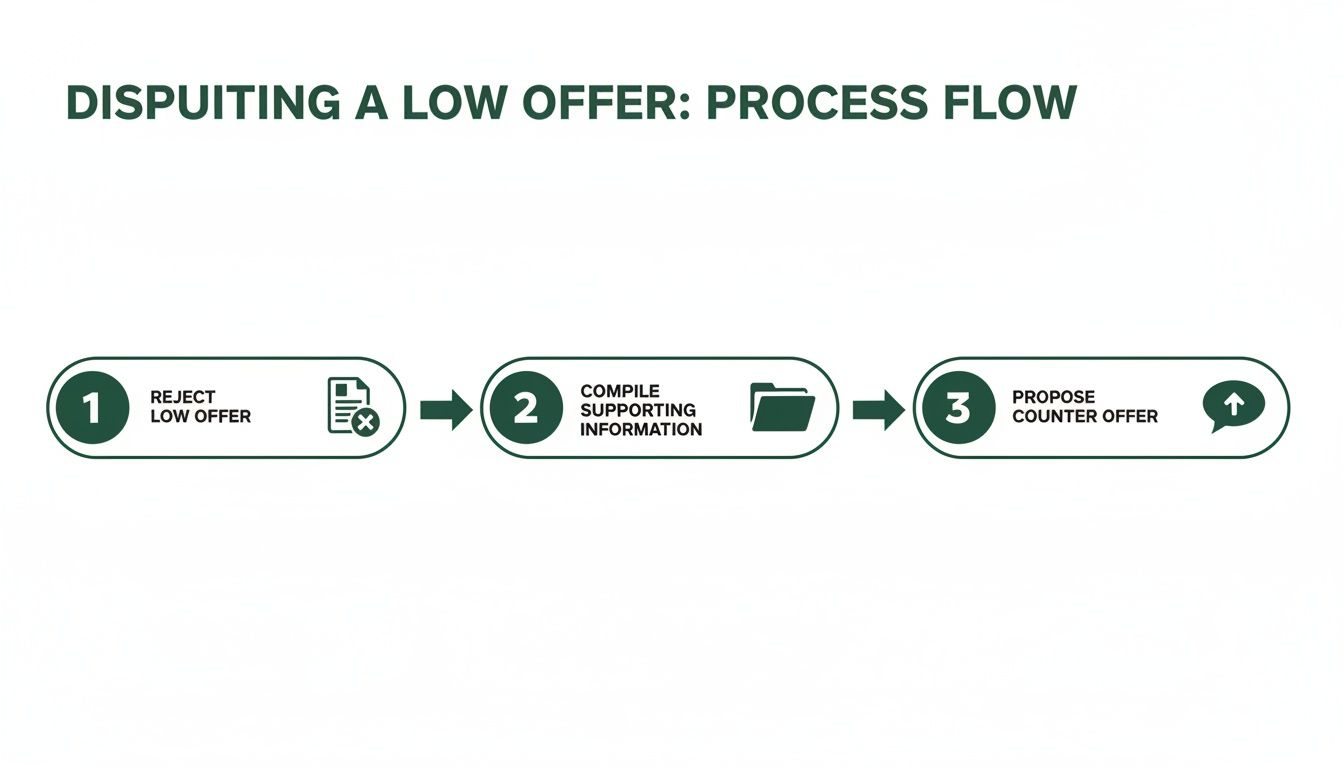
This visual breaks it down: you firmly reject their initial low offer, compile your own proof, and then come back with a counter-offer supported by solid facts.
The Power of Third-Party Validation
Submitting an independent appraisal forces the insurance adjuster to justify their position against an expert’s findings. They can no longer hide behind the “our system says so” excuse. Now, they must address specific, documented proof of your vehicle’s higher value.
An independent report signals to the insurance company that you are serious about your claim and have invested in professional, defensible evidence. This is often the final push needed to break a stalemate. When faced with a detailed, certified report, many adjusters will raise the offer to avoid a more drawn-out dispute. A professional total loss appraisal can dramatically strengthen your position.
A Risk-Free Path to a Better Payout
We understand that paying for an appraisal can feel like a gamble when you’re already dealing with a financial loss. That’s why at SnapClaim, we stand by our work with a straightforward promise.
Our Money-Back Guarantee is simple: if your insurance recovery from the claim is less than $1,000, SnapClaim refunds the full appraisal fee — guaranteed. This ensures that hiring an expert to fight for your fair insurance total loss payout is a decision you can make with complete confidence.
Navigating the Negotiation Process
Once you’ve submitted your counter-offer with solid evidence, the real negotiation begins. The key is to stay persistent and professional, no matter how the adjuster responds.
Typically, the adjuster will come back in one of three ways. Your goal is to keep the pressure on and show them you have the facts to back up your claim for a fair payout.
Potential Insurer Responses
Here are the most common scenarios and how to handle them:
- They Accept Your Evidence: This is the best-case scenario. The adjuster agrees your proof is solid and raises the settlement. If this happens, get the new offer in writing before you verbally agree to anything.
- They Provide a Counter-Offer: This is more common. The adjuster bumps their offer up but still lands below what you asked for. Don’t be discouraged—this is a great sign! It means your evidence is working.
- They Hold Their Ground: In some cases, the adjuster will refuse to budge, insisting their initial valuation from the low total appraisal report is final. This is a hardball tactic designed to intimidate you into backing down.
Your Next Strategic Moves
No matter what they throw at you, your response should be calm, documented, and firm.
If they come back with a counter-offer, thank them but calmly reiterate that your market research supports your original valuation. Ask them to provide a specific, written justification explaining why their new number is still lower than the real-world data you provided.
If they refuse to negotiate, it’s time to play your trump card: formally invoking your policy’s Appraisal Clause. This is a powerful provision in most auto policies that forces the dispute into a binding process where both sides hire independent appraisers. Knowing how to negotiate with insurance companies is what turns a lowball offer into a fair settlement.
Frequently Asked Questions (FAQ)
What if I already cashed the insurance check?
Cashing a check, especially one marked “full and final payment,” can complicate your dispute as it may signal acceptance. However, some states allow you to continue negotiating. If you’ve already cashed it, immediately notify the insurer in writing that you are still disputing the valuation. It’s always best to wait until you have a final, signed agreement before cashing any checks.
How long do I have to dispute a low total appraisal report?
While your state’s statute of limitations for property damage may be a year or more, you should act immediately. The longer you wait, the harder it becomes to find relevant comparable vehicle listings from the time of the accident. Start the dispute process as soon as you receive an unsatisfactory offer to build the strongest case with the freshest evidence.
What happens if the settlement offer is less than my car loan?
This is known as being “upside down” on your loan, and it means you’ll have to pay the remaining balance out of pocket after the insurance payout. If you have GAP (Guaranteed Asset Protection) insurance, it should cover this difference. If not, successfully negotiating a higher settlement for your car’s fair market value is critical to reducing or eliminating what you owe.
Is hiring an independent appraiser really worth the cost?
For most people challenging a low offer, the answer is a clear yes. An independent appraisal report provides objective, data-driven proof that insurers must take seriously and can lead to thousands of dollars in additional recovery. SnapClaim’s Money-Back Guarantee makes it a risk-free decision: if your insurance recovery from the claim is less than $1,000, we refund the full appraisal fee. It’s a confident step toward getting the compensation you deserve.
About SnapClaim
SnapClaim is a premier provider of expert diminished value and total loss appraisals. Our mission is to equip vehicle owners with clear, data-driven evidence to recover the full financial loss after an accident. Using advanced market analysis and industry expertise, we deliver accurate, defensible reports that help you negotiate confidently with insurance companies.
With a strong commitment to transparency and customer success, SnapClaim streamlines the claim process so you receive the compensation you rightfully deserve. Thousands of reports have been delivered to vehicle owners and law firms nationwide, with an average of $6,000+ in additional recovery per claim.
Why Trust This Guide
This guide was reviewed and verified by SnapClaim’s auto appraisers, who specialize in diminished value and total loss disputes.
Our team continually updates every article to reflect current insurer guidelines, valuation standards, and court-accepted appraisal practices, ensuring that you’re relying on information trusted by professionals nationwide.
Get Started Today
Whether you’re challenging a low total loss settlement or proving your vehicle’s post-repair loss in value, SnapClaim makes it simple to take the next step.
Generate a free diminished value or total loss estimate in minutes and see how much compensation you may be owed.
👉 Get your free total loss value estimate today