

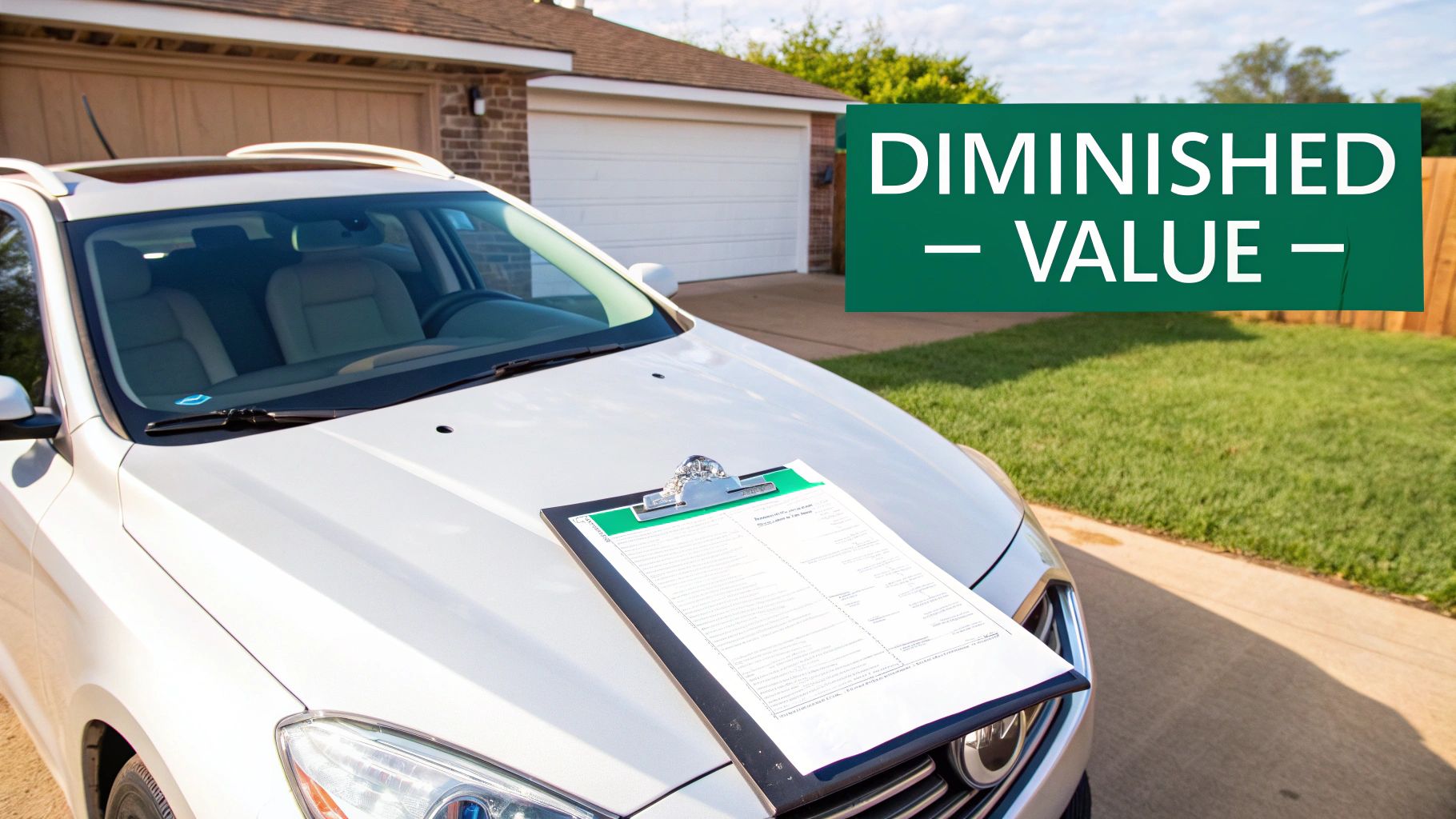
Your car was repaired properly and it still sells for less, because the accident now shows on its history report. That gap is inherent diminished value, and when an Allstate driver caused the crash it is recoverable from their policy. This guide covers what qualifies, how Allstate reaches its number, and what to do when the offer is low.
What You Are Actually Claiming
- Inherent diminished value — the loss caused purely by the accident being on record, even after flawless repairs. This is the claim.
- Repair-related diminished value — additional loss from poor work: mismatched paint, non-OEM parts, uneven panel gaps.
- Immediate diminished value — the drop while the car sits damaged, before repair. Rarely claimed.
Who can file
You file a third-party claim against the at-fault driver’s Allstate policy. The Allstate driver needs to be at fault — shared blame reduces or defeats the claim. The car must have been repaired rather than written off, you must hold the title, and the damage needs to be real: structural or frame work makes a case, a scuffed bumper does not.
Claiming diminished value from your own insurer is generally a dead end — standard policies pay to repair the car, not to compensate for its lost market value. Georgia is the significant exception, where Mabry v. State Farm established that policyholders can recover diminished value from their own carrier.
How Allstate Reaches Its Number
Insurers commonly apply a capped formula called 17c, named after paragraph 17(c) of the assessment method that came out of the Mabry litigation in Georgia. Seeing the arithmetic explains why first offers land where they do.
- Cap at 10%. A $30,000 car has its maximum diminished value set at $3,000 before anything is inspected.
- Damage modifier. Damage graded “moderate” might carry 0.50: $3,000 becomes $1,500.
- Mileage modifier. 40,000 miles might carry 0.80: $1,500 becomes $1,200.
The offer is $1,200 on a car whose accident history could cost several thousand at resale. The formula never looks at comparable local sales, and that is precisely the gap your evidence fills.
| Insurer formula | Independent appraisal | |
|---|---|---|
| Starting point | A generic book value, then a fixed percentage cap | Your vehicle’s actual pre-accident market value |
| Adjustments | Arbitrary multipliers for damage grade and mileage | Comparable sales of similar vehicles in your local market |
| Accounts for your market | No | Yes |
| Standards | Internal, unpublished | USPAP-compliant, prepared by a certified appraiser |
| Who it serves | The party paying the claim | Neither party — it reports the market |
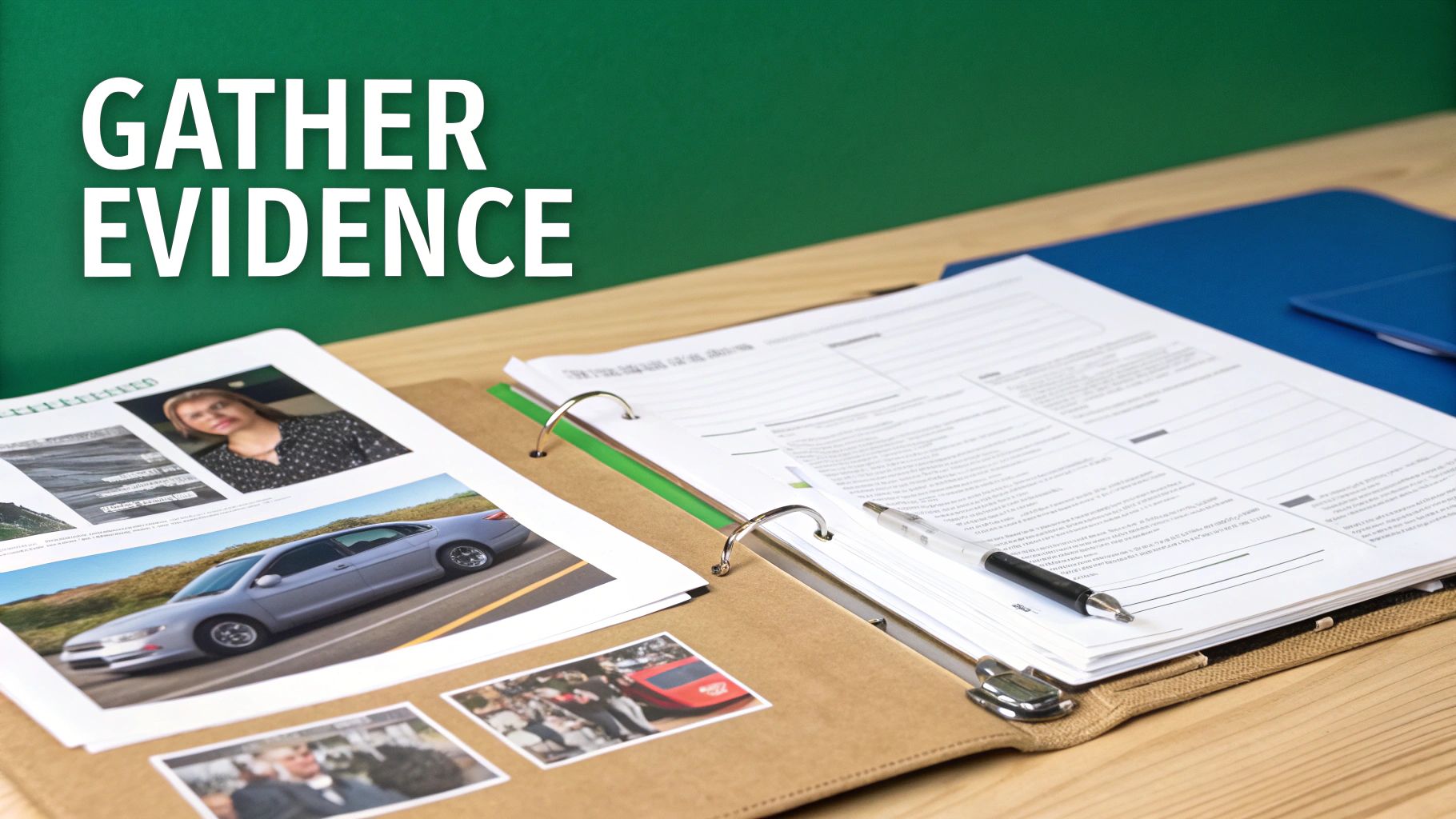
Gathering the Right Evidence
| Document | Why You Need It |
|---|---|
| Official Police/Accident Report | Establishes the facts of the incident and, most importantly, who was at fault. |
| Final Itemized Repair Invoice | This is your most critical evidence, proving the severity of the damage by detailing every part replaced and every hour of labor. |
| High-Quality “Before” Photos | If available, photos of your car in great condition create a powerful “before and after” narrative. |
| Detailed “After” Photos | After repairs are complete, take clear photos of the repaired areas from multiple angles to document the final outcome. |
| The Body Shop’s Estimate of Record | The initial estimate provides another layer of detail, showing the intended scope of work before repairs began. |
| A post-accident vehicle history report | A fresh Carfax or AutoCheck showing the new accident record is the documented proof of the stigma. |
Flag any structural work or non-OEM parts explicitly — both weigh heavily on resale. Post-repair diagnostic scans are worth including where you have them.
The Demand Letter
Include your contact details, the Allstate claim number, the date of loss and the at-fault driver’s name, your vehicle’s year, make, model and VIN, the exact amount claimed, and copies — never originals — of the police report, repair invoice, photos and appraisal.
“As documented in the attached certified appraisal report, my vehicle has suffered an inherent loss of value totaling [$ amount]. This figure is based on a comprehensive market analysis and reflects the permanent effect of its accident history on resale value. I am requesting payment of this amount within 30 days.”
Set a response deadline of 15 to 30 days and send it by certified mail with return receipt, so the date of delivery is a matter of record. A full template is here: diminished value claim letter template.
Negotiating With the Adjuster
| Adjuster’s Tactic | Your Evidence-Based Response |
|---|---|
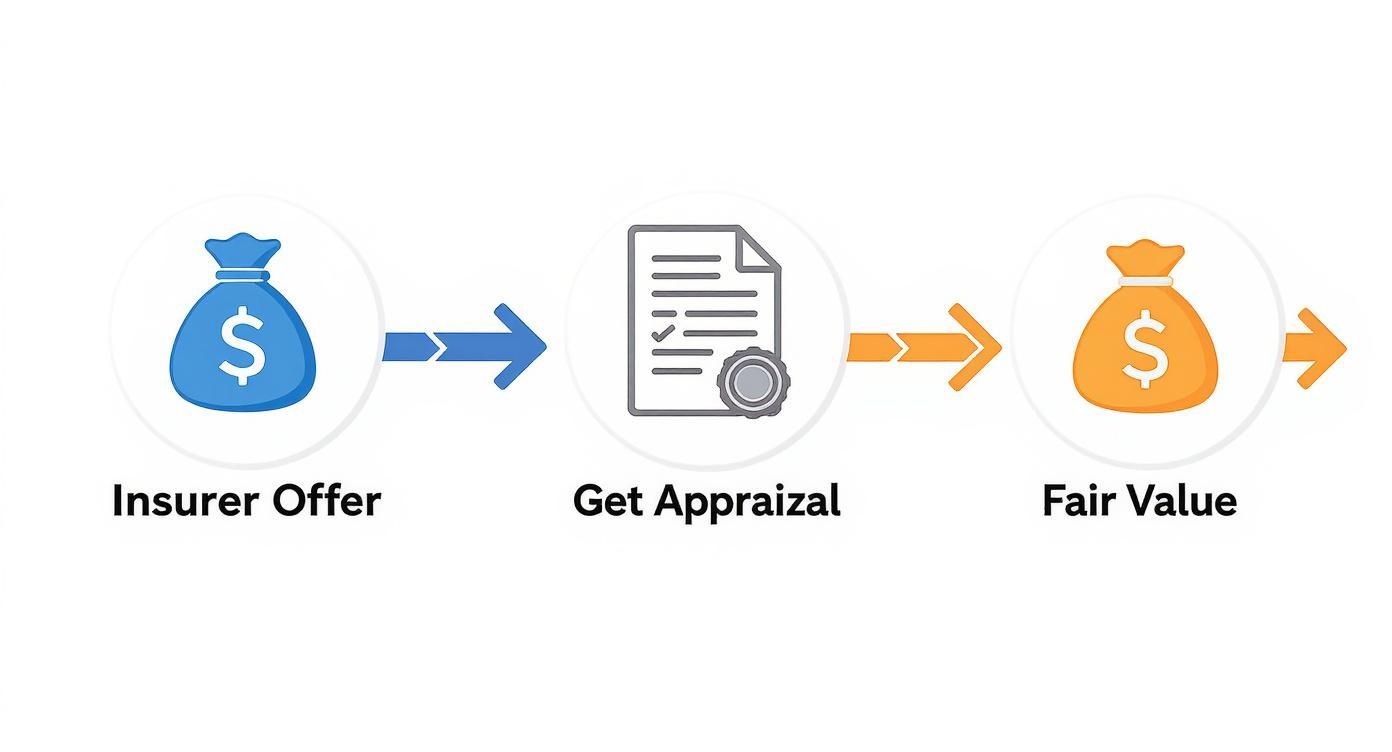
| “Our formula calculated the loss at a much lower amount.” | “I understand you have an internal formula, but it doesn’t reflect my local market. My certified appraisal uses real-time sales data from comparable vehicles in this area to prove the loss on my car.” |
| “The repairs were high-quality and made the vehicle whole again.” | “While I appreciate the quality of the repairs, the vehicle now has a permanent accident history that cannot be erased. My appraisal documents this market reality, which is what causes the loss in resale value.” |
| “We don’t accept third-party appraisals.” | “This report was prepared by a certified, independent appraiser using industry-standard methodologies. It provides a verifiable analysis of my financial loss. Can you please point to the specific data or methods in the report that you disagree with?” |
| “Your vehicle has high mileage, so there is no diminished value.” | “My vehicle’s mileage was already factored into its pre-accident fair market value. The appraisal calculates the percentage of value lost due to the new accident history, which is a separate issue from normal depreciation.” |
| “Your state doesn’t require us to pay this.” | “Could you point me to the specific statute you’re referencing? My understanding is that a third-party claimant can recover all damages caused by your insured, including the inherent loss of market value.” |
If you have not heard back within five to seven business days, follow up in writing. Summarise every phone call by email afterwards — that record is what makes escalation work.
When Allstate Denies or Lowballs
There are two kinds of no. A soft denial is an insultingly low offer rather than a refusal — it is an opening position and it is negotiable. A hard denial is a flat refusal to pay anything, and it needs a different response.
- Get it in writing, with the specific reason for the denial.
- Ask for a manager. Adjusters have settlement authority limits; supervisors have higher ones.
- File a complaint with your state’s Department of Insurance, which you can find through the NAIC directory. Free, and insurers must respond in writing.
- Small claims court. Limits run roughly $5,000 to $15,000 depending on the state, which covers most diminished value claims. You represent yourself and the filing fee is small. See our guide to diminished value in small claims court.
Deadlines and State Rules
The deadline is your state’s statute of limitations for property damage. It varies widely — from one year in some states to six in others — and it runs from the date of the accident, not the date repairs finished.
It also changes. Florida cut its negligence limitations period from four years to two for claims accruing on or after 24 March 2023, which makes a good deal of older online guidance wrong for Florida drivers. Check your state’s current limit on our state-by-state diminished value laws page.
This is general information, not legal advice. For anything turning on your state’s law, speak to an attorney licensed there.
Frequently Asked Questions
About SnapClaim
SnapClaim is a premier provider of expert diminished value and total loss appraisals. Our mission is to equip vehicle owners with clear, data-driven evidence to recover the full financial loss after an accident. Using advanced market analysis and industry expertise, we deliver accurate, defensible reports that help you negotiate confidently with insurance companies.
With a strong commitment to transparency and customer success, SnapClaim streamlines the claim process so you receive the compensation you rightfully deserve. Thousands of reports have been delivered to vehicle owners and law firms nationwide, with an average of $6,000+ in additional recovery per claim.
Why Trust This Guide
This guide was reviewed and verified by SnapClaim’s auto appraisers, who specialize in diminished value and total loss disputes.
Our team continually updates every article to reflect current insurer guidelines, valuation standards, and court-accepted appraisal practices, ensuring that you’re relying on information trusted by professionals nationwide.
Get Started Today
Whether you’re challenging a low total loss settlement or proving your vehicle’s post-repair loss in value, SnapClaim makes it simple to take the next step.
Generate a free diminished value or total loss estimate in minutes and see how much compensation you may be owed.
👉 Get your free diminished value estimate today