

When your insurance company makes an offer for your damaged or totaled car, remember this: that first number is rarely their best. It’s a starting point designed to close the claim quickly and for the least amount of money. But you don’t have to accept it.
Invoking the appraisal clause is your contractual right to challenge a lowball offer. It’s a powerful tool that forces an independent, fair valuation of what your vehicle was actually worth, putting you back in control of the negotiation.
Why Your Insurer’s First Offer Is Rarely Fair

It’s a common scenario. The settlement offer for your vehicle hits your inbox, and your stomach drops. It’s just low. You know your car, with its low mileage and recent upgrades, was worth more. But the insurer’s report is filled with generic “comparable” vehicles from 100 miles away that don’t match your car’s trim or condition.
This isn’t a mistake. It’s a business strategy. Insurance carriers are in the business of minimizing payouts to protect their bottom line. They often rely on automated valuation software that spits out numbers but misses the unique details of your vehicle, resulting in an inaccurate, lowball assessment of its true pre-accident value.
Common Tactics That Lead to Lowball Offers
How do they get the number so low? Insurers frequently undervalue claims by:
- Using outdated or irrelevant “comparable” vehicles that don’t match your car’s condition, mileage, or options.
- Applying incorrect or excessive deductions for minor, pre-existing wear and tear.
- Completely ignoring recent upgrades, custom modifications, or the superior condition of your vehicle.
- Failing to account for local market demand, which can add thousands to your car’s real-world value.
This is especially true when you’re dealing with a diminished value claim or a total loss payout. The initial offer is a negotiation tactic, plain and simple. Too many people accept it without a fight, leaving a significant amount of money on the table.
When to Consider Invoking the Appraisal Clause
Invoking the appraisal clause is the right move when you’ve tried to negotiate and you’re getting nowhere. It formally shifts the conversation from the adjuster’s opinion to a data-driven process. The clause forces both you and the insurer to hire independent appraisers, who then work to determine the actual value of the loss.
Here are the key scenarios where the appraisal clause becomes your most effective tool for a fair settlement.
| When Invoking the Appraisal Clause Makes Sense | ||
|---|---|---|
| Scenario | Why It’s Your Best Move | Potential Outcome |
| Low Total Loss Offer | The insurer’s offer is thousands below your vehicle’s actual cash value (ACV) based on real-world comparable sales. | A settlement that accurately reflects your car’s true pre-accident market value. |
| Denied Diminished Value | Your insurer offers a tiny amount or outright denies your diminished value claim, ignoring the real loss in resale value. | Fair compensation for the value your car lost simply because it now has an accident history. |
| Disputes Over Repair Costs | The insurer’s repair estimate won’t cover the cost of a proper, safe repair using quality OEM parts. | Sufficient funds to ensure your vehicle is restored correctly to its pre-accident condition. |
Ultimately, this process moves the discussion away from opinions and back to the hard facts—what the market says your vehicle was worth.
Finding and Understanding the Appraisal Clause in Your Policy
Before you can use the appraisal clause, you have to find it. Insurance companies don’t exactly put it on the front page with a welcome banner. It’s usually buried deep in your policy, often under a section like “Damage to Your Auto,” “Dispute Resolution,” or “What to Do in Case of a Loss.”
Your policy is the rulebook for your claim. It might feel like a dense, boring read, but locating this one clause is a critical first step. Grab your policy documents—whether it’s the paper booklet or a PDF from your insurer’s website—and use the search function (Ctrl+F on a computer) for the word “appraisal.” That will almost always take you straight to it.
Translating the Legal Language
Once you’ve found the clause, you’ll see it’s written in dense, formal language. Don’t get discouraged. The core idea behind all that legalese is actually pretty simple. It outlines a clear process for when you and your insurer can’t agree on the numbers.
At its heart, the appraisal clause says that if you and the insurance company are at a standstill over the “amount of loss”—like the car value after accident or a total loss payout—either of you can make a written demand to start the appraisal process.
Here’s a breakdown of what that language usually requires:
- Written Demand: You have to formally tell your insurer in writing that you’re invoking the appraisal clause. A phone call won’t cut it.
- Independent Appraisers: You and the insurance company each hire your own “competent and disinterested” appraiser. This is key—your appraiser works for you, and theirs works for them.
- Umpire Agreement: The two appraisers first try to agree on a value. If they can’t, they must select a neutral third party, called an umpire, to step in and make a final decision.
- Shared Costs: You pay for your appraiser, the insurer pays for theirs, and you both split the cost of the umpire if one is needed.
Understanding these terms is crucial because it sets the stage for everything that comes next. To dive deeper into the legal specifics, check out our complete guide on the appraisal clause and how it functions in claim disputes.
Why State Laws and Policy Details Matter
It’s important to remember that not all appraisal clauses are identical. The exact wording can change from one policy to another, and your state’s laws can also play a big role. For example, some states impose strict deadlines that insurers must follow once appraisal is invoked.
This is why you need to read your specific policy—it’s the contract that governs your claim. Understanding how to manage contracts, including digging into specific clauses, is a core part of ensuring you’re following the rules.
Crucial Insight: The appraisal clause isn’t for arguing about if a claim is covered. It’s only for settling disputes over the dollar amount of a covered loss.
By taking a few minutes to find and understand this clause, you become an empowered policyholder who knows their rights. You’re initiating a formal, contractually-guaranteed process to get a fair value for your insurance total loss payout or diminished value claim.
How to Officially Start the Appraisal Process
So, you’ve decided that invoking the appraisal clause is your best move. Now it’s time to get the ball rolling. This isn’t about firing off an angry email; it’s about starting a formal, structured process laid out in your insurance policy.
Getting this first step right is crucial. It shows the insurance company you’re serious and sets a professional tone for the entire negotiation. The process kicks off with one key document: your written demand letter.
Crafting Your Formal Demand Letter
A casual chat with your adjuster won’t work. Your policy requires a formal, written notice to officially start the appraisal process. This letter needs to be clear, professional, and straight to the point, leaving no room for misinterpretation.
Make sure your letter hits these key points:
- Your Policy and Claim Info: Include your full name, policy number, and claim number right at the top.
- A Clear Statement of Intent: State directly that you are invoking the appraisal clause as provided by your insurance policy.
- The Point of Disagreement: Briefly mention that you dispute the settlement amount offered for your vehicle.
- Your Appraiser’s Details: Name the independent appraiser you’ve chosen to represent you.
Send this letter via certified mail with a return receipt. That little green slip is your proof they received it, creating a paper trail you might need later.
Sample Demand Language:
“Dear [Adjuster’s Name],
This letter is my formal demand to invoke the appraisal clause under my auto policy, [Your Policy Number], for claim number [Your Claim Number].
I am disputing the settlement amount offered for my [Year, Make, Model of Vehicle]. As per my policy, I have selected [Your Appraiser’s Name] of [Appraiser’s Company] to act as my competent and disinterested appraiser. Please have your appraiser contact them at [Appraiser’s Phone Number or Email] to begin.
I expect your full cooperation as outlined in our contract.”
This straightforward approach gets the message across professionally and puts the process into motion. For more detailed examples and templates, our complete guide on how to invoke the appraisal clause has you covered.
Selecting Your Independent Appraiser
This is the single most important decision you’ll make in the process. Your appraiser isn’t just a car expert; they are your advocate. You need someone with the expertise and data to build a rock-solid case on your behalf. Most importantly, they must be truly independent, meaning they don’t have an ongoing relationship with insurance carriers.
Look for an appraiser who specializes in diminished value or total loss disputes and has a proven track record. A SnapClaim report, for example, provides the hard evidence needed to dismantle an insurer’s lowball offer and supports your claim with certified data.
How the Two Appraisers Work Together
Once you’ve picked your appraiser and the insurer has picked theirs, their job is to agree on the amount of loss. They’ll review all the evidence—your vehicle’s condition, repair estimates, and comparable sales data.
Your appraiser will present their findings, ideally in a detailed, certified report, to the insurer’s appraiser. From there, they negotiate. A strong, data-backed appraisal report makes this much easier because it forces the conversation to stick to real numbers and market evidence.
The Role of the Neutral Umpire
What if the two appraisers just can’t agree? That’s where the umpire steps in. The umpire is a neutral, third-party expert that both appraisers must agree on. Their job is to review the arguments from both sides and break the deadlock.
If the two appraisers and the umpire all come up with different figures, the final award is set by the two whose numbers are closest. For example:
- Your appraiser says the loss is $10,000.
- The insurer’s appraiser says $6,000.
- The umpire lands at $9,000.
In this scenario, the umpire’s figure is closer to your appraiser’s, so the binding award would be $9,000. That decision is legally binding for both you and the insurance company. Research shows this process works: a study on appraisal outcomes found that initial insurance offers were, on average, over 45% lower than the actual costs determined through appraisal.
Why Your Appraiser’s Evidence Is Everything
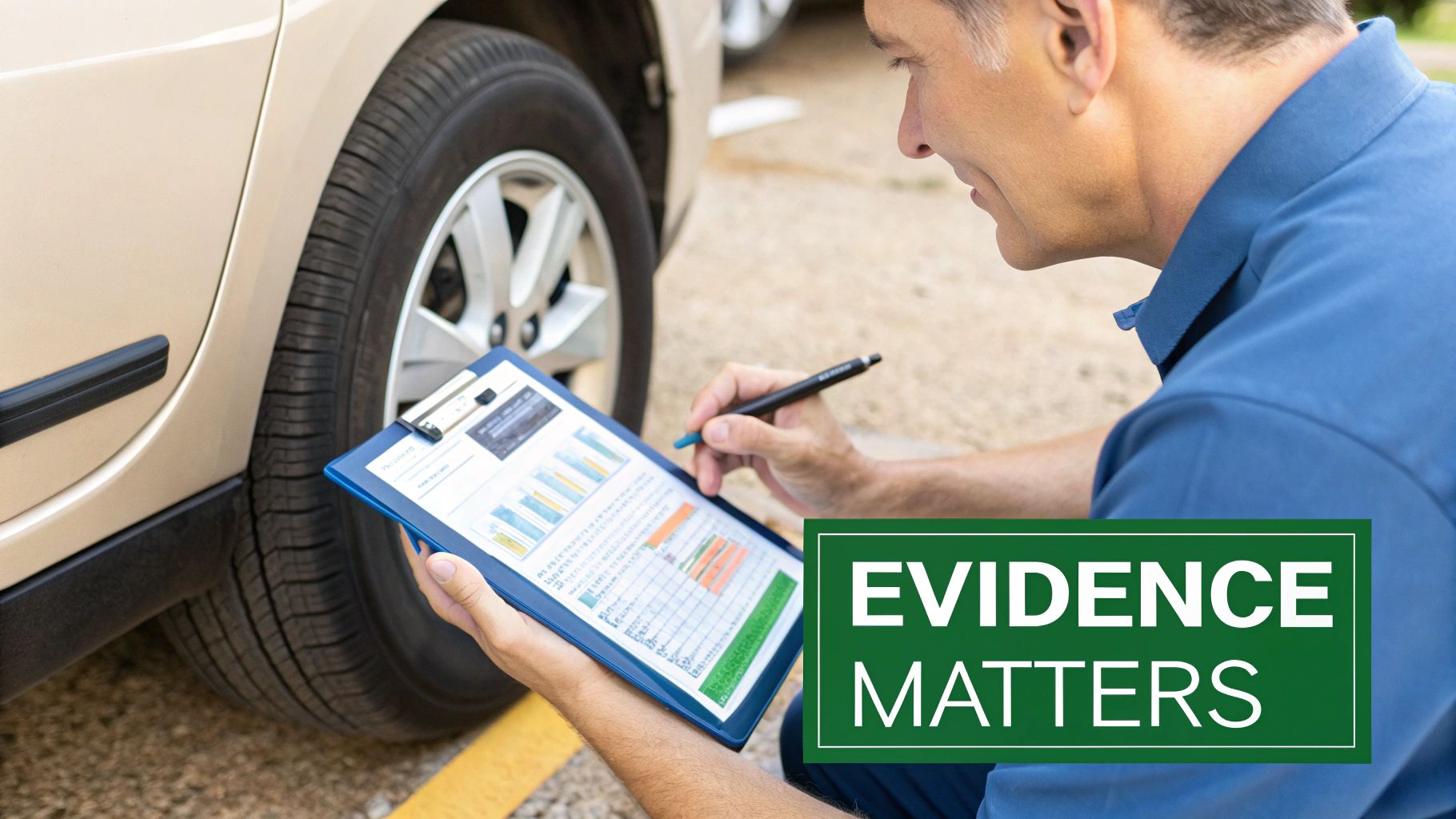
Once you decide you’re invoking the appraisal clause, the entire fight shifts. It’s no longer about emotional arguments but about one thing: evidence. The winner in this process is the one who brings the most credible, verifiable, and data-backed case to the table.
Your appraiser is an advocate armed with cold, hard facts to prove your vehicle’s actual value. This isn’t a job for a mechanic or body shop manager. While they are experts at fixing cars, they usually lack the specialized training in market analysis and valuation methods that insurance disputes require.
The Power of an Independent Specialist
A truly independent appraiser has one loyalty: to you. They have no ties to insurance companies and no reason to accept a low number. Their reputation is built on delivering accurate, unbiased valuations.
An appraiser who specializes in diminished value claims or total loss disputes brings a specific set of skills:
- Methodology Mastery: They know the court-accepted valuation formulas and standards.
- Market Analysis Expertise: They are pros at finding true, local “apples-to-apples” comparable vehicles.
- Negotiation Experience: They’ve seen every trick in the insurer’s playbook and know how to counter them with data.
Picking the right expert is everything. It’s the difference between walking in with an opinion and walking in with proof.
Why a Certified Report Changes the Game
A professional, data-driven appraisal report gives you a powerful advantage. A detailed report, like those we generate at SnapClaim, removes all emotion from the conversation. It turns the debate into a fact-based analysis that the insurance company’s appraiser cannot easily ignore.
A powerful appraisal report doesn’t just suggest a higher value; it proves it with undeniable evidence. It puts the burden on the insurer’s appraiser to defend their lowball figure against objective data. Our reports build an airtight case for your vehicle’s true worth by using:
- Comprehensive Market Analysis: We scan thousands of real-time listings to pinpoint your vehicle’s fair market value based on its exact trim, mileage, and condition in your local area.
- Industry-Standard Formulas: Our methodology aligns with recognized appraisal practices, so every calculation is transparent and defensible.
- Verifiable Data Points: Every piece of the valuation is supported by clear evidence, from comparable sales data to condition adjustments.
When your appraiser uses a SnapClaim report, they’re using a document that speaks the insurance industry’s native language—data. The negotiation is no longer about what you feel the car is worth; it’s about what the market data proves it’s worth. You can explore more data on how independent appraisals impact claim outcomes and see the proof for yourself.
Common Insurance Company Tactics to Watch Out For
While invoking the appraisal clause is your right, don’t expect the insurance company to make it easy. Insurers have a playbook of tactics designed to slow things down, create frustration, and discourage you from fighting for what you’re owed. Knowing these tactics helps you stay in control.
Delay, Distract, and Discourage
One of the most common tactics is simply dragging their feet. An insurer might take weeks to acknowledge your demand letter, “forget” to assign their appraiser, or bury you in pointless paperwork. These delays are often intentional, hoping you’ll get frustrated and accept their low offer. Don’t fall for it.
If you’ve sent your demand and are met with silence, follow up. A firm but professional email referencing your certified mail receipt is often enough to get a response. Keep a log of every interaction—date, time, who you spoke with, and a summary. This paper trail is your proof of diligence.
Appointing a “Biased” Appraiser
Your policy language is clear: both parties must select a “competent and disinterested” appraiser. However, insurers often have a go-to list of appraisers who get a steady stream of work from them. While not technically employees, their loyalty can be skewed, leading them to rubber-stamp the insurer’s low number. This is why having your own truly independent appraiser with strong data is so critical.
It helps to understand the common reasons for insurance claim denials and delays to see how this fits into their broader strategy.
Vetting Your Own Appraiser Is Non-Negotiable
Just as you should be skeptical of the insurer’s pick, you need to be rigorous when choosing your own. A classic mistake is hiring someone who lacks real appraisal clause experience.
Before you hire an appraiser, ask them:
- How many appraisal clause disputes have you handled?
- What is your valuation methodology?
- Can I see a sample report?
- Do you primarily work for insurance carriers or for vehicle owners?
Weighing the Costs and Removing the Risk
Yes, you are responsible for paying your own appraiser, which can make some people hesitate. But it’s better to view it as an investment, not an expense. A top-tier appraiser can often increase your settlement by thousands of dollars, making their fee a bargain.
At SnapClaim, we remove that financial worry with our Money-Back Guarantee. It’s simple: if your insurance recovery from the claim is less than $1,000, SnapClaim refunds the full appraisal fee—guaranteed. This removes the risk, so you can confidently fight for a fair insurance total loss payout with an expert in your corner.
Finalizing Your Settlement and Getting Paid
This is the moment you’ve been waiting for. The appraisal process concludes with a formal document called the “award.” Once your appraiser and the insurer’s appraiser—or the umpire—agree on a final value, that decision is locked in and legally binding on both you and the insurance company.
The debate is officially over. The insurance company is now contractually obligated to pay the amount stated in the award. It’s no longer a negotiation; it’s a final, enforceable decision.
Receiving and Submitting the Award
The award document will be signed by at least two of the three parties involved. As soon as you receive it, send it to your insurance adjuster along with any other required settlement paperwork.
From there, the insurance company processes the final payment. While timelines can vary, most insurers issue payment within 14 to 30 days of receiving the signed award. This is the payoff for standing your ground by invoking the appraisal clause.
What If the Insurer Refuses to Pay?
It’s extremely rare, but if the insurance company drags its feet or refuses to pay, don’t panic. You are holding a signed, legally recognized document. Your first step is to send a formal written demand for payment. If they still refuse, your next move is to file a complaint with your state’s Department of Insurance. This usually gets their attention quickly.
The entire appraisal process is built on established standards that ensure fairness and consistency. You can learn more about international valuation standards to see the professional foundation behind this process. Ultimately, the process is designed to ensure you’re compensated fairly, making the investment in a quality appraisal worth it. For a closer look at what to expect, review our breakdown of auto appraisal costs and fees.
FAQs: Invoking the Appraisal Clause
When you’re thinking about invoking the appraisal clause, a lot of questions come up. Here are answers to the most common ones our experts hear from vehicle owners.
How much does it cost to invoke the appraisal clause?
You and the insurance company each pay for your own appraiser. If a neutral umpire is needed to break a tie, that cost is usually split between you. While there’s an upfront cost, view it as an investment in a higher settlement. To remove the risk, SnapClaim offers a Money-Back Guarantee: if your additional insurance payout is less than $1,000, we refund your appraisal fee in full.
How long does the appraisal process take?
Every case is different, but most appraisals conclude within 30 to 90 days. The timeline depends on the complexity of your claim and how quickly the insurer responds. Starting the process with a detailed, professional appraisal report from SnapClaim can speed things up by reducing the back-and-forth.
Is the appraisal award binding?
Yes. In most states and under nearly all policies, the final amount decided by the appraisal process is legally binding on both you and the insurance company. Once that award is signed, it’s not a suggestion—it’s a final decision. The insurer is legally required to pay the agreed-upon amount.
Can I claim diminished value if the accident wasn’t my fault?
Yes, absolutely. If the other driver was at fault, you can file a diminished value claim against their insurance company. Invoking the appraisal clause is one of the most effective ways to settle a dispute over diminished value when they offer you a low amount or deny your claim outright. A certified report from a service like SnapClaim provides the proof you need to negotiate fairly.
Ready to stop arguing and start getting the compensation you deserve? SnapClaim provides the certified, data-driven reports you need to strengthen your claim and negotiate from a position of power.
Get your free estimate today or order a total loss appraisal report!
About SnapClaim
SnapClaim is a premier provider of expert diminished value and total loss appraisals. Our mission is to equip vehicle owners with clear, data-driven evidence to recover the full financial loss after an accident. Using advanced market analysis and industry expertise, we deliver accurate, defensible reports that help you negotiate confidently with insurance companies.
With a strong commitment to transparency and customer success, SnapClaim streamlines the claim process so you receive the compensation you rightfully deserve. Thousands of reports have been delivered to vehicle owners and law firms nationwide, with an average of $6,000+ in additional recovery per claim.
Why Trust This Guide
This guide was reviewed and verified by SnapClaim’s auto appraisers, who specialize in diminished value and total loss disputes. Our team continually updates every article to reflect current insurer guidelines, valuation standards, and court-accepted appraisal practices, ensuring that you’re relying on information trusted by professionals nationwide.
Get Started Today
Whether you’re challenging a low total loss settlement or proving your vehicle’s post-repair loss in value, SnapClaim makes it simple to take the next step. Generate a free diminished value or total loss estimate in minutes and see how much compensation you may be owed.