


After a car accident, your vehicle’s value drops, even with perfect repairs. This loss, known as diminished value, can cost you thousands. Hiring one of the best diminished value appraisers is the most effective way to recover the money you’re rightfully owed from the insurance company.
An expert appraiser acts as your advocate, providing the data-backed proof needed to challenge an insurer’s lowball offer and negotiate a fair settlement. Without their help, you are left at the mercy of the insurance company’s biased calculations.
Why an Expert Appraiser Is Your Strongest Ally
After an accident, your focus is on repairs. But even a perfectly fixed car now has an accident history, which permanently lowers its resale value. This loss is called diminished value—the difference between your car’s pre-accident worth and its post-repair worth.
Insurance companies aim to minimize payouts. Their initial offer for your diminished value is almost always calculated to protect their bottom line, not to make you financially whole. They often use flawed formulas or ignore real market data, resulting in an offer that’s a fraction of what you’re owed.
A Real-World Example of Value Left Behind
Here’s a common scenario. The owner of a nearly new Toyota RAV4 with under 15,000 miles was rear-ended, causing $9,800 in damage. The insurance company’s first diminished value offer was a mere $1,200.
Sensing this was unfair, the owner hired a certified diminished value appraiser. The appraiser’s report analyzed real-world sales data for similar RAV4s with and without accident histories, proving the true market value loss.
The Result: The certified appraisal calculated the actual diminished value at $6,100. Armed with this data, the owner negotiated a final settlement of $5,600—nearly five times the original offer.
This story is not an exception; it’s the rule. Without that expert report, the owner would have lost over $4,000. This is why a professional appraiser is essential for recovering your financial loss.
The Power of an Independent Report
An independent appraiser works for you, not the insurance company. Their sole purpose is to determine the true car value after accident repairs. They build a powerful, evidence-based case that adjusters cannot easily dismiss.
A professional report from one of the best diminished value appraisers provides:
- Objective Evidence: It replaces the insurer’s biased formulas with hard market data.
- Negotiating Power: It gives you the leverage to confidently challenge lowball offers.
- Credibility: The report is a court-recognized document that supports your claim with authority.
Investing in an expert appraisal isn’t just buying a document; it’s securing the proof you need to demand fair compensation. It’s the single most effective step toward being made whole after an accident.
What to Look for in the Best Diminished Value Appraisers
Not all auto appraisers are the same, especially when it comes to a complex diminished value claim. A general appraiser may understand cars, but the best diminished value appraisers possess a highly specialized skill set.
Think of it like this: you wouldn’t ask a family doctor to perform heart surgery. You need a specialist. A true expert’s report will command respect from an insurance adjuster, not get ignored.
Credentials That Signal Real Expertise
First, examine their professional background. An appraiser’s certifications and hands-on experience reveal their level of commitment and expertise.
A top-tier expert will typically have:
- Specialized Certifications: Look for credentials from respected national organizations, which signal a commitment to ethical standards and ongoing education.
- Deep Diminished Value Experience: Ask how many diminished value cases they handle annually. An appraiser with hundreds of these specific claims under their belt knows how to counter insurance company tactics.
- Courtroom Experience: An appraiser who has served as an expert witness has proven that their methodology can withstand legal scrutiny.
These qualifications are more than just titles. They are proof that the appraiser’s work is built on a solid foundation of professional integrity and real-world knowledge.
A Transparent and Defensible Methodology
How an appraiser calculates your loss separates the pros from the amateurs. Many insurers use a simplistic, flawed formula called “17c” to generate low offers. A true expert would never use it.
Instead, they employ a transparent, market-driven approach. They should be able to explain their process, which involves analyzing real-time sales data for comparable vehicles—both with and without accident histories. This direct market comparison is the only legitimate way to prove the actual loss in your car value after an accident.
A key sign of an expert is their ability to show you exactly how they arrived at their valuation. If an appraiser is secretive about their methods, consider it a major red flag.
The demand for this specialty has grown significantly. You can discover more about appraisal industry trends to see why this proven expertise is so critical.
Post-Appraisal Support and Confidence
Finally, the best diminished value appraisers don’t disappear after sending you the report. They stand behind their work.
Insurance companies will almost always push back on a claim. A top professional anticipates this and provides post-appraisal support, helping you craft responses and defend the valuation. This partnership gives you the tools and confidence to see your claim through to a fair resolution.
Critical Questions to Ask Before You Hire an Appraiser
Choosing the right diminished value appraiser is a crucial decision. You are not just buying a report; you are hiring an advocate to fight for your financial recovery. Asking smart, direct questions is the best way to vet potential candidates.
A confident and experienced appraiser will provide clear, straightforward answers. Vague responses or confusing jargon are red flags.
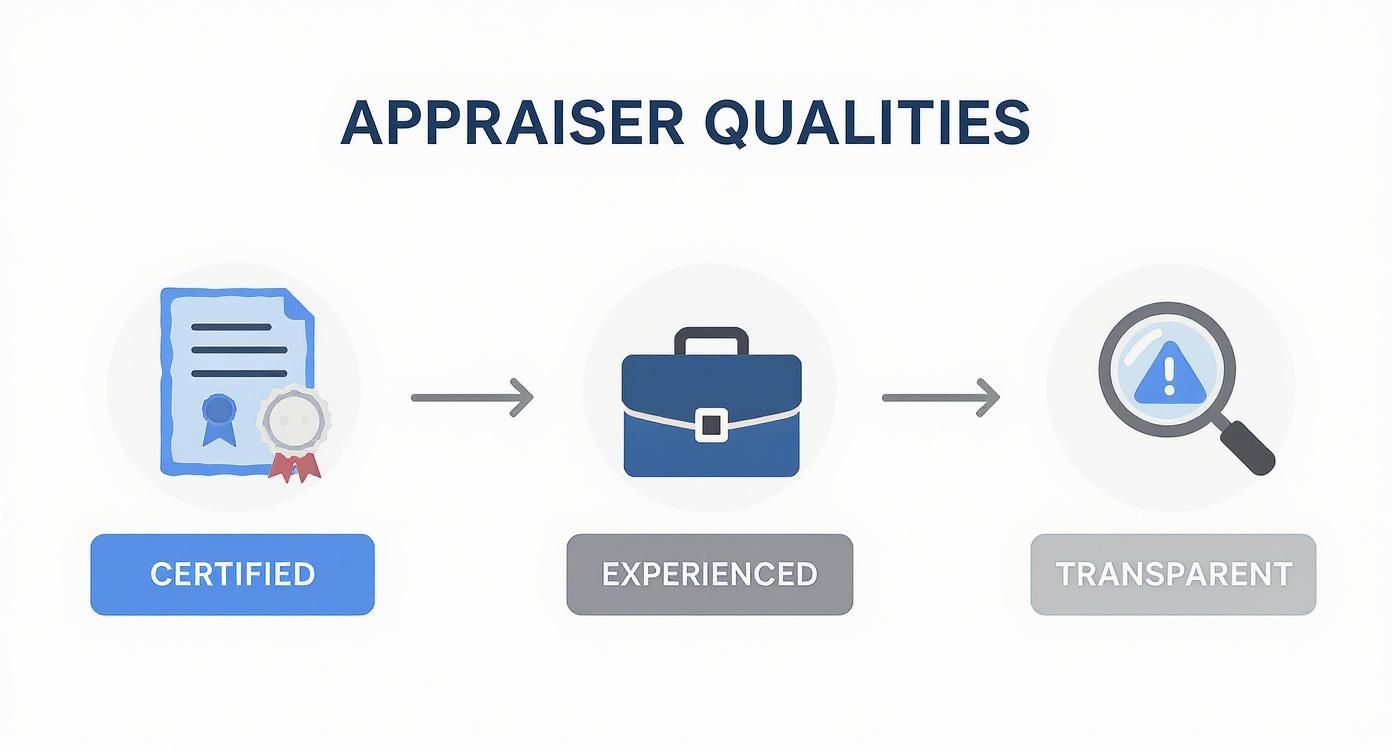
The best appraisers combine official credentials, deep experience, and a transparent process to create a trustworthy valuation.
Questions About Their Methodology and Data
An appraiser’s methodology is the foundation of your claim. Insurance adjusters are trained to find weaknesses in reports, so the process must be bulletproof.
Here’s what you should ask:
- How do you calculate diminished value? An expert should explain their market analysis process in simple terms.
- What specific market data do you use? A strong report pulls from multiple data sources, like dealer sales records and auction results.
- How many diminished value claims do you handle? You need a specialist who understands the unique challenges of these cases.
Questions About Their Support and Track Record
A great appraiser’s job isn’t finished when the report is delivered. The real test is how they support you when the insurance company disputes the claim.
An appraisal report is your primary negotiation tool. The expert who created it should be ready to help you use that tool effectively.
Find out about their commitment by asking:
- What support do you offer if the insurer rejects the report? A good appraiser includes post-appraisal support in their service.
- Are your reports compliant with professional standards? The answer should be a confident “yes.”
Use this table to evaluate their answers.
Evaluating Appraiser Responses: What to Look For
| Question for the Appraiser | A Strong Answer Indicates | A Weak Answer Indicates |
|---|---|---|
| Can you explain your methodology? | Expertise. They use a market analysis approach, citing real-world sales data and explicitly rejecting formulas like 17c. | Inexperience. They mention the “17c formula” or a vague “percentage of repair cost” method, which insurers easily dismiss. |
| What are your data sources? | Thoroughness. They pull from dealer sales records, auction results, and recognized guides like Kelley Blue Book for a comprehensive view. | Laziness. They rely on a single source or generic online calculators that lack the detail needed for a specific vehicle. |
| Do you provide post-appraisal support? | Commitment. They offer to help you respond to adjuster questions and clarify their findings as part of their service. | A Transactional Mindset. They say their job is done once the report is sent or try to charge extra for basic follow-up. |
| Is this your primary specialty? | Focus. They handle hundreds of DV cases a year and understand the specific tactics used by insurance companies. | A Side Gig. They only handle a few DV claims here and there, lacking the specialized experience to win tough negotiations. |
Knowing what a diminished value appraisal should cost will also help you gauge fair pricing. Armed with this knowledge, you can confidently select one of the best diminished value appraisers to advocate for you.
Anatomy of a Defensible Appraisal Report
Your appraisal report is the engine that drives your entire diminished value claim. A weak, formula-based report will be quickly dismissed by an insurance adjuster, but a strong, data-driven analysis gives you the leverage needed for a fair settlement.
Knowing the components of a defensible report helps you identify quality work. Adjusters are trained to find holes in arguments, so your report must be airtight and built on undeniable facts.
Core Components of a Credible Report
The best diminished value appraisers create a logical, evidence-based narrative that clearly illustrates your financial loss.
An effective report must include:
- Detailed Vehicle Information: The VIN, mileage, options, and a clear description of the pre-accident condition.
- Pre-Loss Fair Market Value: An analysis using multiple reputable sources like Kelley Blue Book, NADAguides, and local dealer listings to establish your car’s value before the accident.
- Comprehensive Damage Assessment: A review of the repair estimate, noting any structural damage and the use of non-OEM parts. Appraisers often consider the significance of CAPA certified parts in repair assessments.
- Real-World Market Data: This is the heart of the report. It should feature actual sales data from local markets, proving the price difference between cars with and without accident histories.
A defensible appraisal never relies on an arbitrary formula like the “17c rule.” It uses verifiable, real-world sales data to prove how much less a buyer would pay for your vehicle due to its accident history.
What to Look For in the Analysis
The quality of the analysis makes a report compelling. The appraiser’s job is to connect the dots for the insurance adjuster, leaving no room for misinterpretation.
Look for a clear, logical explanation for the findings. The methodology should be transparent and easy to follow. A detailed breakdown of how the final diminished value figure was calculated is the sign of a true professional. Our guide on how to read an appraisal report can help you understand these details.
A strong report is your most powerful negotiation tool. It provides the proof you need to reject lowball offers and fight for the full compensation you deserve.
Common Pitfalls When Filing a Diminished Value Claim
Filing a diminished value claim seems simple, but it’s full of traps that can cost you thousands. Even with a perfectly repaired car, a few common mistakes can significantly reduce your final settlement.
Knowing these pitfalls is the first step to avoiding them.
One of the biggest mistakes is accepting the insurance company’s first offer. That initial number is a starting point for negotiation, and it is almost always a lowball. Accepting it means leaving money on the table.
Another critical error is waiting too long. Every state has a statute of limitations for property damage claims—a legal deadline. If you miss it, you may lose your right to any compensation.
Choosing the Wrong Support System
Perhaps the most damaging mistake is hiring the cheapest appraiser available. A flimsy, poorly researched report is worse than no report at all because it gives the insurer an easy reason to deny your claim.
The best diminished value appraisers provide court-ready, data-backed reports designed to withstand scrutiny.
A high-quality appraisal is an investment in your claim. It strengthens your position and helps you maximize your financial recovery against common insurance company tactics.
Hiring a budget appraiser who uses a generic online calculator is a recipe for failure. An expert appraiser, however, builds a case that is difficult to dispute.
Misunderstanding the Market’s Impact
An appraiser’s effectiveness depends on their understanding of the current used car market. For example, recent studies show vehicles with accident histories can lose an additional 10-15% in value.
Independent appraisals lead to average settlements that are 40% higher than insurers’ initial calculations. The best appraisers combine deep market knowledge with sharp data analytics to produce rock-solid valuations.
These pitfalls are avoidable with the right preparation and expert support. Being proactive and informed is the smartest way to achieve a successful outcome.
Frequently Asked Questions (FAQ)
Navigating a post-accident claim can be confusing. Here are answers to some of the most common questions about diminished value.
Can I claim diminished value if the accident was my fault?
Typically, you can only file a diminished value claim against the at-fault driver’s insurance company. Your own collision policy is designed to cover repair costs, not the loss in market value. In some states, like Georgia, you may be able to file a claim under your Uninsured/Underinsured Motorist (UIM) coverage if the at-fault driver lacks sufficient insurance. Always check your specific state laws.
How much does a quality diminished value appraisal cost?
A certified, defensible diminished value appraisal usually costs between $250 and $600. The price depends on your vehicle’s value, the complexity of the damage, and the level of detail required. Be wary of “free” or cheap reports, as they often lack the credibility to stand up to an insurer’s scrutiny.
What if the insurance company rejects my appraisal?
It’s common for insurers to push back on an independent appraisal. The best diminished value appraisers anticipate this and build reports with solid data and a transparent methodology. If your claim is disputed, a good appraiser will provide post-appraisal support to help you counter the adjuster’s arguments. For more information, this detailed guide on diminished value claims is a trusted legal resource.
Is a diminished value claim worth it for an older car?
It depends more on the car’s pre-accident value and the severity of the damage than its age. A well-maintained classic, luxury, or specialty vehicle can still suffer a significant loss in value. As a general rule, if your car was worth over $10,000 before the accident and sustained structural damage, an appraisal is likely worthwhile.
Get Expert Help From the Best Diminished Value Appraisers
Choosing the best diminished value appraisers is the most important step in recovering your vehicle’s lost value. An expert-backed report provides the leverage you need to negotiate a fair settlement and ensures you are not left financially vulnerable after an accident.
With a SnapClaim certified appraisal, you get the proof you need to strengthen your claim. We are so confident in our data-driven methodology that we offer a Money-Back Guarantee: If your insurance recovery from the claim is less than $1,000, SnapClaim refunds the full appraisal fee—guaranteed.
Don’t leave money on the table. Get your free estimate today or order a certified appraisal report to strengthen your insurance claim.
👉 Get Your Free Estimate Today
About SnapClaim
SnapClaim is a premier provider of expert diminished value and total loss appraisals. Our mission is to equip vehicle owners with clear, data-driven evidence to recover the full financial loss after an accident. Using advanced market analysis and industry expertise, we deliver accurate, defensible reports that help you negotiate confidently with insurance companies.
With a strong commitment to transparency and customer success, SnapClaim streamlines the claim process so you receive the compensation you rightfully deserve. Thousands of reports have been delivered to vehicle owners and law firms nationwide, with an average of $6,000+ in additional recovery per claim.
Why Trust This Guide
This guide was reviewed and verified by SnapClaim’s auto appraisers, who specialize in diminished value and total loss disputes. Our team continually updates every article to reflect current insurer guidelines, valuation standards, and court-accepted appraisal practices, ensuring that you’re relying on information trusted by professionals nationwide.
Get Started Today
Whether you’re challenging a low total loss settlement or proving your vehicle’s post-repair loss in value, SnapClaim makes it simple to take the next step. Generate a free diminished value or total loss estimate in minutes and see how much compensation you may be owed.